<?xml version="1.0" encoding="utf-8"?>
<feed xmlns="http://www.w3.org/2005/Atom">

  <title><![CDATA[Stephen David Miller]]></title>
  <link href="https://sdavidmiller.com/atom.xml" rel="self"/>
  <link href="https://sdavidmiller.com/"/>
  <updated>2025-06-11T10:28:16-07:00</updated>
  <id>https://sdavidmiller.com/</id>
  <author>
    <name><![CDATA[Stephen David Miller]]></name>
    
  </author>
  <generator uri="http://octopress.org/">Octopress</generator>


  <entry>
    <title type="html"><![CDATA[Best Films of 2024: Oscars Edition]]></title>
    <link href="https://sdavidmiller.com/octo/blog/2025/03/01/best-films-of-2024-oscars/"/>
    <updated>2025-03-01T09:00:00-08:00</updated>
    <id>https://sdavidmiller.com/octo/blog/2025/03/01/best-films-of-2024-oscars</id>
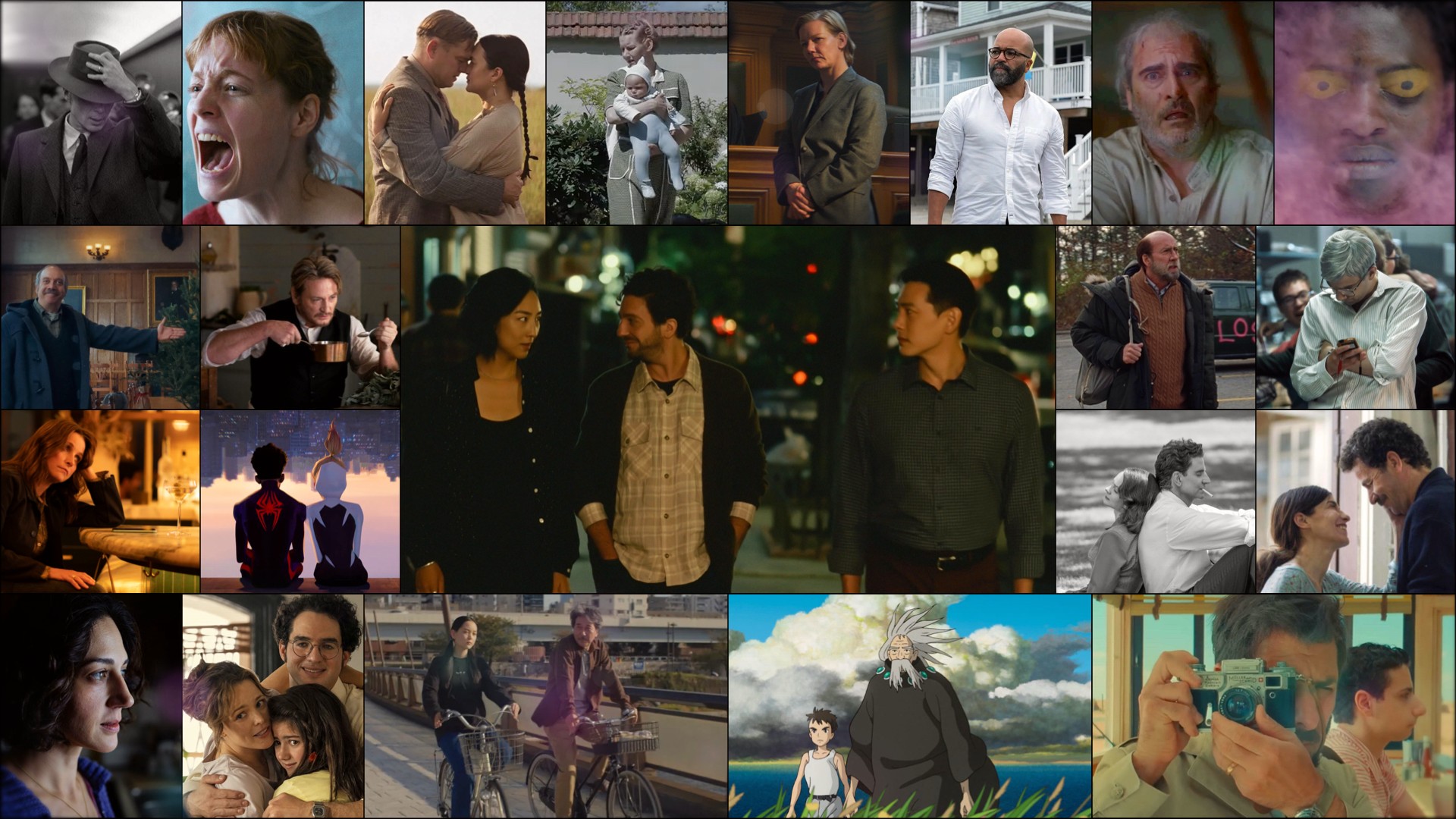
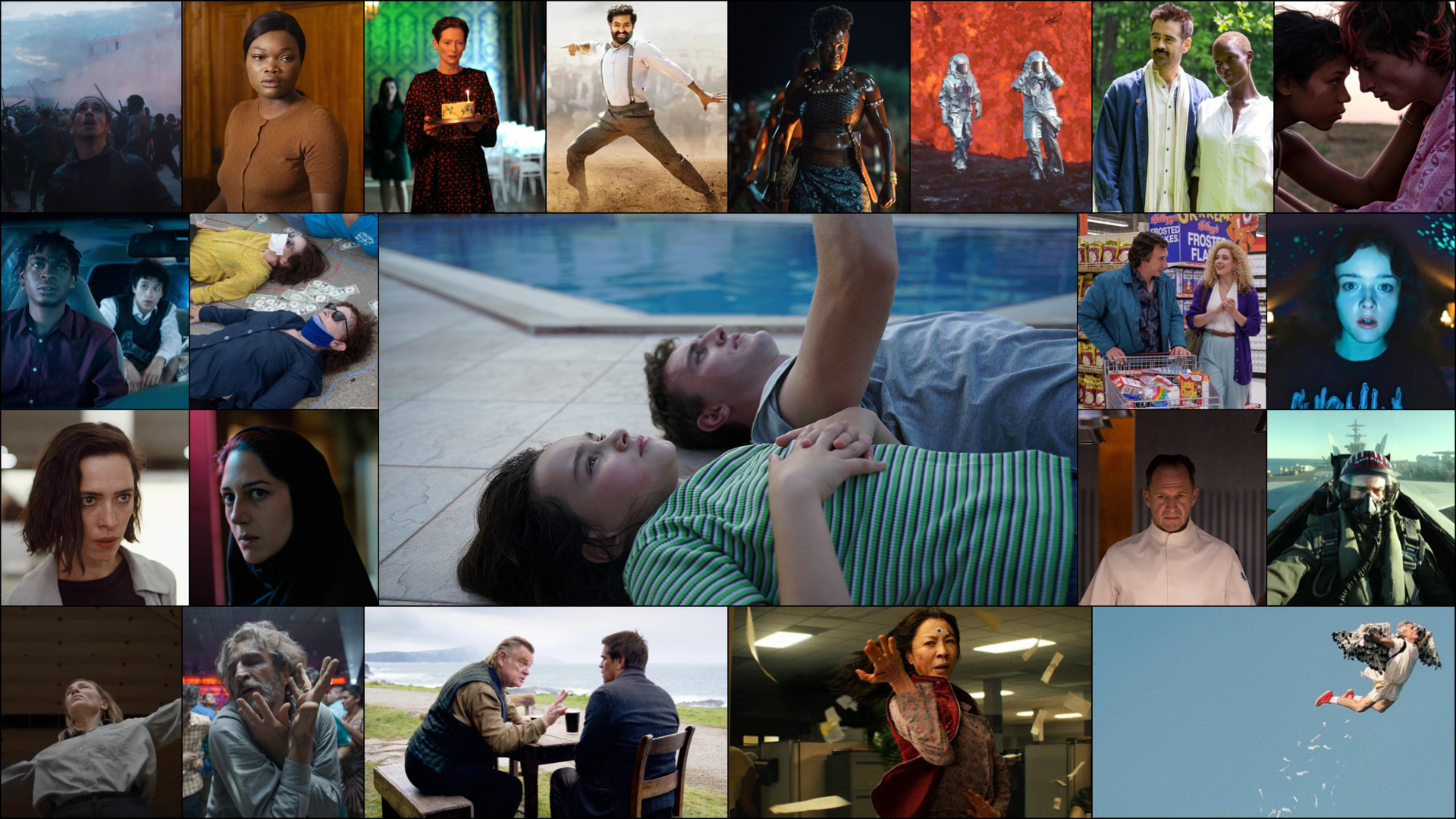
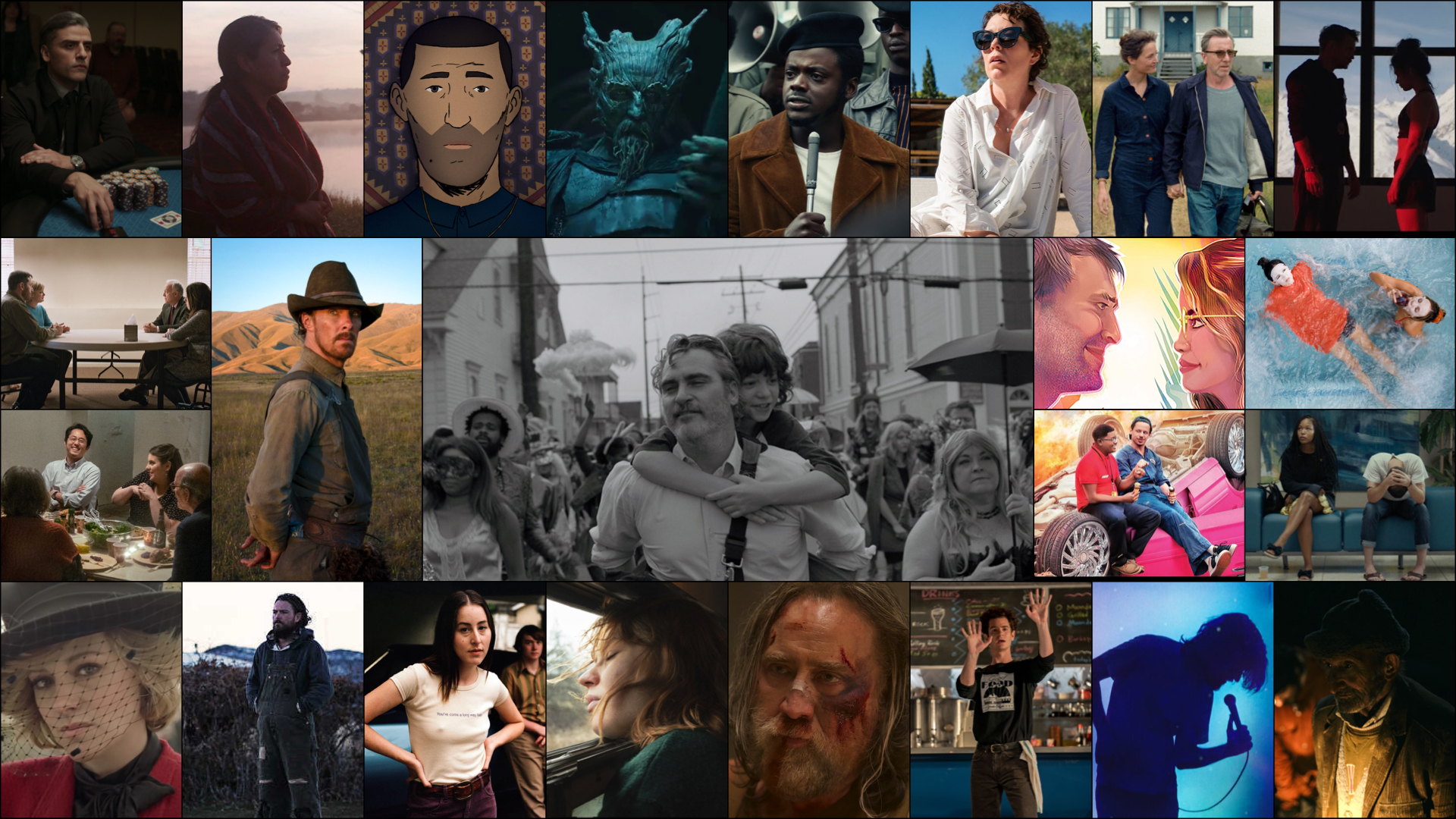
    <content type="html"><![CDATA[<p><img src="https://sdavidmiller.com/octo/images/best_of_2024/best-of-2024.jpg" width=800 title="Best Films of 2024: Oscars Edition" align="center"/></p>

<p><strong>Cut to the chase</strong>: Want to see this year&rsquo;s <em>actual</em> list? Head over to <a href="https://www.decodingeverything.com/p/10-cinematic-pairings-that-captured">Decoding Everything</a>.</p>

<p><strong>Previous write-ups</strong>: Check out the last decade of <a href="https://sdavidmiller.com/octo/blog/categories/best-of">end-of-year lists</a> to get a sense of our similarities and differences.</p>

<p><strong>Podcast</strong>: You can listen to my straightforward Top 10 list on <a href="https://www.thespoilerwarning.com/archives/recapping-the-films-of-2024">The Spoiler Warning</a>.</p>

<h3>Introduction</h3>

<p>I have a tradition of tallying my favorite films of the year and turning them into an essay for my blog. But for the last few years, I’ve been honored to contribute that essay instead to David Chen’s <a href="https://www.decodingeverything.com/">Decoding Everything</a> newsletter. If you haven’t already, you should <a href="https://www.decodingeverything.com/p/10-cinematic-pairings-that-captured">read it first</a>: It’s a significantly more polished (and complete) encapsulation of my thoughts about the year in cinema.</p>

<div class="substack-post-embed"><p lang="en">10 Cinematic Pairings That Captured The Mood Of 2024 by David Chen</p><p>Stephen David Miller unpacks the year via twenty interconnected films.</p><a data-post-link href="https://www.decodingeverything.com/p/10-cinematic-pairings-that-captured">Read on Substack</a></div>


<script async src="https://substack.com/embedjs/embed.js" charset="utf-8"></script>


<br/>


<p>Still, for the sake of continuity, I always like to post a little something extra for readers of my blog and/or this Substack. Last year, that came in the form of an <a href="https://sdavidmiller.com/octo/blog/2024/03/05/best-films-of-2023/">Appendix</a>. This year, I thought I’d shift gears and talk about tomorrow’s Academy Awards—and, in the process, give one last “hurrah” to the many films I loved.</p>

<p>For each category, I’ll share three opinions: which nominee <strong>will</strong> win, which <strong>should</strong> win, and what <strong>alternatives</strong> should have been nominated in their place. Because I think it’s only fair to judge categories I have some personal experience with, I’m going to omit a few:</p>

<ul>
<li>Animated Short Film, Documentary Short Film, and Live Action Short Film. I didn’t manage to catch any shorts this year, so for those of you making a prediction bracket of your own, I suggest you give it a Google!</li>
<li>Documentary Feature. I only caught up with one of the nominees, <em>No Other Land</em>. It’s a phenomenal doc, and I’m personally rooting for it to win! But I can’t honestly judge it against a slate I haven’t seen.</li>
<li>Music (Original Song). I’ve seen two of the four films nominated, and in the case of <em>Emilia Pérez</em>, I forgot the songs roughly 30 seconds after they stopped playing. On the one hand, it would only take me ~15 minutes on Spotify to rectify this problem and be a completist. On the other: This category is garbage and I don’t care who wins.</li>
</ul>


<p>OK, now on to the awards!</p>

<h3><strong>Animated Feature Film</strong></h3>

<ul>
<li><em>Flow</em></li>
<li><em>Inside Out 2</em></li>
<li><em>Memoir of a Snail</em></li>
<li><em>Wallace &amp; Gromit: Vengeance Most Fowl</em></li>
<li><em>The Wild Robot</em></li>
</ul>


<p><strong>What will win? </strong>If you’d asked me to predict this category a few months ago, a low budget Latvian film with zero dialogue, little exposition, and an intentionally stripped-down aesthetic wouldn’t have been high on my list of contenders. But awards voting bodies continue to surprise me this year, and by all indications, <strong><em>Flow</em></strong> is going to take home the prize.</p>

<p><strong>What should win? </strong>In terms of quality, it’s a tie for me between <em>Memoir of a Snail</em> and <em>Flow</em>. Both are excellent. But for its sheer audacity (and what this win means for the category moving forward), I’ve got to give an edge to <strong><em>Flow</em></strong>.</p>

<p><strong>What should have been nominated instead? </strong>This was a fairly weak year for animated features. Setting aside <em>Robot Dreams</em> (which was already nominated last year), the only three I loved (<em>Flow</em>, <em>Memoir of a Snail</em>, <em>The Wild Robot</em>) are already represented in this category. No notes!</p>

<h3><strong>International Feature Film</strong></h3>

<ul>
<li><em>Emilia Pérez</em></li>
<li><em>Flow</em></li>
<li><em>The Girl With The Needle</em></li>
<li><em>I’m Still Here</em></li>
<li><em>The Seed of the Sacred Fig</em></li>
</ul>


<p><strong>What will win? </strong>If not for the train wreck of negative publicity, <em>Emilia</em> probably would have had this in the bag. But I think even the stubborn, <em>Bohemian Rhapsody </em>and <em>Green Book</em>-adoring factions of the Academy know a lost cause when they’ve seen one. Whereas <strong><em>I’m Still Here</em></strong> continues to have a groundswell of support. It catapulted seemingly overnight from being a film many American critics hadn’t seen, to being a serious contender in multiple categories. It also happens to be excellent, and has no serious detractors to my knowledge. I think this is Walter Salles’ award to lose.</p>

<p><strong>What should win? </strong>I think <em>Flow</em>, <em>The Girl With The Needle</em>, and <em>I’m Still Here</em> would all be worthy wins. But <strong><em>The Seed of the Sacred Fig</em></strong> is my personal favorite, both as a standalone work of art and as a potent political statement. Mohammad Rasoulof and his cast <a href="https://www.theguardian.com/film/article/2024/may/17/exhausting-and-extremely-dangerous-mohammad-rasoulof-on-his-hazardous-escape-from-eight-year-sentence">fled Iran in secret</a> to attend the Cannes premiere, and cheering for them as they entered the Palais <a href="https://www.decodingeverything.com/p/cannes-2024-palme-dor-prizewinners-anora">remains one of my most moving moments of 2024</a>.</p>

<p><strong>What should have been nominated instead?</strong> Payal Kapadia’s <strong><em>All We Imagine As Light</em></strong> was one of my favorites of the year, and it’s a shame India didn’t submit it for consideration. Likewise for Poland and <strong><em>Green Border</em></strong>, a powerful work of docu-fiction which couldn’t be more timely given current anti-refugee sentiments and <a href="https://www.nytimes.com/live/2025/02/28/us/trump-news">the recent change of tune</a> regarding the Russo-Ukrainian war. Sub out <em>Emilia Pérez</em> (a movie I didn’t hate but certainly don’t think belongs in serious contention: You can <a href="https://www.thespoilerwarning.com/archives/2024-cannes-film-festival-part-2">listen to my scatterbrained thoughts out of Cannes</a>) and <em>The Girl With The Needle</em> (a powerful, brooding arthouse drama which I liked just a tad less than the others).</p>

<h3><strong>Visual Effects</strong></h3>

<ul>
<li><em>Alien: Romulus</em></li>
<li><em>Better Man</em></li>
<li><em>Dune: Part Two</em></li>
<li><em>Kingdom of the Planet of the Apes</em></li>
<li><em>Wicked</em></li>
</ul>


<p><strong>What will win? </strong>I haven’t been following any of the buzz when it comes to these technical categories, so take all of these predictions with a grain of salt: I don’t know anything you don’t know. But I’d wager this is a dead tie between <em>Dune: Part Two</em> and <em>Wicked</em>. Going to give the edge to <strong><em>Dune: Part Two</em></strong> as a consolation prize for not winning much else.</p>

<p><strong>What should win? </strong>I haven’t seen <em>Better Man</em>, but I have seen the other four, and think <strong><em>Dune: Part Two</em> </strong>is the most deserving among them…with <em>Kingdom of the Planet of the Apes</em> just a smidge behind it. (The Robbie Williams biopic looks great, for what it’s worth, but it’s hard to imagine anyone out-CG-aping that franchise.)</p>

<p><strong>What should have been nominated instead? </strong>It’s outrageous to me that <a href="https://www.decodingeverything.com/p/cannes-2024-furiosa-a-mad-max-saga-review">the best action spectacle of the year</a>, <strong><em>Furiosa: A Mad Max Saga,</em></strong> isn’t getting a single awards nod. Drop <em>Alien: Romulus</em> and give <em>something</em> to George Miller’s epic.</p>

<h3><strong>Sound</strong></h3>

<ul>
<li><em>A Complete Unknown</em></li>
<li><em>Dune: Part Two</em></li>
<li><em>Emilia Pérez</em></li>
<li><em>Wicked</em></li>
<li><em>The Wild Robot</em></li>
</ul>


<p><strong>What will win? </strong>Same disclaimer as above regarding technical categories. I imagine <em>Dune: Part Two</em> has a solid shot here, and can also see a strong argument for <em>A Complete Unknown</em> given how vital diegetic music is to its success. But I think <strong><em>Wicked</em></strong> takes this as a last minute sub for <em>Emilia Pérez</em>.</p>

<p><strong>What should win? <em>The Wild Robot</em></strong> is an inspired nomination for this category. It’s less flashy in its use of sound than the other picks, but it’s the film whose sound design I find most personally memorable.</p>

<p><strong>What should have been nominated instead? </strong>Again, <strong><em>Furiosa: A Mad Max Saga</em></strong> should be sweeping these technical awards. Drop <em>Emilia Pérez</em> to make room for it.</p>

<h3><strong>Costume Design</strong></h3>

<ul>
<li><em>A Complete Unknown</em></li>
<li><em>Conclave</em></li>
<li><em>Gladiator II</em></li>
<li><em>Nosferatu</em></li>
<li><em>Wicked</em></li>
</ul>


<p><strong>What will win? </strong>I wouldn’t be at all surprised if <em>Wicked</em> took the prize, and it would be a deserving victory. But I suspect the same voting bloc that swoons for Elizabethan period pieces and royal regalia will go all in on Vatican chic. I’m calling this for <strong><em>Conclave</em></strong>.</p>

<p><strong>What should win? </strong>There are few categories I feel less opinionated about than Costume Design. But I found <strong><em>Nosferatu</em></strong>’s period aesthetic very striking, and a big part of that comes down to costuming.</p>

<p><strong>What should have been nominated instead? </strong>I can’t say I know precisely where costumes end and makeup begins, but <strong><em>I Saw The TV Glow</em></strong> nails both in its eerie recreation of the 90s Nickelodeon look and feel. I’m as enchanted by Greenwich Village as anyone, but for the sake of variety, I’d let Mr. Melancholy and his minions bump out <em>A Complete Unknown</em>.</p>

<h3><strong>Makeup and Hairstyling</strong></h3>

<ul>
<li><em>A Different Man</em></li>
<li><em>Emilia Pérez</em></li>
<li><em>Nosferatu</em></li>
<li><em>The Substance</em></li>
<li><em>Wicked</em></li>
</ul>


<p><strong>What will win? </strong>It’s hard to imagine the Academy resisting the charms of <strong><em>Wicked</em></strong>. She’s green, for Pete’s sake! And it’s a metaphor for racism and other stuff, probably!</p>

<p><strong>What should win? </strong>This is a stacked category, and there’s a decent argument for every nominee: Even <em>Emilia Pérez</em>, the punching bag of this year’s awards season, uses makeup and hairstyling in a way that is crucial to the story. But for me, it comes down to the two body horror flicks. While <em>The Substance</em> was the better film in my opinion, <strong><em>A Different Man</em></strong> is the one which lives or dies by its precise use of makeup. It nails it.</p>

<p><strong>What should have been nominated instead?</strong> Even though I defend <em>Emilia Pérez</em> in this category, its inclusion is inextricably linked to its clumsy, ultra-binary handling of trans identity. Why settle for clumsy, when I can nominate a far better film about the trans experience which happens to have <em>incredible</em> hair and makeup? Give its spot to <strong><em>I Saw The TV Glow</em></strong> instead.</p>

<h3><strong>Production Design</strong></h3>

<ul>
<li><em>The Brutalist</em></li>
<li><em>Conclave</em></li>
<li><em>Dune: Part Two</em></li>
<li><em>Nosferatu</em></li>
<li><em>Wicked</em></li>
</ul>


<p><strong>What will win? </strong>None of these nominees would surprise me with a win, but I think <strong><em>Wicked</em></strong> is going to take it given the sheer scale of its production.</p>

<p><strong>What should win? </strong>All five films impressed me with their production design (especially <em>Nosferatu</em>), but only one pulled it off on a shoestring budget. <strong><em>The Brutalist</em></strong> is the most deserving of the bunch, and doubly so when considering the constraints they managed it under.</p>

<p><strong>What should have been nominated instead? </strong>I’m going to sound like a broken record, but I adored the look and feel of <strong><em>I Saw The TV Glow</em></strong>. It’s hard to cut anything in this category, but I’d lose <em>Conclave</em> as a matter of personal preference. It does an admirable job of recreating the Vatican; I’m just not as thrilled by it.</p>

<h3><strong>Music (Original Score)</strong></h3>

<ul>
<li><em>The Brutalist</em></li>
<li><em>Conclave</em></li>
<li><em>Emilia Pérez</em></li>
<li><em>Wicked</em></li>
<li><em>The Wild Robot</em></li>
</ul>


<p><strong>What will win? </strong>Normally I’d be inclined to bet on <em>Wicked</em> here, but I suspect the <em>Emilia Pérez </em>stragglers will split the musical vote. So instead I’m going with Volker Bertelmann’s excellent score for <strong><em>Conclave</em></strong>.</p>

<p><strong>What should win? </strong>Bertelmann’s work on <em>Conclave</em> is great, as is Daniel Blumberg’s for <em>The Brutalist</em>. But by my memory, Kris Bowers’ score for <strong><em>The Wild Robot</em></strong> blows the competition out of the water.</p>

<p><strong>What should have been nominated instead? </strong>The total lock out of <strong><em>Challengers</em></strong> from this year’s awards ceremony is bizarre, and nowhere is it more glaring than in the Original Score category. Trent Reznor and Atticus Ross not only should have been nominated; they should have won. Other highlights were <strong><em>All We Imagine As Light</em></strong> (particular Topshe’s <a href="https://www.youtube.com/watch?v=1QOnIgV6YrU">song which closes the film</a>, though I’m unsure where “score” ends and “soundtrack” begins when it comes to original compositions) and Alex Somers &amp; Scott Alario’s ephemeral <strong><em>Nickel Boys</em></strong> score. Lose <em>Wicked</em>, <em>Emilia Pérez</em>, and (gun to my head) <em>Conclave</em> to make room for these.</p>

<h3><strong>Film Editing</strong></h3>

<ul>
<li><em>Anora</em></li>
<li><em>The Brutalist</em></li>
<li><em>Conclave</em></li>
<li><em>Emilia Pérez</em></li>
<li><em>Wicked</em></li>
</ul>


<p><strong>What will win? </strong>Judging by its awards season momentum, I think this is <strong><em>Anora</em></strong>’s to lose.</p>

<p><strong>What should win? </strong>I’ve gotta go with the consensus here: Sean Baker’s linear editing process is vital to the momentum of his films, and he knocked it out of the park with <strong><em>Anora</em></strong>.</p>

<p><strong>What should have been nominated instead? </strong>Count this among the multiple categories which <strong><em>Nickel Boys</em> </strong>ought to have won by a landslide: Nicholas Monsour’s elliptical, rhythmic editing is crucial to the film’s artistic success. Also throw in <strong><em>Challengers</em></strong> for those heart-pumping tennis sequences. No hard feelings, <em>Emilia Pérez</em> and <em>Wicked.</em></p>

<h3><strong>Cinematography</strong></h3>

<ul>
<li><em>The Brutalist</em></li>
<li><em>Dune: Part Two</em></li>
<li><em>Emilia Pérez</em></li>
<li><em>Maria</em></li>
<li><em>Nosferatu</em></li>
</ul>


<p><strong>What will win? </strong>Voters will be captivated by the way Greig Fraser managed to turn <em>Dune: Part Two</em> into <em>Lawrence of Arabia</em>, but ultimately I think they’ll give this to Lol Crawley for <strong><em>The Brutalist</em></strong>. The ingenuity of filming in VistaVision is sure to win over film nerds everywhere, and the end product looks like a (couple hundred) million bucks.</p>

<p><strong>What should win? </strong>Count me among the hypothetical nerds. Of these options, <strong><em>The Brutalist</em></strong> feels most deserving.</p>

<p><strong>What should have been nominated instead? </strong>It’s a travesty that <strong><em>Nickel Boys</em></strong> wasn’t nominated for the one category it seemed like an obvious lock to win. Jomo Fray’s first-person filming technique is every bit as clever as Crawley’s bag of tricks, and carries far more emotional weight: This movie is a miracle, and it lives or dies by its cinematography. I can’t rightly drop <em>Maria</em> because I haven’t seen it, so here again I’ll settle for kicking out <em>Emilia Pérez</em>.</p>

<h3><strong>Writing (Original Screenplay)</strong></h3>

<ul>
<li><em>Anora</em></li>
<li><em>The Brutalist</em></li>
<li><em>A Real Pain</em></li>
<li><em>September 5</em></li>
<li><em>The Substance</em></li>
</ul>


<p><strong>What will win? </strong>Screenplay awards tend to function as a consolation prize for smaller films. Normally, a Sean Baker indie or offbeat Brady Corbet epic would seem like perfect candidates. But this is a strange year, and <em>Anora</em> and <em>The Brutalist</em> are anything but underdogs. Instead, I think the Academy will award Jesse Eisenberg for <strong><em>A Real Pain</em></strong>.</p>

<p><strong>What should win? </strong>If my prediction pans out, the Academy will have made the right choice. <strong><em>A Real Pain</em></strong> flows like a masterful short story; it’s tight, clever, and deserving of the win.</p>

<p><strong>What should have been nominated instead? </strong><em>The Substance</em> was one of my favorite films of the year, but I’d hardly call it tightly written: <a href="https://www.decodingeverything.com/p/cannes-2024-palme-dor-prizewinners-anora">I was surprised when it won Best Screenplay at Cannes</a>, and I’m doubly surprised to see it here. And <em>The Brutalist</em>, which I loved, struggles in its second half largely due to its screenplay. Meanwhile, <em>September 5</em> was…fine. Substitute those for <strong><em>The Seed of the Sacred Fig</em> </strong>for its deft blending of socio-political metaphor and a psychological thriller, <strong><em>I Saw The TV Glow</em></strong> for fashioning a universe whole cloth and making it emotionally gutting, and <strong><em>Challengers</em></strong> for effortlessly juggling multiple timelines while giving us the single most satisfying callback of the year.</p>

<h3><strong>Writing (Adapted Screenplay)</strong></h3>

<ul>
<li><em>A Complete Unknown</em></li>
<li><em>Conclave</em></li>
<li><em>Emilia Pérez</em></li>
<li><em>Nickel Boys</em></li>
<li><em>Sing Sing</em></li>
</ul>


<p><strong>What will win? </strong>Here, I think the Academy’s love of (good!) middlebrow dramas will tip the scales in favor of Peter Straughan for <strong><em>Conclave</em></strong>.</p>

<p><strong>What should win? </strong><em>Sing Sing</em> is my runner-up pick, and in most years it would probably be a lock: It’s cathartic and stirring. But as an act of adaptation, <strong><em>Nickel Boys</em></strong> is astounding on multiple levels. If you’ve read the novel, you probably understand just how difficult it would be to put on screen. RaMell Ross and Joslyn Barnes turn that difficulty into a strength, making the inability to depict certain aspects a thesis of the film. It’s staggeringly clever.</p>

<p><strong>What should have been nominated instead? </strong>There was no more radical act of adaptation this year than Vera Drew and Bri LeRose’s <strong><em>The People’s Joker</em></strong>, whose queer reimagining of Batman lore makes the perfect argument for why we continue to rework and repackage existing stories. Throw in Zach Baylin’s screenplay for <strong><em>The Order</em></strong>, which adds surprising complexity to a terrifying true story. Lose <em>Emilia Pérez</em> and <em>A Complete Unknown</em>, both of which lacked the courage of their convictions: Splitting the difference between “easy viewing” and “provocation,” they wound up saying nothing.</p>

<h3><strong>Actor In A Supporting Role</strong></h3>

<ul>
<li>Yura Borisov (<em>Anora</em>)</li>
<li>Kieran Culkin (<em>A Real Pain</em>)</li>
<li>Edward Norton (<em>A Complete Unknown</em>)</li>
<li>Guy Pearce (<em>The Brutalist</em>)</li>
<li>Jeremy Strong (<em>The Apprentice</em>)</li>
</ul>


<p><strong>Who will win? </strong>People can cry “category fraud” all they want, but running <strong>Kieran Culkin</strong> in Supporting has clearly paid off: His is the most certain victory of the night.</p>

<p><strong>Who should win? </strong>This might be the single strongest category of this year’s Oscars; all five performances are great. But <strong>Kieran</strong> would also get my vote: He lives up to the hype. (For what it’s worth, I’d argue he <em>does</em> function as a sort of supporting character on steroids: However much screen time he has, the narrative is all about Jesse Eisenberg’s response to, and inability to access, Culkin’s character. Granted, by that logic Timothée Chalamet should also have run in Supporting for <em>A Complete Unknown</em>, which is exactly the sort of trolling Dylan would have approved of.)</p>

<p><strong>Who should have been nominated instead? </strong>Again, this is an extremely strong category. But <strong>Nicholas Hoult</strong> blew me away with his portrayal of a white supremacist in <em>The Order</em>, and all of <em>I Saw The TV Glow</em> hinges on the magnetic pull of <strong>Jack Haven</strong>’s Maddy. Lose Jeremy Strong and (heretical opinion forthcoming) Edward Norton. If I had three more spots to spare, I’d throw in Mike Faist for <em>Challengers</em>, Mark Eydelshteyn for <em>Anora</em>, and Jason Schwartzman for his hilarious not-technically-Ginsberg-but-I-mean-it’s-kinda-sorta-Ginsberg turn in <em>Queer</em>—but I’ve already cut two worthy contenders, and refuse to shed any more blood.</p>

<h3><strong>Actress In A Supporting Role</strong></h3>

<ul>
<li>Monica Barbaro (<em>A Complete Unknown</em>)</li>
<li>Ariana Grande (<em>Wicked</em>)</li>
<li>Felicity Jones (<em>The Brutalist</em>)</li>
<li>Isabella Rossellini (<em>Conclave</em>)</li>
<li>Zoe Saldaña (<em>Emilia Pérez</em>)</li>
</ul>


<p><strong>Who will win? </strong>Despite starring in the awards season equivalent of the Hindenburg, <strong>Zoe Saldaña</strong> still seems poised to take home the win. If the Academy were looking for a safer choice, Ariana Grande would run away with this—and still has a solid chance to. But I think they’ll wait until <em>Wicked: For Good</em> to give G[a]linda her flowers.</p>

<p><strong>Who should win? </strong>Look, I want Isabella Rossellini to get a lifetime achievement award as much as the next person, and it’s shocking that this is her first Oscar nom. But <em>Conclave</em> is no <em>Blue Velvet</em>, and as strong as she is in this role, it feels too minor for me to give her the trophy. The cinephile in me wants to award Felicity Jones for her career-best work in <em>The Brutalist</em>, but in truth, I think <strong>Ariana Grande</strong> has earned this. Comic performances are too often sidelined by the Academy, and hers is as deserving as any I’ve seen in recent memory.</p>

<p><strong>Who should have been nominated instead? </strong><em>The Piano Lesson</em> seems to have been buried by the Netflix algorithm, but <strong>Danielle Deadwyler</strong> is a force of nature in it as Berniece. <strong>Aunjanue Ellis-Taylor</strong> also deserves serious attention for her work in <em>Nickel Boys</em>. Swap them for Saldaña (who does solid work given the circumstances, but is still acting in an over-the-top melodrama) and Rossellini (I’m going against the grain with this one, but I just don’t think there’s enough <em>there</em> there).</p>

<h3><strong>Actor In A Leading Role</strong></h3>

<ul>
<li>Adrien Brody (<em>The Brutalist</em>)</li>
<li>Timothée Chalamet (<em>A Complete Unknown</em>)</li>
<li>Colman Domingo (<em>Sing Sing</em>)</li>
<li>Ralph Fiennes (<em>Conclave</em>)</li>
<li>Sebastian Stan (<em>The Apprentice</em>)</li>
</ul>


<p><strong>Who will win? </strong>It’s a dead heat between Brody and Chalamet, but I give the edge to <strong>Timotheé</strong>, whose momentum has only grown since his killer appearance on <em>Saturday Night Live</em>. Adrien <a href="https://popviewers.com/snl-most-problemantic-cancelled-segments-snl50/">was also featured on a recent SNL</a>, though I somehow doubt that one’s helping his chances.</p>

<p><strong>Who should win? </strong>I’d be more than happy with Brody or Chalamet taking this, and intellectually I’m inclined to give it to Brody. But my heart belongs to <strong>Colman Domingo</strong>, whose performance in <em>Sing Sing</em>—and facility at matching the energy of first-time actors—feels most worthy of celebration.</p>

<p><strong>Who should have been nominated instead? Sebastian Stan</strong> deserves to be here, but they picked the wrong movie: He’s great in <em>The Apprentice</em>, but he’s even better in <em>A Different Man</em>. Keep the name, swap the titles. Then bump Ralph Fiennes, whose excellent work in <em>Conclave </em>still didn’t grab my attention as much as <strong>Josh O’Connor</strong> did in <em>Challengers</em>. (For the record: I’m calling Zendaya and O’Connor leads, and Faist supporting. Apologies to the relationship anarchy types, but this throuple has a hierarchy).</p>

<h3><strong>Actress In A Leading Role</strong></h3>

<ul>
<li>Cynthia Erivo (<em>Wicked</em>)</li>
<li>Karla Sofía Gascón (<em>Emilia Pérez</em>)</li>
<li>Mikey Madison (<em>Anora</em>)</li>
<li>Demi Moore (<em>The Substance</em>)</li>
<li>Fernanda Torres (<em>I’m Still Here</em>)</li>
</ul>


<p><strong>Who will win? </strong>The momentum building for <em>Anora</em> could push Mikey Madison over the top, but I expect <strong>Demi Moore</strong> will retain her lead. Hollywood loves a comeback story, and this one is as juicy as it gets.</p>

<p><strong>Who should win? </strong>Fernanda Torres is incredible in <em>I’m Still Here</em>, and Madison has enough charisma to bend an entire movie to her will. But <strong>Demi Moore</strong>’s turn in <em>The Substance</em> is vulnerable, self-referential, and fearlessly committed. I’ll be thrilled to see her take home the gold.</p>

<p><strong>Who should have been nominated instead? </strong>Cynthia Erivo is great as usual, but (plug your ears, theater kids) I just don’t think the character of Elphaba has enough complexity to make for a winning lead performance. And Karla Sofía Gascón charmed my sleep-deprived self well enough at Cannes, but in the sober light of day…she’s gotta go. Trade them for <strong>Juliette Gariépy</strong>, who is enigmatic and captivating in <em>Red Rooms</em>, and <strong>Lily Collias</strong>, whose work in <em>Good One</em> is somehow quiet and earth-shattering. (Note: I haven’t been able to catch <em>Hard Truths</em> yet, but by all accounts Marianne Jean-Baptiste is more deserving than any of these nominees.)</p>

<h3><strong>Directing</strong></h3>

<ul>
<li>Jacques Audiard (<em>Emilia Pérez</em>)</li>
<li>Sean Baker (<em>Anora</em>)</li>
<li>Brady Corbet (<em>The Brutalist</em>)</li>
<li>Coralie Fargeat (<em>The Substance</em>)</li>
<li>James Mangold (<em>A Complete Unknown</em>)</li>
</ul>


<p><strong>Who will win? </strong>It’s a coin toss between Baker/Corbet for Director and <em>Anora</em>/<em>The Brutalist </em>for Picture, but something in me suspects the Academy will spread the wealth this year: Give Director to the more audacious work, and Picture to the bigger crowdpleaser. With that in mind, I’m calling <strong>Brady Corbet</strong> for the win.</p>

<p><strong>Who should win? </strong>I’d love to see Baker or Fargeat take home the gold, but ultimately I agree with the Academy in my head: <em>The Brutalist</em> is <strong>Brady Corbet</strong>’s singular vision, and the culmination of gallons of blood, sweat, and tears. <a href="https://www.decodingeverything.com/p/tiff-2024-brady-corbets-the-brutalist-movie-review">It’s an achievement that deserves to be championed</a>.</p>

<p><strong>Who should have been nominated instead? </strong>Spoilers for the next section, but <strong>RaMell Ross</strong> directed what I’d consider <em>by far</em> to be the most moving and formally accomplished film of the year with <em>Nickel Boys</em>. He deserves this honor more than anyone. Also throw <strong>Luca Guadagnino</strong> into the mix for <em>Challengers</em>: I imagine if he’d gone to bat for that instead of <em>Queer </em>this year, he might have made it here himself. Lose Audiard and Mangold, both of whom have made far more deserving movies in the past and will have plenty of chances to do so again.</p>

<h3><strong>Best Picture</strong></h3>

<ul>
<li><em>Anora</em></li>
<li><em>The Brutalist</em></li>
<li><em>A Complete Unknown</em></li>
<li><em>Conclave</em></li>
<li><em>Dune: Part Two</em></li>
<li><em>Emilia Pérez</em></li>
<li><em>I’m Still Here</em></li>
<li><em>Nickel Boys</em></li>
<li><em>The Substance</em></li>
<li><em>Wicked</em></li>
</ul>


<p><strong>What will win? </strong>In a year that feels like a tug of war between traditional Oscar fare (<em>A Complete Unknown, Conclave, Emilia Pérez, Wicked</em>) and more challenging cinematic swings (<em>The Brutalist</em>, <em>I’m Still Here</em>, <em>Nickel Boys</em>, <em>The Substance</em>), two films split the difference by being both crowd-pleasing and critically beloved: <em>Anora</em> and <em>Dune: Part Two</em>. And <a href="https://aframe.oscars.org/news/post/oscars-voting-101-how-it-works">ranked choice voting</a> means there’s a big advantage to straddling both sides of the fence. If you’d told me last summer that this would be the state of things, I’d say <em>Dune: Part Two</em> had it in the bag: It’s a major spectacle, and Denis Villeneuve has been building Hollywood cred for years. But that decidedly isn’t how the year shook out, and the fact that an unapologetic, Palme d’Or-winning tragi-comedy about a sex worker is now the obvious front-runner tells you just how much we’re evolving as a culture. And I say, bring it on. <strong><em>Anora</em></strong> is my bet for Best Picture, and <a href="https://www.decodingeverything.com/p/cannes-2024-sean-bakers-anora-movie-review">I’ll be cheering when it happens</a>.</p>

<p><strong>What should win? </strong>With that said, <em>Anora</em> isn’t my personal preference, even if I’m excited for it to win. <strong><em>Nickel Boys</em></strong> is the more accomplished <em>and</em> the more important work. Unfortunately, I don’t think it stands a chance. As far as the Academy has come, there’s still only so much you can challenge the viewer and take home the top prize. But for what it’s worth, I believe <em>Nickel Boys</em> is the nominee most likely to stand the test of time. A decade from now, audiences will look back and wonder why the hell we slept on a masterpiece.</p>

<p><strong>What should have been nominated instead? </strong>If you really want to know my thoughts on this, you can check out <a href="https://www.decodingeverything.com/p/10-cinematic-pairings-that-captured">my essay about the best films of the year</a>, or <a href="https://www.thespoilerwarning.com/archives/recapping-the-films-of-2024">the Top 10 list I gave on my podcast</a>. But in the spirit of keeping Best Picture as a combination of populist and artsy fare, I’ll opt for a lighter touch. Lose <em>A Complete Unknown</em> and <em>Wicked</em>, and substitute them for two other star-driven vehicles: <strong><em>Challengers</em></strong> and <strong><em>Furiosa: A Mad Max Saga</em></strong>. Swap out <em>Emilia Pérez</em> with its clumsy attempts at “allyship”, and replace it with the more honest trans expression of <strong><em>I Saw The TV Glow</em></strong>. And if you’re willing to stretch the classic voter just a bit out of their comfort zone, drop one Catholic Church drama for another. Ralph Fiennes is great in <em>Conclave</em>, but have you tried Cillian Murphy in <strong><em>Small Things Like These</em></strong>?</p>

<hr />

<p>Phew! And with that, I’m calling it a night. Be sure to <a href="https://www.nytimes.com/2025/03/01/arts/television/oscars-2025-when-time-watch.html">tune in to tomorrow’s broadcast</a> so you can watch me be wrong in real time.</p>
]]></content>
  </entry>
  
  <entry>
    <title type="html"><![CDATA[Cannes 2024 Coverage]]></title>
    <link href="https://sdavidmiller.com/octo/blog/2024/06/01/cannes-2024/"/>
    <updated>2024-06-01T09:00:00-07:00</updated>
    <id>https://sdavidmiller.com/octo/blog/2024/06/01/cannes-2024</id>
    <content type="html"><![CDATA[<p><img src="https://sdavidmiller.com/octo/images/cannes24/cannes-2024.jpg" width=800 title="Cannes 2024 Coverage" align="center"/></p>

<p>Over the years, I&rsquo;ve had a tradition of publishing post-festival &ldquo;round-up&#8221;s on this site. With Cannes 2024, I&rsquo;m bucking that trend—not for lack of content, but because I&rsquo;ve already written entirely too much!</p>

<p>This year, I was proud to contribute five articles to David Chen&rsquo;s <a href="https://decodingeverything.com">Decoding Everything</a> newsletter, giving live updates on the fest. Despite being framed around individual red carpet events, each piece functions more like a miniature round-up: part travelogue, part running tally of titles to watch, part in-depth review. Churning these out while also trying to catch 3-4 premieres a day was absolute chaos, and I loved every minute of it. I hope you&rsquo;ll give them a read:</p>

<ol>
<li><a href="https://www.decodingeverything.com/p/cannes-2024-furiosa-a-mad-max-saga-review">[CANNES 2024 DISPATCH &ndash; FURIOSA: A MAD MAX SAGA]</a></li>
<li><a href="https://www.decodingeverything.com/p/cannes-2024-megalopolis-review">[CANNES 2024: FRANCIS FORD COPPOLA&rsquo;S &lsquo;MEGALOPOLIS&rsquo; IS A BEWILDERING MESS]</a></li>
<li><a href="https://www.decodingeverything.com/p/cannes-horizon-an-american-saga-part-1-review">[CANNES 2024: &lsquo;HORIZON: AN AMERICAN SAGA &ndash; CHAPTER 1&rsquo; IS BARELY A MOVIE]</a></li>
<li><a href="https://www.decodingeverything.com/p/cannes-2024-sean-bakers-anora-movie-review">[CANNES 2024: SEAN BAKER’S ‘ANORA’ IS ONE OF THE BEST FILMS OF THE YEAR]</a></li>
<li><a href="https://www.decodingeverything.com/p/cannes-2024-palme-dor-prizewinners-anora">[CANNES 2024: THE PRIZEWINNERS YOU&rsquo;LL BE HEARING ABOUT FOR THE REST OF THE YEAR]</a></li>
</ol>

]]></content>
  </entry>
  
  <entry>
    <title type="html"><![CDATA[Best Films of 2023: Appendix]]></title>
    <link href="https://sdavidmiller.com/octo/blog/2024/03/05/best-films-of-2023/"/>
    <updated>2024-03-05T09:00:00-08:00</updated>
    <id>https://sdavidmiller.com/octo/blog/2024/03/05/best-films-of-2023</id>
    <content type="html"><![CDATA[<p><img src="https://sdavidmiller.com/octo/images/best_of_2023/best-of-2023.jpg" width=800 title="Best Films of 2023" align="center"/></p>

<p><strong>Cut to the chase</strong>: Want to see this year&rsquo;s <em>actual</em> list? Head over to <a href="https://www.decodingeverything.com/p/10-cinematic-pairings-that-defined">Decoding Everything</a>.</p>

<p><strong>Previous write-ups</strong>: Check out the last decade of <a href="https://sdavidmiller.com/octo/blog/categories/best-of">end-of-year lists</a> to get a sense of our similarities and differences.</p>

<p><strong>Podcast</strong>: You can listen to my straightforward Top 10 list on <a href="https://www.thespoilerwarning.com/archives/bonus-recapping-the-films-of-2023">The Spoiler Warning</a>.</p>

<h3>Introduction</h3>

<p>This is my 10th consecutive year of writing Best Of movie roundups. But for the first time since I conceived of this tradition, this year’s write-up will <strong>not</strong> be hosted on my personal blog. Instead, I was thrilled to be asked to contribute my 2023 Best Of list to David Chen’s newsletter, <a href="https://www.decodingeverything.com">Decoding Everything</a>.</p>

<p>As someone who has been listening to David since long before I started writing about movies, this was a massive honor. I’m well aware that my style—dense, ruminating, personal—doesn’t always make for the most attention-grabbing content. So the opportunity to reach a wide audience, in collaboration with a creator I admire, was huge for me. I’m immensely proud of the <a href="https://www.decodingeverything.com/p/10-cinematic-pairings-that-defined">resulting piece</a>, and hope you’ll read it before scrolling any further.</p>

<p><a href="https://www.decodingeverything.com/p/10-cinematic-pairings-that-defined">[DECODING EVERYTHING: 10 CINEMATIC PAIRINGS THAT DEFINED 2023]</a></p>

<p>Still, I’m a completist at heart, so I had to put <em>something</em> here for posterity. Rather than just link to the essay and be done with it, I thought it’d be fun to use this space as a sort of Addendum or Special Features section. So let&rsquo;s dive into a few extras, starting with a bonus pairing which I really loved, but couldn&rsquo;t make fit within the storytelling theme of the Decoding Everything piece.</p>

<h3>Bonus: Visual Feasts — Spider-Man: Across the Spider-Verse and The Taste of Things</h3>

<p>It&rsquo;s a maxim I hold dear for art, meals, and Top 10 lists: Sometimes more is more. Though these write-ups tend to fixate on narrative and theme, those aren&rsquo;t the primary reasons I go to the theater. The pleasures of cinema are far less textual than <em>textural</em>, communicating something more expressive than a plot.</p>

<p>This bonus award is for maximalism in filmmaking, highlighting two films which have virtually nothing in common except for a shared sense of abundance. Indulgent and overwhelming in the best possible way, they enchanted me from the opening frame.</p>

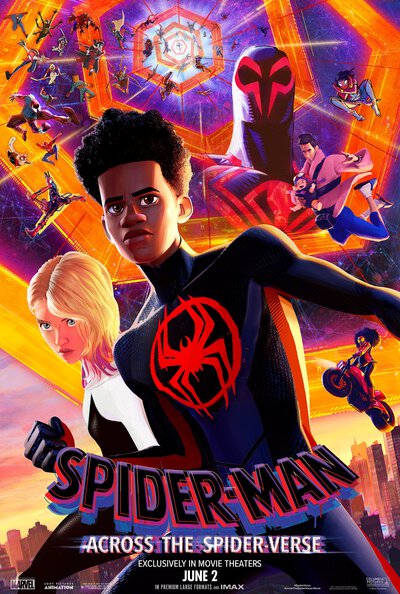
<p><img src="https://sdavidmiller.com/octo/images/best_of_2023/spider-man-across.jpg" width=150 title="Spider-Man: Across the Spider-Verse" align="right"/>
A case could be made that <strong><em>Spider-Man: Across the Spider-Verse</em></strong> was the greatest technical triumph in cinema this year. It&rsquo;s become a standard bit of hyperbole to claim that &ldquo;every frame could be a painting,&rdquo; but here it would arguably be damning with faint praise. Given its manic synthesis of visual styles, it&rsquo;s more accurate to say that every frame could be its own exhibit—variations on a theme by a collective of creators, in conversation with one another but unmistakably distinct. From the pulsing pastels of Spider-Gwen to the zine-inspired anarchy of Spider-Punk, it&rsquo;s bursting at the seams with visual invention. And like <em>Everything Everywhere All At Once</em> before it, that overstimulation is vital to its emotional core. Miles&#8217; struggle to stay grounded in the face of swirling contradictions rings all too familiar in our present media environment. It&rsquo;s a feeling best conveyed by way of cacophony.</p>
<p><img src="https://sdavidmiller.com/octo/images/best_of_2023/taste-of-things.jpg" width=150 title="The Taste of Things" align="right"/>
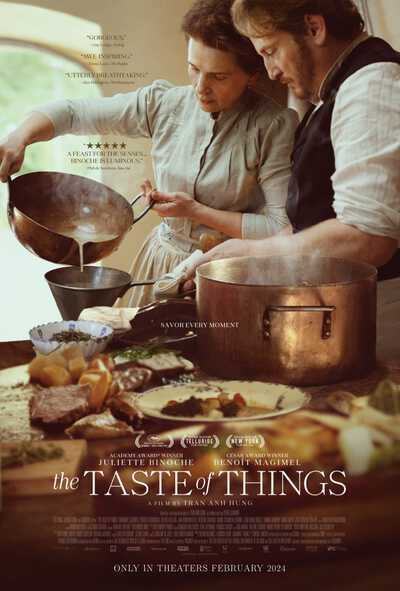
If <em>Spider-Man</em> overwhelmed my visual cortex, <strong><em>The Taste Of Things</em></strong> had other senses on its mind. Tran Anh Hung&rsquo;s luxurious drama about a gourmand and his muse is as antithetical to Miles&#8217; multiverse as one can get. It&rsquo;s intimate, unhurried, and obsessively focused. Though the dialogue is technically uttered in French, the characters prefer to speak in a more universal tongue: the love language of food being prepared and enjoyed. Large swaths of runtime are devoted to their passion, most notably a near-wordless half hour sequence in the kitchen. The camera glides through the crowded space, peeping into bubbling pots of stew and lingering on sweaty hunks of veal with voyeuristic intensity. From my vantage point in the front row at the red carpet premiere, the experience was borderline pornographic. Eight months later I still vividly recall a glistening rack of lamb splayed beyond my field of vision, literally too much decadence to take in at once. You never forget your first time. I entered the theater hungry, left positively ravenous, and I wouldn&rsquo;t have it any other way.<sup id="fnref:1"><a href="#fn:1" rel="footnote">1</a></sup></p>

<p>And now, in the spirit of lush excess, let&rsquo;s throw in a beverage pairing!</p>

<h3>Supplemental Pairing: 1950s Vintages</h3>

<p>I caught 125 new releases last year, but that only reflects about half of my total film intake. For the remainder, I continued a tradition I began early in the pandemic by marching backwards through film history to fill in embarrassing blindspots. Though I pull from a few sources, my biggest inspiration for this effort is the <a href="https://letterboxd.com/filmspotting/list/filmspotting-madness-2024-shortlist-best/">Filmspotting Madness shortlist</a>, a collection of about 100 titles which feed into their annual March Madness-style tournament to name the &ldquo;greatest&rdquo; film of a given decade. <a href="https://www.filmspotting.net/madness">This year&rsquo;s tournament</a> is focused on the 1950s, and the lineup is fantastic.</p>

<p>So, in the spirit of maximalism, let&rsquo;s add a supplemental pairing to complement the main course. For each of the ten themes from my Decoding Everything piece, I&rsquo;ll offer you one or two barrel-aged expressions from my personal cellar—treasured discoveries from my 1950s marathon which complement the dialogue the two 2023 films are engaged in.</p>

<p><strong>10. Coming Home Can Be a Trial — ‘Beau Is Afraid’ and ‘Omen’</strong><br/>
<em>Pairs with: Wild Strawberries (1957)</em></p>

<p>This pairing is about fraught family gatherings: films which use heightened storytelling to explore the complicated emotional inheritance parents pass down to their children. <strong><em>Wild Strawberries (1957)</em></strong> fits beautifully in this regard while also flipping the script, focusing instead on the messy combination of grief and guilt which the <em>parent</em> feels about the inheritance they&rsquo;ve created.</p>

<p><strong>9. Invisible Protections — ‘Shayda’ and ‘Are You There God? It’s Me Margaret’</strong><br/>
<em>Pairs with: Pather Panchali (1955)</em></p>

<p>These two films celebrate mothers who work tirelessly to protect their children from an often brutal, uncaring world, while also functioning as retrospective coming-of-age stories. Satyajit Ray’s entire <em>Apu Trilogy</em> does this brilliantly. While <em>Aparajito (1956)</em> is arguably the most mother-focused of the three, I have to insist that you watch them in order, which means recommending the first (and also, by my reckoning, the greatest) entry: <strong><em>Pather Panchali (1955)</em></strong>.</p>

<p><strong>8. Unexpected Compositions — ‘Maestro’ and ‘The Blue Caftan’</strong><br/>
<em>Pairs with: A Star is Born (1954) and A Place in the Sun (1951)</em></p>

<p>This pairing has a few layers to it: 1. what it means to love an artist, 2. what it means to love someone for whom you will never be fully “enough,” and (though I tried to tread lightly on spoilers) 3. the pressures the closet imposes on a marriage, both for the man who has to hide his fullest self and for the woman who loves him. For #1 and #2, I’d suggest George Cukor’s <strong><em>A Star is Born (1954)</em></strong>, both for the thematic resonance of loving an artist, and for the fun tie-in to Bradley Cooper’s last directorial outing. While I found this year’s 1950’s marathon surprisingly subversive, the Hays Code still generally kept #3 in the realm of subtext. For that one, I’ll throw in <strong><em>A Place in the Sun (1951)</em></strong>, a film which—especially if you’re familiar with Montgomery Clift’s personal life and his friendship with Elizabeth Taylor—functions as a moving metaphor for sexuality and repression. It’s a film about a man caught between two worlds, and the women he loves whom he nevertheless hurts.</p>

<p><strong>7. Thriving is Overrated — ‘You Hurt My Feelings’ and ‘The Holdovers’</strong><br/>
<em>Pairs with: Marty (1955)</em></p>

<p>There are many films from the 50’s which would pair with each of these individually. But taken together, as an ode to people who learn to be at peace with their shortcomings and use that honesty to build meaningful relationships, I can’t think of a more heartwarming companion than <strong><em>Marty (1955)</em></strong>. Ernest Borgnine and Betsy Blair’s unlikely romance will melt the heart of even the toughest critic, while also begging the question “Are we honestly supposed to believe these people are not attractive?”</p>

<p><strong>6. Double-Edged Dreams — ‘Dream Scenario’ and ‘BlackBerry’</strong><br/>
<em>Pairs with: A Face in the Crowd (1957)</em></p>

<p>This pairing is about the downside of ambition, and particularly the way that fame can make confidence curdle into a toxic sort of entitlement. Elia Kazan’s <strong><em>A Face in the Crowd (1957)</em></strong> is a shockingly prescient look at that phenomenon. But rather than inhabit the mind of the man who throttles to fame, this focuses on the people in his orbit, on the outside looking in, simultaneously fascinated and horrified by the ascent. While Cage and Howerton are both excellent in their respective roles, neither can light a candle to Andy Griffith’s mind-blowing turn as Lonesome Rhodes.</p>

<p><strong>5. Nothing Is Theoretical — ‘Oppenheimer’ and ‘The Teachers’ Lounge’</strong><br/>
<em>Pairs with: The Human Condition: No Greater Love (1959)</em></p>

<p>These films serve as cautionary tales about the limits of theory, and the importance of letting real-world empathy intrude on any calculation. Masaki Kobayashi’s <em>The Human Condition</em> trilogy may be the most monumental work of fiction on this subject in <em>any</em> medium. By focusing on the experiences of a Japanese soldier, it also provides a useful counterbalance to <em>Oppenheimer</em>’s (intentionally) narrow Western lens. While the three films function best as a single statement, if you can only see one it should be <strong><em>No Greater Love (1959)</em></strong>, which traces one man’s loss of idealism when presented with real-world suffering.</p>

<p><strong>4. The More Satisfying Narrative — ‘Anatomy of a Fall’ and ‘American Fiction’</strong><br/>
<em>Pairs with: Anatomy of a Murder (1959)</em></p>

<p>This pairing is about films which blur the lines between truth and narrative satisfaction, interrogating which stories we tend to gravitate to and why. While <em>Rashomon (1950)</em> arguably set the template for stories-about-storytelling, I just can’t resist pairing this with <strong><em>Anatomy of a Murder (1959)</em></strong>, the courtroom drama whose title <em>Anatomy of a Fall</em> is alluding to. This Jimmy Stewart classic is a brilliant deconstruction of confirmation bias, playing on audience expectations to reveal how easily our convictions can be manipulated. To anyone who thinks major American films weren&rsquo;t subversive or ambiguous until New Hollywood showed up, I&rsquo;d strongly recommend giving this one a watch.</p>

<p><strong>3. When The Pieces Don’t Fit — ‘The Boy and the Heron’ and ‘Asteroid City’</strong><br/>
<em>Pairs with: A Man Escaped (1956) and Floating Weeds (1959)</em></p>

<p>These are stories about characters who derive meaning from confined spaces, walled-off worlds. Not coincidentally, they’re also made by famously meticulous directors who create &ldquo;walled-off&rdquo; worlds of their own. So it’s only fitting that I pair this with something by a similarly meticulous director. Hell, I’ll give you two. Bresson’s <strong><em>A Man Escaped (1956)</em></strong> is a moving depiction of one man’s ingenious way of finding meaning, and hope, in a WWII prison camp—his quiet recitations of faith, drained of all affect, are as good a proof of Wes Anderson’s “You can’t wake up if you don’t fall asleep” mantra as anything I’ve seen. Add to that Ozu’s <strong><em>Floating Weeds (1959)</em></strong>, whose traveling troupe of actors use confinement and repetition to work through more complex emotions. A case could be made that Ozu is a shared inspiration for both modern directors—a master of composition known for his recurring collaborators and his empathetic depiction of children, who deals as much with head-on sentiment as he does with solitude, negative space.</p>

<p><strong>2. While The World Burns — ‘The Zone of Interest’ and ‘Killers of the Flower Moon’</strong><br/>
<em>Pairs with: Night and Fog (1956) and The Sweet Smell of Success (1957)</em></p>

<p>This is a somber pairing about people who have severed their moral compasses, and the atrocities they (we) are capable of as a result. So it only feels fitting to pair this with <strong><em>Night and Fog (1956)</em></strong>, Resnais’ powerful documentary about the Holocaust and the blinders the world put on in response. Warning: For as much as this is essential viewing, it is also graphic in its depiction and should not be entered lightly. If fiction is more your speed today, I’ll recommend <strong><em>The Sweet Smell of Success (1957)</em></strong>, a gloriously dark character study about men who shut off their consciences and wield language as a weapon.</p>

<p><strong>1. Containing Multitudes — ‘Past Lives’ and ‘Perfect Days’</strong><br/>
<em>Pairs with: Nights of Cabiria (1957)</em></p>

<p>These two films are about emotional plurality, following characters who hold multiple conflicting feelings at once. <strong><em>Nights of Cabiria (1957)</em></strong> springs to mind as a lovely complement to that idea. Like <em>Perfect Days</em>, it’s about a person whom society would typically ignore, who finds joy in life’s oddities and minutiae. Like <em>Past Lives</em>, it’s about a woman coming to terms with her identity, her romantic entanglements, and what alternate paths might be available to her. But the main reason I’d consider these together is a specific quality they all share: a perfect (and, in many ways, remarkably similar) closing shot. I won’t spoil any of them; just know that you&rsquo;re in for a treat.</p>

<h3>Closing Bits</h3>

<p>It has now been a full decade since I started doing these year end write-ups. When I started, this site was mostly devoted to weekly film reviews. Nowadays I put my immediate thoughts on <a href="https://letterboxd.com/sdavidmiller">Letterboxd</a>, and reserve this space for lengthier reflections. This year I wrote an <a href="https://sdavidmiller.com/octo/blog/2023/07/09/past-lives-eternal-sunshine/">essay about <em>Past Lives</em> and <em>Eternal Sunshine</em></a> which meant quite a lot to me. I also wrote a <a href="https://sdavidmiller.com/octo/blog/2023/05/29/cannes-2023-recap/">recap of Cannes</a>. In addition to my lengthier <a href="https://www.decodingeverything.com/p/10-cinematic-pairings-that-defined">2023 recap</a>, I also wrote a <a href="https://www.decodingeverything.com/p/the-five-best-films-of-the-2023-toronto">TIFF retrospective</a> for David Chen&rsquo;s <a href="https://www.decodingeverything.com">Decoding Everything</a> newsletter. Both festival roundups cover a handful of titles on this list.</p>

<p>Over at <a href="https://www.thespoilerwarning.com">The Spoiler Warning podcast</a>, we&rsquo;re still going strong at a (near) weekly cadence: The vast majority of the films above we&rsquo;ve discussed at length on the podcast, either in self-contained review episodes or in festival deep dives. You can listen to our <a href="https://www.thespoilerwarning.com/archives/bonus-recapping-the-films-of-2023">2023 recap episode</a> to hear me wax poetic about the above (and a dozen other) favorites, or listen to our <a href="https://www.thespoilerwarning.com/archives/state-of-the-podcast-2024">2024 State of the Podcast episode</a> to hear a bit about the 17(!) year history of the pod and what we might shake up in the future.</p>

<p>I do this as a passion project, but many others do it professionally. I firmly believe in financially supporting the people whose creative outputs I enjoy. For a few movie-adjacent suggestions: I&rsquo;m a proud supporter of (podcasts) <a href="https://filmspotting.supportingcast.fm">Filmspotting</a>, <a href="http://patreon.com/filmpodcast">The Filmcast</a>, <a href="https://www.decodingtv.com/">Decoding TV</a>, <a href="https://www.patreon.com/blankcheck/">Blank Check</a>, and <a href="https://www.patreon.com/NextPictureShow/">The Next Picture Show</a>, as well as (individuals) <a href="https://www.patreon.com/flmfrkcentral">Walter Chaw</a>, <a href="https://www.patreon.com/davechen">David Chen</a>, <a href="https://www.patreon.com/gemko">Mike D&#8217;Angelo</a>, <a href="https://812filmreviews.substack.com">Robert Daniels</a>, <a href="https://oldfilmsflicker.substack.com">Marya E. Gates</a>, <a href="https://episodes.ghost.io">Emily St. James</a>, <a href="https://www.patreon.com/nathanrabinshappyplace">Nathan Rabin</a>, <a href="https://thereveal.substack.com">Keith Phipps and Scott Tobias</a>. I&rsquo;d encourage you check them out, and throw in a few bucks if you&rsquo;re able.</p>

<p>See you next year!</p>
<div class="footnotes">
<hr/>
<ol>
<li id="fn:1">
<p>To whittle my list(s) down to a manageable size, I arbitrarily restricted myself to fiction. But if you&rsquo;re still hungry after watching <em>The Taste Of Things</em>, I highly recommend Frederick Wiseman&rsquo;s behemoth documentary <em>Menus Plaisirs &ndash; Les Troisgros</em>. If you thought <a href="https://sdavidmiller.com/octo/blog/2013/11/13/at-berkeley/">watching me program a robot</a> was sensual, wait until you get behind the scenes of a 3 Star Michelin restaurant.<a href="#fnref:1" rev="footnote">&#8617;</a></p></li>
</ol>
</div>

]]></content>
  </entry>
  
  <entry>
    <title type="html"><![CDATA[Parallel Tracks: Past Lives and Eternal Sunshine of the Spotless Mind]]></title>
    <link href="https://sdavidmiller.com/octo/blog/2023/07/09/past-lives-eternal-sunshine/"/>
    <updated>2023-07-09T10:00:00-07:00</updated>
    <id>https://sdavidmiller.com/octo/blog/2023/07/09/past-lives-eternal-sunshine</id>
    <content type="html"><![CDATA[<p><em>Note: This review contains spoilers for both Past Lives and Eternal Sunshine of the Spotless Mind</em></p>

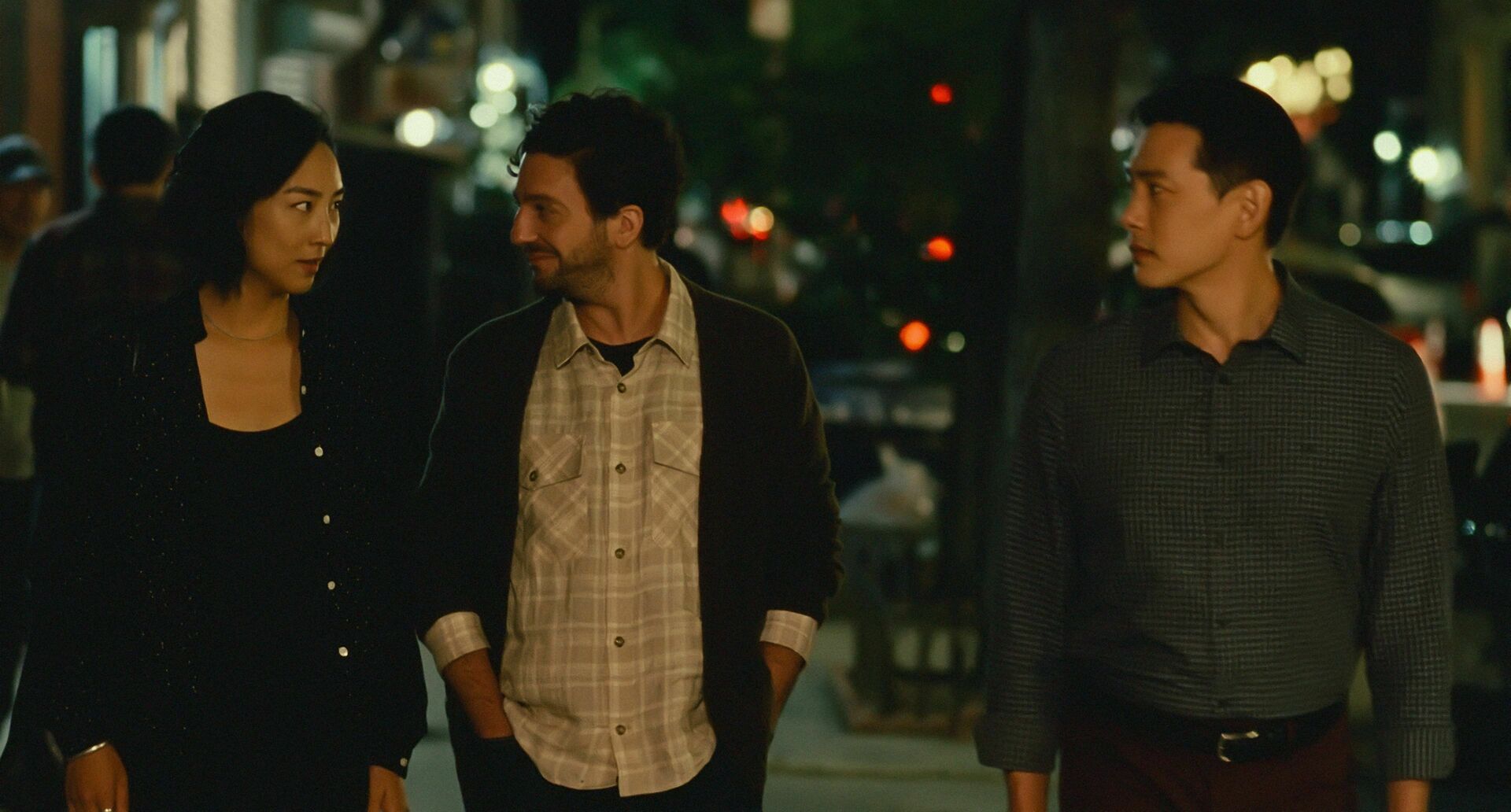
<p><img src="https://sdavidmiller.com/octo/images/past_lives/past_lives.jpg" width=800 align="center"/></p>

<blockquote><p>With your body next to me, its sleepy sighing<br/>
Sounds like waves upon a sea too far to reach<br/>
&ndash; Okkervil River, &ldquo;Seas Too Far To Reach&rdquo;</p></blockquote>

<br/>


<blockquote><p>You dream in a language that I can&rsquo;t understand.<br/>
It&rsquo;s like there&rsquo;s this whole place inside of you where I can&rsquo;t go.<br/>
&ndash; Arthur to Nora, Past Lives</p></blockquote>

<br/>


<blockquote><p>I can&rsquo;t remember anything without you.<br/>
&ndash; Joel to Clementine, Eternal Sunshine of the Spotless Mind</p></blockquote>

<p>There&rsquo;s an early exchange in <em>Past Lives</em> that I can&rsquo;t seem to shake. Nora has just been accepted to an artist residency in Montauk, and she&rsquo;s sharing the news with Hae-Sung over Skype. She&rsquo;s clearly excited, and who could blame her? Writing professionally has been a dream of hers ever since she was a twelve-year-old &ldquo;crybaby&rdquo; in Seoul, and here it is, her first big break—a moment of validation, likely the first of its kind, and a possible springboard from academia into a full-fledged career. But the first thing she says to him has nothing to do with careerist aspirations or practical concerns. Instead, she&rsquo;s swept up in the romantic idea of the location itself: &ldquo;Eternal Sunshine of the Spotless Mind.&rdquo;</p>

<p>Celine Song and I are almost exactly the same age; by all context clues, so is Nora. And while I can&rsquo;t speak to their lives, I can speak to mine: Back in grad school, I had this tendency to imagine my life in the artistic third person. A sleep-deprived marathon for a conference submission was a knotted run-on sentence in a postmodern novel; a blurry cab ride to the airport at sunrise became a shoegaze soundtrack, a melody etched in negative space; a solo cocktail in a hotel lobby bar involved 35mm film grain and a gentle fade to black. &ldquo;Main character syndrome&rdquo; is accurate but feels misleading, somehow. I wasn&rsquo;t trying to make my life <em>bigger</em> so much as lend meaning to its smallness, using the only language I had at my disposal: the art that I consumed.</p>

<p>Virtually the whole of my identity at this time was wrapped up in my &ldquo;favorites.&rdquo; Author: David Foster Wallace.<sup id="fnref:1"><a href="#fn:1" rel="footnote">1</a></sup> Band: Okkervil River. Movie: <em>Eternal Sunshine of the Spotless Mind</em>. These were hidden treasures I&rsquo;d discovered when I was at my most malleable: art which moved me, challenged me, became a prism through which I could rectify the world and my place in it. When I evangelized my favorites to you—and oh, trust me, I would—it wasn&rsquo;t meant to be a litmus test so much as a bid for connection. Only by sharing a vocabulary could you properly understand me. And that was love, as best as I could figure: to be fully seen, fully understood.</p>

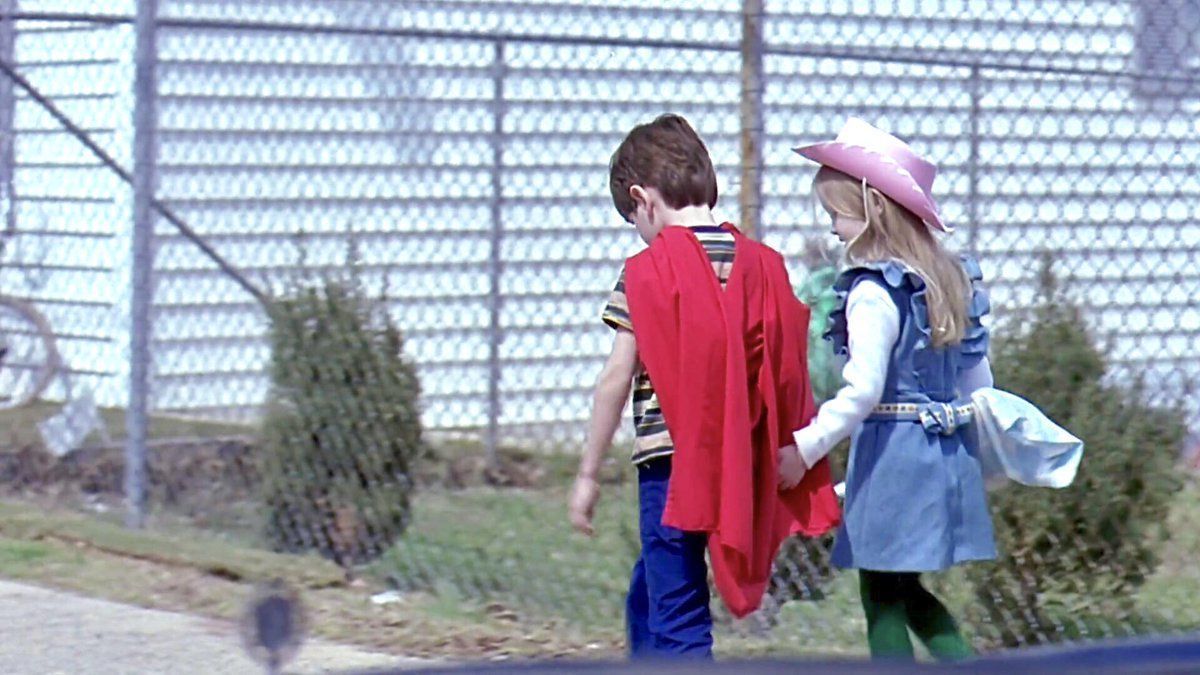
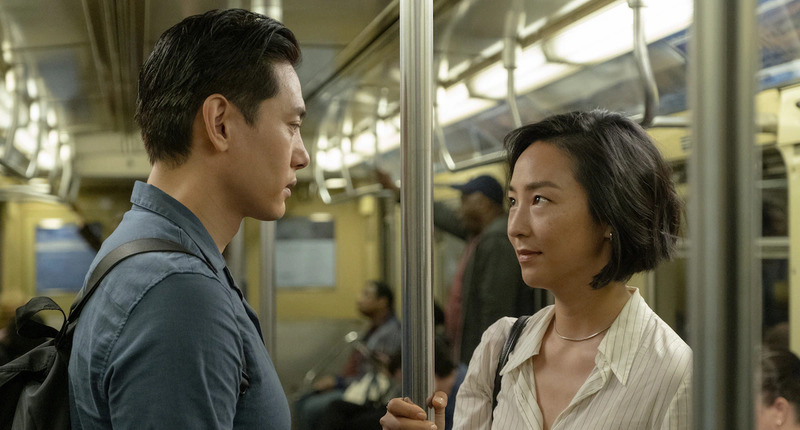
<p><img src="https://sdavidmiller.com/octo/images/past_lives/past_lives_children.jpg" width=500 alt="Past Lives" align="center"/>
<img src="https://sdavidmiller.com/octo/images/past_lives/eternal_sunshine_children.jpg" width=500 alt="Eternal Sunshine of the Spotless Mind" align="center"/></p>

<p>Few works of art stoked that desire in me quite like <em>Eternal Sunshine of the Spotless Mind</em>. Specifically this image: Joel and Clementine, hand in hand, barreling through the deepest recesses of Joel&rsquo;s mind. His anxieties, his neuroses, his foundational scars, all of them laid bare and beautiful, communally shared. Those gnawing regrets he can now perfectly atone for; those room-splitting silences he can now give voice to, explain. The gap between intention and action, between the perfect pitch we hear in our heads and our atonal attempts to transpose it—all of those barriers that make being a person feel impossible, in this fantastical vision cease to exist. Clementine can finally see Joel exactly as Joel sees himself. Or, rather, his internalized version of Clementine can.</p>

<p>If that last caveat seems like a crucial distinction, the young idealist in me had no issue ignoring it. Joel&rsquo;s memory of Clementine <em>was</em> Clementine as far as I was concerned.<sup id="fnref:2"><a href="#fn:2" rel="footnote">2</a></sup> She was, after all, an inextricable part of his psyche: the logical conclusion of his honest journey inward, a retroactive fulfillment of even his childhood desires, a Grand Unified Theory Of Joel who made all of his misshapen wants add up to something elegant, profound. Joel and Clementine were soulmates, destined to meet and re-meet in Montauk a thousand times over because it was tautologically correct, because they could be no other way. Having recognized the essential truth of their relationship, love demanded that Joel move heaven and earth to preserve it. Whether the real Clementine who erased him would be inclined to agree&hellip;well, to me, this was never a question. She had to agree, because it was <em>right</em>. It was the perfect love story.</p>

<p>In my early 20s I carried a similar conviction, a faith in the hard truth of inherently soft things. It manifested itself in my ranking of art, in my narrow political certainties, and especially, most damningly, in love. Whether coaxing crushes into relationships by way of grand gestures or crafting impassioned arguments to save ones that had already ended, I behaved as if the gap between outside and inside hinged only on myself. On my ability to make others <em>see things as I saw them</em>. As if the tiny carbon copy of other people I carried in my head comprised the whole of their identity: living concepts I could interrogate, plug in to philosophic formulas and output unassailable proofs. If I had earnestly introspected and concluded that we were meant to be together, cinematic logic compelled me to fight for it. The alternative was to lose something once-in-a-lifetime, something about which I had been certain.</p>

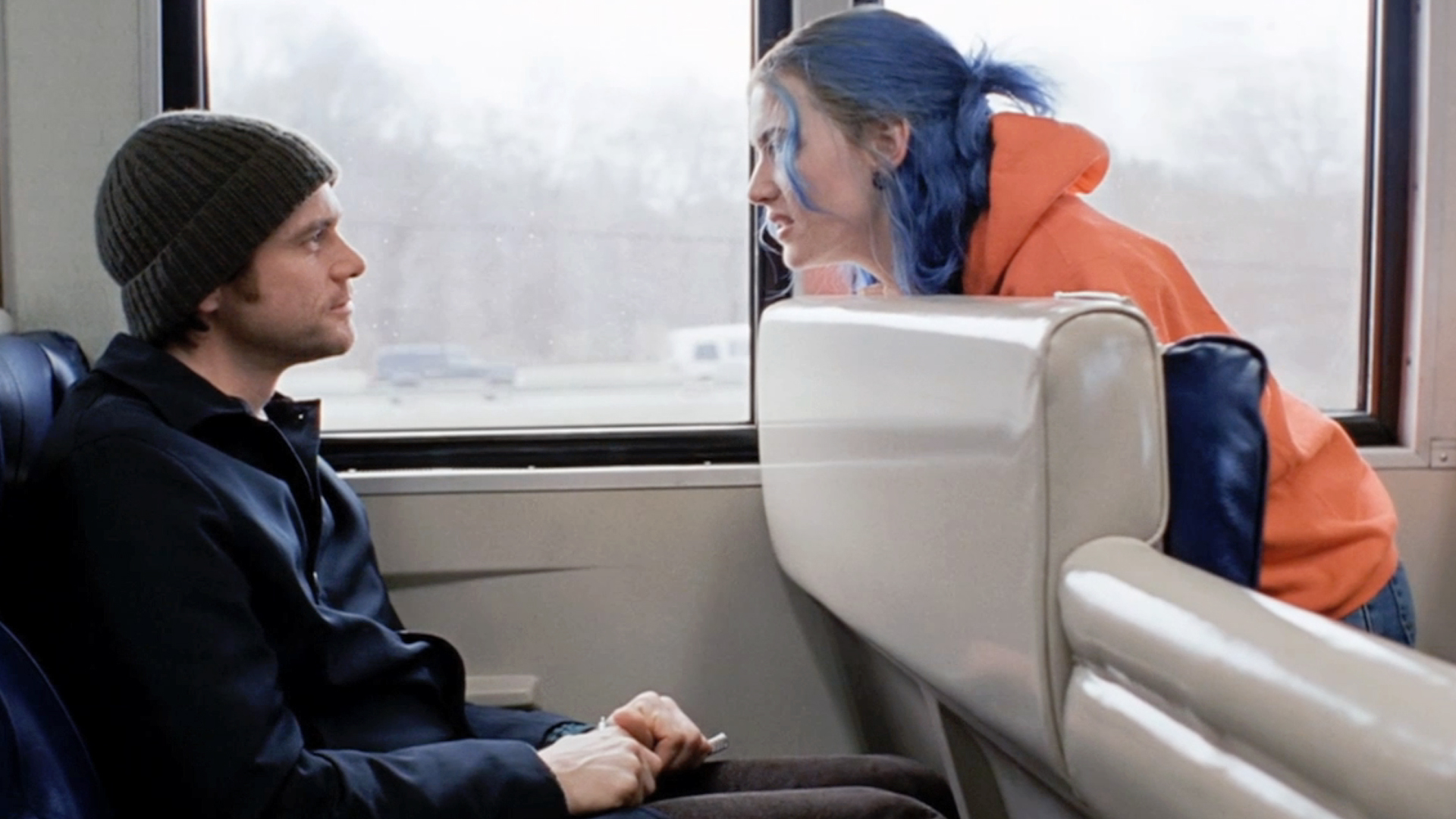
<p><img src="https://sdavidmiller.com/octo/images/past_lives/past_lives_train.jpg" width=500 alt="Past Lives" align="center"/>
<img src="https://sdavidmiller.com/octo/images/past_lives/eternal_sunshine_train.jpg" width=500 alt="Eternal Sunshine of the Spotless Mind" align="center"/></p>

<p>Hae-Sung is making his own grand gesture of sorts in the third act of <em>Past Lives</em>: a last-ditch effort to right what the universe has wronged. He has loved the carbon copy of Nora that lives in his head for some 24 years, been certain that she was &ldquo;the one,&rdquo; and the audience is given every reason to agree with his assessment. After all, he and Nora share a wordless connection, a history, a culture. We open with them together in her childhood memory, that malleable place where Joel could only project Clementine retroactively. They recur in each other&rsquo;s stories, and when they intersect they literally converse in the language of her dreams. &ldquo;Childhood sweethearts who reconnect twenty years later and realize they were meant for each other&#8221;—it&rsquo;s a narrative Hae-Sung himself might have drafted in the artistic third person. He may not quite know what he&rsquo;s hoping to accomplish as he boards that 14-hour flight to JFK, but the impulse that carries him is all too familiar: a relentless conviction of the heart.</p>

<p>Whereas Arthur feels uncertain, and for very good reason: In any literary analysis pitting him against Hae-Sung, there&rsquo;s no question of who comes out on top. Arthur has no access to the world of Nora&rsquo;s dreams, try though he may to study up on the vocabulary. As for memory, he only catches whatever fragments she chooses to express. And if she hadn&rsquo;t met him in Montauk, some other warm body may well have taken his place. Their marriage is, at its root, a matter of happenstance—there&rsquo;s no elegant theory of why they must always be so. A thousand different lives might have yielded a thousand different husbands, parallel tracks leading Nora to alternate versions of &ldquo;happy.&rdquo; Better or worse? Who could say? That conversation they have after Hae-Sung&rsquo;s first visit is my favorite part of <em>Past Lives</em> because it&rsquo;s so achingly honest, borne of yet another too-familiar feeling: impotence. Insufficiency. The recognition that you might be less than enough, and that it isn&rsquo;t within your power to change it. To Arthur&rsquo;s spiraling neuroses, Nora has only this to add: &ldquo;You&rsquo;re forgetting the part where I love you.&rdquo;</p>

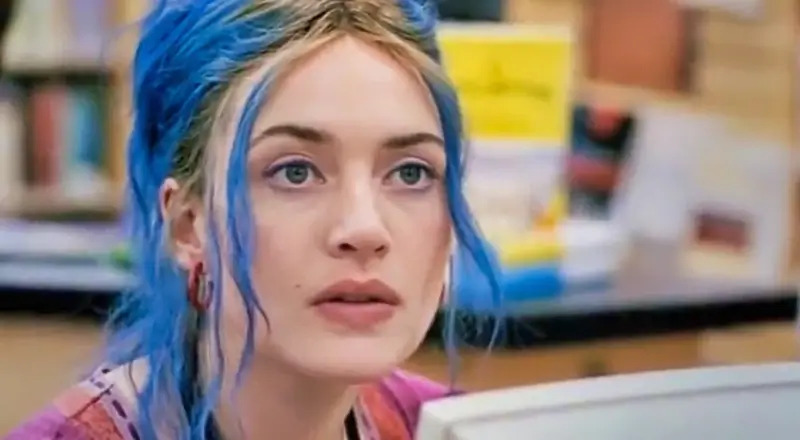
<p><img src="https://sdavidmiller.com/octo/images/past_lives/past_lives_nora.jpg" width=500 alt="Past Lives" align="center"/>
<img src="https://sdavidmiller.com/octo/images/past_lives/eternal_sunshine_clementine.jpg" width=500 alt="Eternal Sunshine of the Spotless Mind" align="center"/></p>

<p>Sometimes it&rsquo;s easy to overthink things, to forget what really matters. Nora—not the mental mirror image Hae-Sung has adored since twelve, not the novelistic concept Arthur (only half-jokingly) critiques, but the real, flesh-and-blood protagonist at the heart of <em>Past Lives</em>—her decisions and actions are hers alone, and they matter not because they&rsquo;re &ldquo;meant to be&rdquo; but because they <em>actually happened</em>. Her presence is a tangible, valuable thing. Her love is a continual choice. And she possesses more inside than could ever be perfectly shared. Essential parts of her identity (as Korean, as immigrant, as individual) Arthur will never fully understand; years of hard-fought, uncinematic closeness, of separate sets of roots straining to share soil, which Hae-Sung cannot romanticize or theorize away. Of course Arthur is feeling less than enough; of course he isn&rsquo;t Nora&rsquo;s everything. The infinite interiority of Nora&rsquo;s life and the ghosts of other lives she carries alongside her—that impossible scale which resists comprehension, which will forever keep him on the outside looking in—it isn&rsquo;t a barrier to love, it&rsquo;s love&rsquo;s essence. &ldquo;You make my life so much bigger.&rdquo; Any version of Nora that could fit in his head would never be capable of widening him.</p>

<p>It took me years of false starts to learn this lesson, and I suspect I&rsquo;ll spend my whole life continuing to re-learn it. That love is not about winning or possessing or <em>making them understand</em>, as if the only thing keeping them from recognizing my own inherent rightness were a lack of understanding, a faulty transmission. To truly love someone is to open yourself up to their enormity; to be reminded of the size and shape of everything you do not know, an immersion in a language you&rsquo;ll never speak with perfect fluency; to be wrong, repeatedly, and (if you manage to stay vulnerable) to let that wrongness make you bigger. My marriage should shape me. My friendships should challenge me. My worldview should be continually fractured and re-formed. If my grad student self saw life as an honest journey inward, today, when I&rsquo;m at my best, I strive for outwardness, awareness. Collisions to knock me outside of myself.</p>

<p>Collisions. Encounters. <em>Inyeon</em>. Hae-Sung and Arthur, two competing characters in the novelization of Nora&rsquo;s story, sharing an improbable 3am drink. They don&rsquo;t have to exist as opposite sides of an argument, because what Nora is wrestling with has nothing to do with a proof: There&rsquo;s no correctness in love, no single right way to be, no predestined meeting in Montauk. The favorites of my youth which I&rsquo;d mistaken for guidebooks, they were just a handful of paths among many—art brushing past me and imprinting fragments of truth, inherently bound by experience. What I adore about <em>Past Lives</em> is that it makes room for the whole of it; it doesn&rsquo;t ask us, or its characters, to choose. Hae-Sung can honor his love without forcing an ultimatum. Nora can grieve one possibility even as she commits to another. She can be honest with Arthur about everything Hae-Sung shakes loose, and Arthur can intentionally see it as goodness. (&ldquo;I&rsquo;m really glad you came here. It was the right thing to do.&rdquo;) They can stay open to these parallel trains out of Montauk, receive their rumbling underfoot not as a threat but opportunity—a chance to find beauty in the scenic route not taken, to be made wider by the presence of other stories. &ldquo;Perfect&rdquo; is a point that insists upon itself, repeating forever, incapable of change. <em>Past Lives</em> isn&rsquo;t a perfect love story. It&rsquo;s something better.</p>
<div class="footnotes">
<hr/>
<ol>
<li id="fn:1">
<p>Footnote reference very much intentional, but also: Patricia Lockwood just published <a href="https://www.lrb.co.uk/the-paper/v45/n14/patricia-lockwood/where-be-your-jibes-now">a brilliant essay</a> on Wallace&rsquo;s complicated legacy (magnetic/infuriating/dazzling/self-aggrandizing/violently misogynistic) and what it means to wear an artist as an identity, to in a small way &ldquo;become&rdquo; them. She gives voice to this stuff way better than I could hope to.<a href="#fnref:1" rev="footnote">&#8617;</a></p></li>
<li id="fn:2">
<p>Make no mistake, I revere <em>Eternal Sunshine</em> and still consider it among my very favorite movies. This isn&rsquo;t a critique of the text of the film, so much as of my clumsy attempts to emulate it in my youth. Watching later in life, especially paired with Kaufman&rsquo;s later work like <em>Anomalisa</em> and <em>I&rsquo;m Thinking Of Ending Things</em>, it feels shocking how little I absorbed a key piece of subtext the script was quite literally shouting it at me: Clementine repeatedly insisting that she&rsquo;s a person, not a concept, while the detritus of Joel&rsquo;s memory crumbles around her.<a href="#fnref:2" rev="footnote">&#8617;</a></p></li>
</ol>
</div>

]]></content>
  </entry>
  
  <entry>
    <title type="html"><![CDATA[Cannes 2023: Recap]]></title>
    <link href="https://sdavidmiller.com/octo/blog/2023/05/29/cannes-2023-recap/"/>
    <updated>2023-05-29T06:37:00-07:00</updated>
    <id>https://sdavidmiller.com/octo/blog/2023/05/29/cannes-2023-recap</id>
    <content type="html"><![CDATA[<p><em>Brief thoughts on the festival as a whole; a quick day-by-day accounting; rankings</em></p>

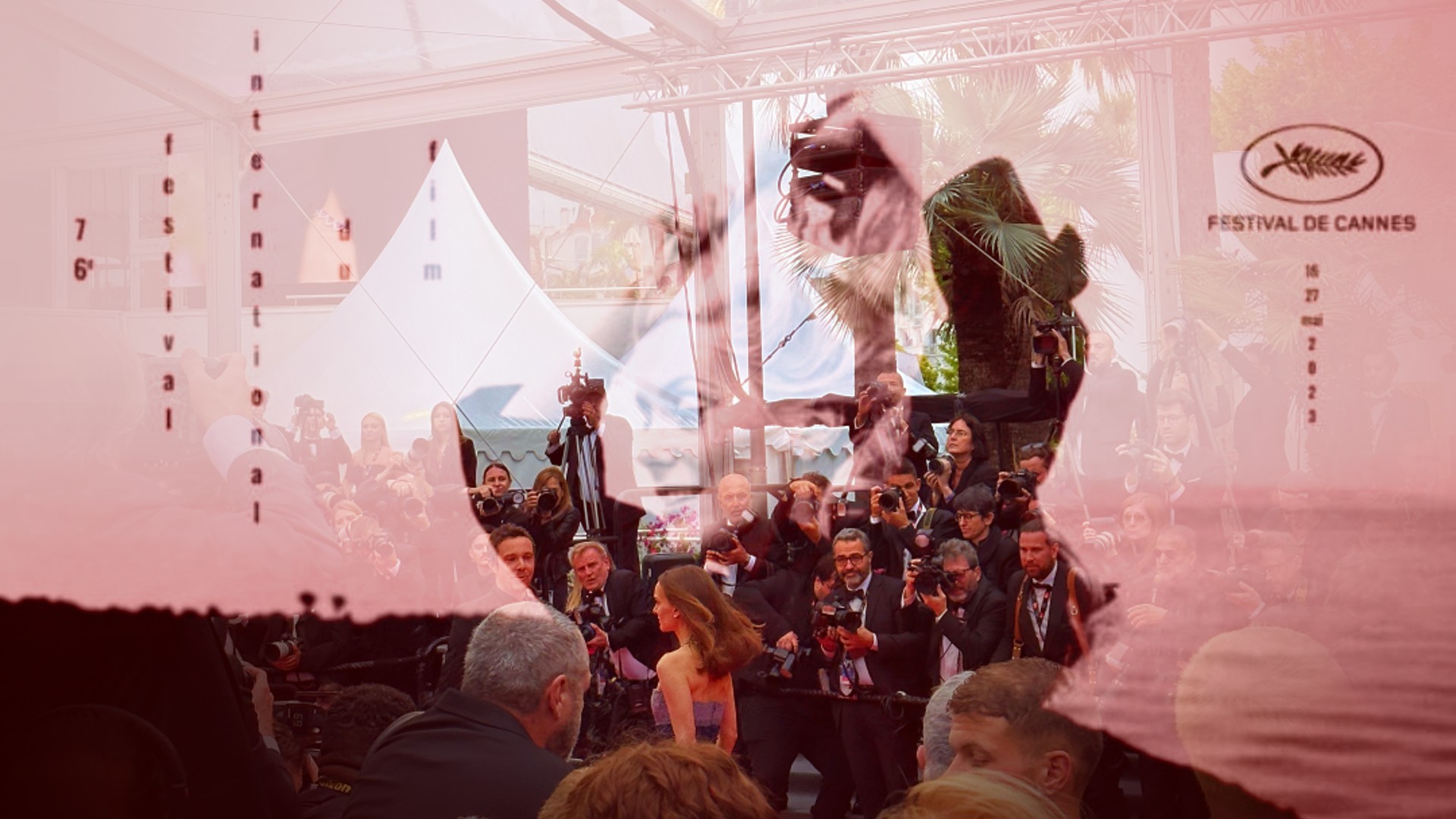
<center><img src="https://sdavidmiller.com/octo/images/cannes23_recap/title.jpg" width=800 title="Cannes 2023" align="center"/></center>


<br/>


<h3>Intro: Back in Black [Tie, Repeatedly, For 11 Consecutive Evenings]</h3>

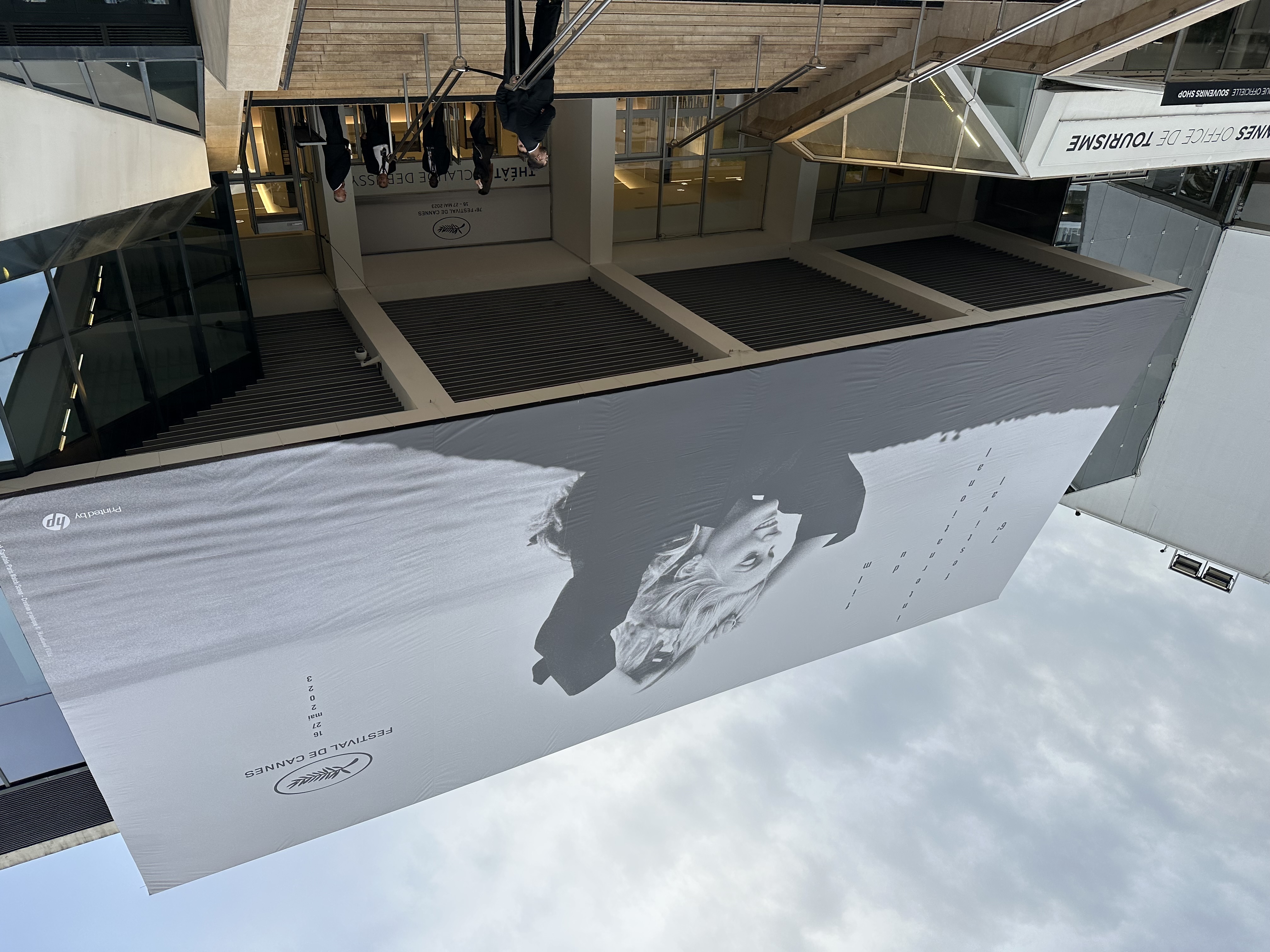
<p>It was March 2020 and the future was bright. My whirlwind &ldquo;3 Days In Cannes&rdquo; in 2018 had functioned as a gateway drug, followed by a full-festival bender in 2019. Despite having a badge that came with no ability to book tickets, I&rsquo;d managed to catch every single film in competition that last year—a grueling process requiring a tolerance for uncertainty; sleeplessness, sweat, and dry erase markers. The gems (<em>Parasite</em>, <em>Portrait of a Lady on Fire</em>) had made all the pain worthwhile, but this time around there was no need to suffer: I&rsquo;d just been approved for a Press accreditation.<sup id="fnref:1"><a href="#fn:1" rel="footnote">1</a></sup> Throw in a kickass AirBnB three blocks from the Palais and a business class upgrade booked with United points, and I was ready to experience the Croisette in style.</p>

<p>You know the sob story. We all have specific experiences we lost to the pandemic, and I&rsquo;m under no illusion that my first world problems deserve anyone&rsquo;s pity. But for the full duration of lockdown it weighed heavily as a symbol, that theatre packed with 2,300 strangers from every corner of the globe. It was the Platonic ideal of the Thing I Can&rsquo;t Believe We Used To Do; communal, spontaneous, anxiety-free. When my (now) wife threw me a Cannes-themed birthday in May 2020, it wasn&rsquo;t just commemorating a single cancelled trip. It was about that special, transportive feeling of being totally surrounded. <a href="https://sdavidmiller.com/octo/blog/2020/07/03/songs-and-memories/3/index.html#Song055">Here&rsquo;s</a> what I wrote at the time:</p>

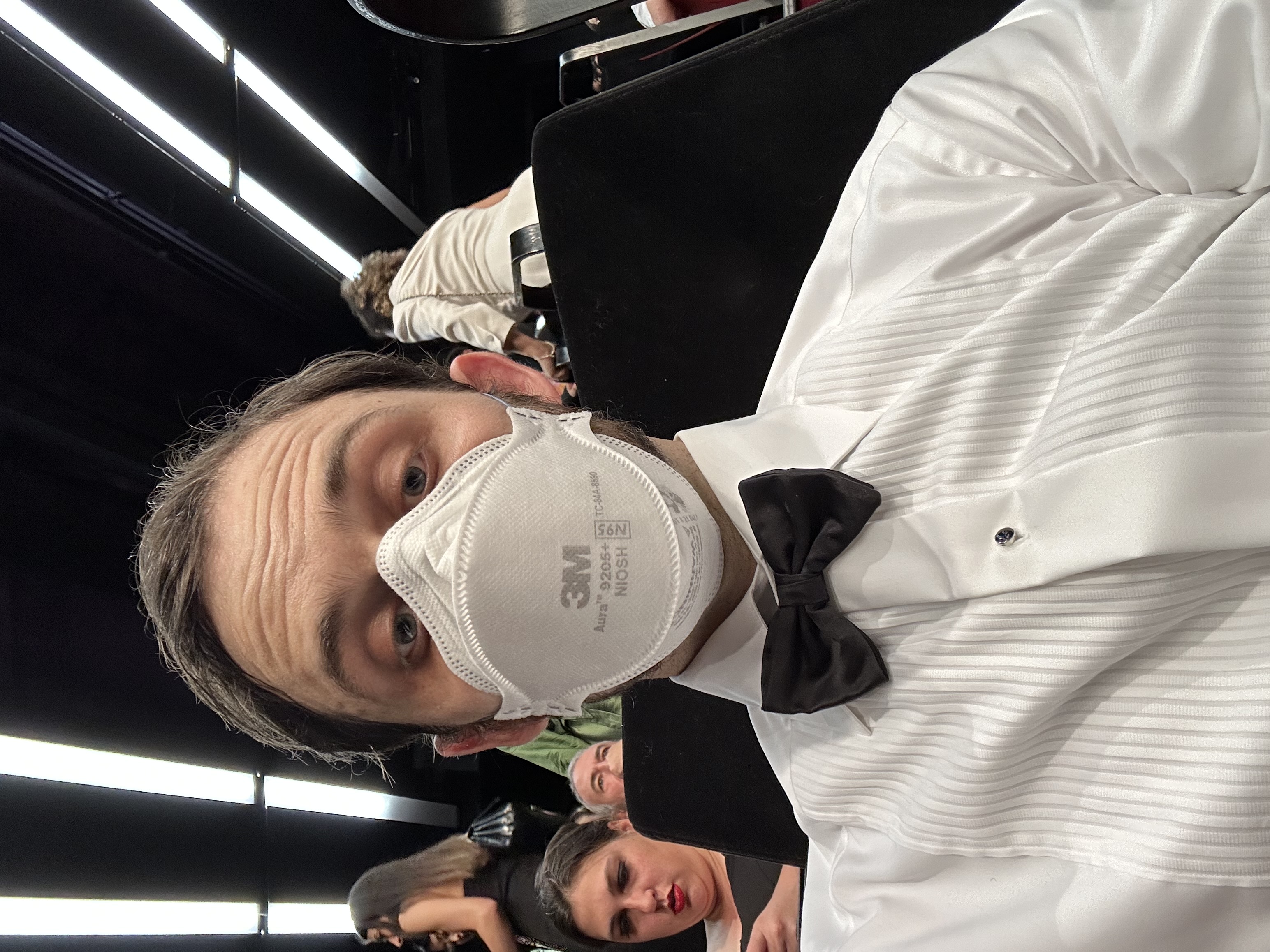
<blockquote><p>When will I sit in an auditorium with 2300 strangers again? Will every cough make me anxious? Will I wipe down my seat? Will my bowtie be paired with an N95 mask? Will we even be able to fully let go, with our mortality making so much goddamn noise? Film will survive, and I’ll continue to love it, but there’s a naivety I’m not sure I’ll ever get back.</p></blockquote>

<p>My fear was misguided; we did get it back. Some quite a bit sooner than others. To this asthmatic who&rsquo;s had a lifelong struggle with breathing-related panic attacks, the pandemic has been long and the journey very slow. I didn&rsquo;t re-enter movie theaters until 2022, and even then it&rsquo;d be for half-empty screenings, mask firmly affixed (and still is, as I type this on the plane). When I finally came down with COVID this past December, it was predictably miserable but also something of a relief. I would still maintain precautions, but I resolved to no longer let them stop me: This year, I was coming back to Cannes.</p>

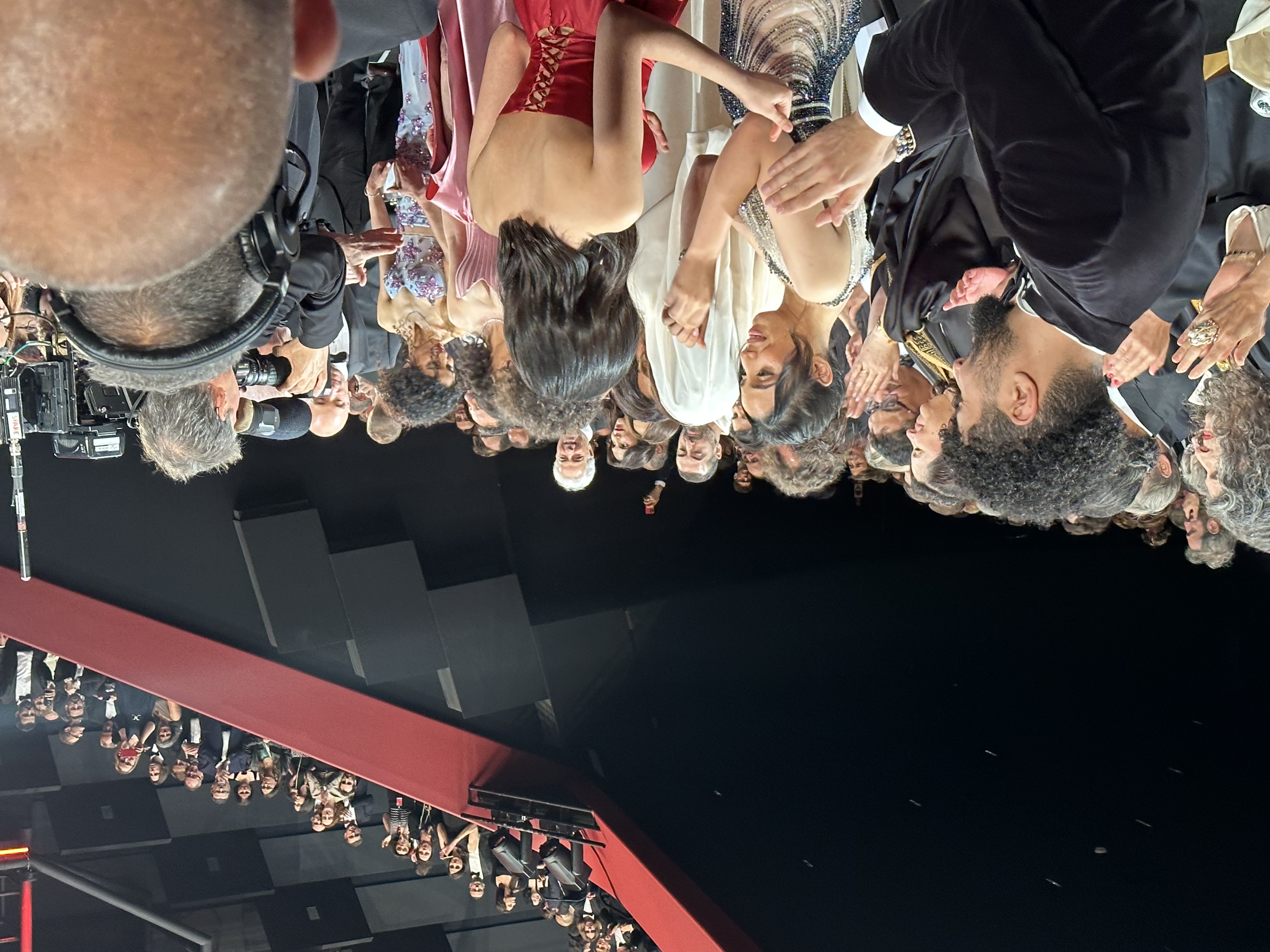
<p>Walking into the Grand Théâtre Lumière for the first time in four years, I was flooded with an emotion that had nothing to do with what was on screen. Chaotic life continued. I could sit shoulder to shoulder with total strangers dressed to the nines for no reason; I could lose myself in the accumulated pitch of 2,300 creaking chairs and the percussion of whispered consonants in languages I don&rsquo;t speak; I could feel the swell when the lights went dim and the curtains opened and that Morricone theme began—the shared hope that something beautiful might occur. Even if it never did, the hope alone would be worth it. It feels <em>so good</em> to wait with baited breath, together.</p>

<center><div style="width:450px;max-width:100%;text-align:center;font-size:0.8em"><figure>
<a href="https://sdavidmiller.com/octo/images/cannes23_recap/seated.jpeg"><img src="https://sdavidmiller.com/octo/images/cannes23_recap/seated_thumb.jpeg" width=450 title="Seated in the GTL, the lone mask in sight" align="center"/></a>
<figcaption>Seated in the GTL, the lone mask in sight</figcaption><br/></div></center>


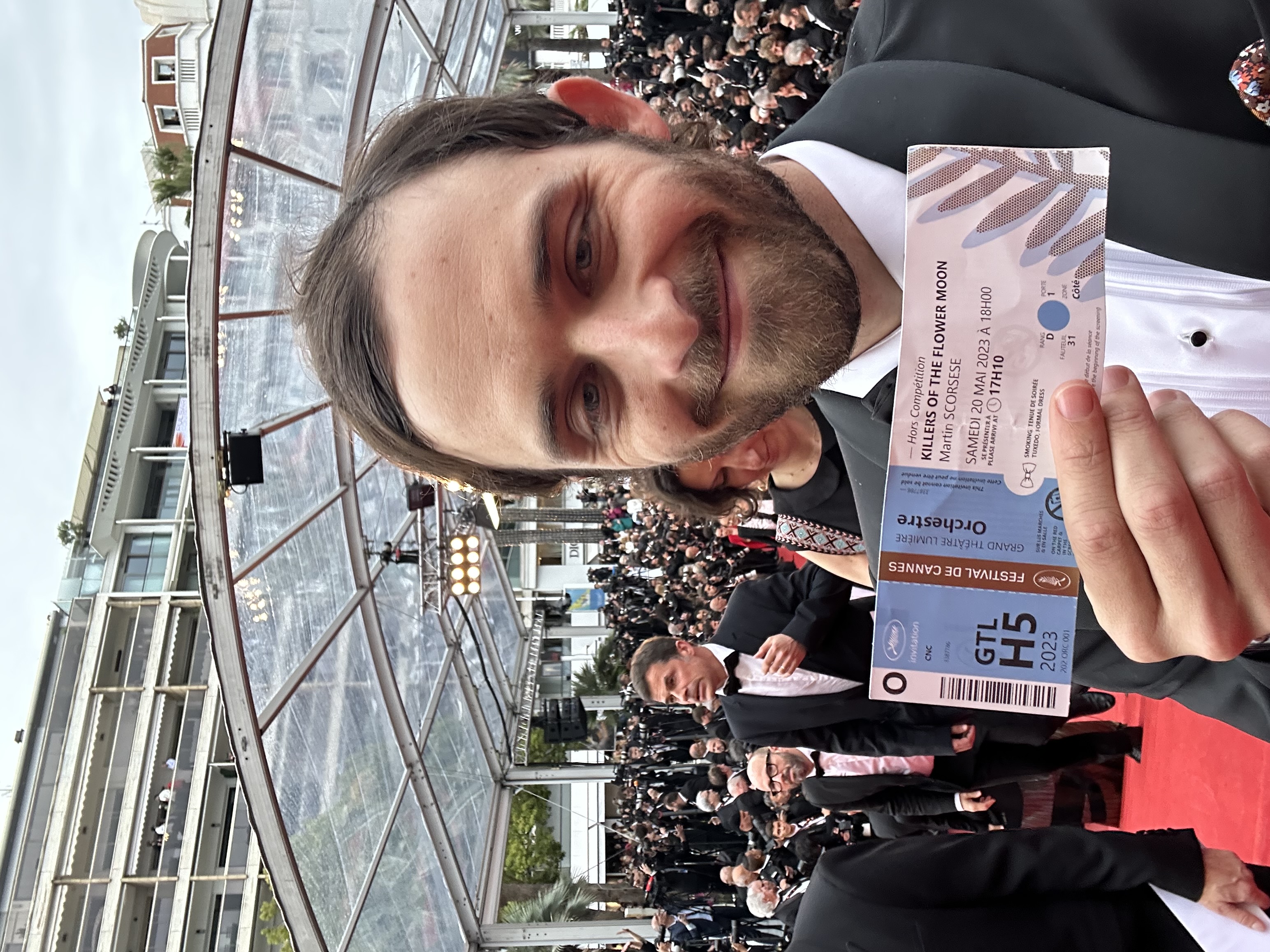
<p>Luckily, I was able to do more than hold my breath. This was a fantastic couple weeks for watching movies, and I&rsquo;d like to think I made the most of them. As with every year, chaos reigned supreme: I rarely had a ticket for anything until a few hours before the screening, and even my best planned days had their fair share of curveballs—infuriating rule changes, setbacks at security, tuxedoed sprints through crowded streets in the 4pm sun. Within that chaos, though, the new online booking system (paired with some nifty new tricks I&rsquo;ll refrain from sharing in case I come again in future years) meant I was able to easily surpass my previous record. I caught 36 films this year, including 20/21 of the Competition slate, a handful of Un Certain Regard and Directors&#8217; Fortnight screenings, and some of the buzziest Out Of Competition titles.<sup id="fnref:2"><a href="#fn:2" rel="footnote">2</a></sup> The vast majority of these were premieres of some sort: I walked the red carpet a total of 22 times,<sup id="fnref:3"><a href="#fn:3" rel="footnote">3</a></sup> which is a stat I&rsquo;m pretty certain I never want to top. Nearly every one of those 36 had something to recommend it; at least a dozen I&rsquo;d consider &ldquo;great&rdquo; and four or five were outstanding.</p>

<p>Every year the movies start to rhyme after a while, and this was no exception. Two related ideas in particular kept coming to the surface. The first has something to do with cognitive dissonance, with carving out meaning in a world constantly bombarding us with tragedy. How should we then live? What is that peculiar, human quality that lets us compartmentalize suffering—turn down the volume on the broadcast—and what happens when that hardens to a callous? Romantic, deluded, jaded, evil; radically different fruit born from the same root impulse. The second is about the illusion of control—the walled-off worlds we create for ourselves, the conscious narratives we draft, the rehearsals we conduct or the details we get lost in in an attempt to understand the unimaginable. Blustery lawyers, meticulous directors, actors seeking truth through imitation. When the light itself is blinding we focus on the shadow, or squeeze it through a pinhole to scale it down to human size.</p>

<p>One personal revelation was also hammered home on this trip: I am not invincible. Hindsight coats everything in a romantic sheen, but the truth is my first three days were pretty miserable. Maybe it&rsquo;s age or the pandemic sleep schedule I&rsquo;ve honed to a routine, but jet-lag wreaked absolute havoc on my system. For days I slept at most two hours a night and barely ate as a result. I remember one call in particular, despairing to Joanna that the sun was coming up and my alarm would be going off any minute. &ldquo;Why set an alarm?&rdquo; she asked. &ldquo;What movie could possibly be more important your health?&rdquo; She was, as usual, spot on. In that moment I cleared my morning schedule and, incredibly, fell asleep—a trick I&rsquo;d repeat for many nights to come. I started to carve out dedicated blocks for naps and meals and treat them as inviolable. I even got back into running, at least 3 miles at least every other day. All of this cost me about ~10 additional screenings. I&rsquo;d make the trade again in a heartbeat.</p>

<p>And with that, here&rsquo;s a rapid-fire (no more than two sentences per entry, albeit with some serious semicolon and em-dash abuse) round-up of everything I watched at Cannes.</p>

<h3>Daily Recap</h3>

<p><em>&ldquo;CO&rdquo; denotes In Competition, &ldquo;OOC&rdquo; Out Of Competition, &ldquo;UCR&rdquo; Un Certain Regard, &ldquo;DF&rdquo; Directors&#8217; Fortnight. &ldquo;§&rdquo; denotes a premiere.</em></p>

<center><div style="width:600px;max-width:100%;text-align:center;font-size:0.8em"><figure>
<a href="https://sdavidmiller.com/octo/images/cannes23_recap/palais.jpeg"><img src="https://sdavidmiller.com/octo/images/cannes23_recap/palais_thumb.jpeg" width=600 title="Walking by the Palais the day before the festival began" align="center"/></a>
<figcaption>My first sight of the Palais, a few hours after touchdown in Nice</figcaption><br/></div></center>


<h4>DAY 0</h4>

<ul>
<li>I skipped the opener <em>Jeanne du Barry</em> over the Johnny Depp of it all, so this day was a gimme. Which is to say, I spent the entire afternoon trying and failing to sleep.</li>
</ul>


<h4>DAY 1</h4>

<ul>
<li><strong>Occupied City, McQueen [OOC§]</strong>: A sprawling, four-hour behemoth of a documentary about the Holocaust as experienced in Amsterdam—narrating its history while documenting its present. Like Sebald&rsquo;s <em>Austerlitz</em>, this communicates the scale of tragedy by way of numbing, overwhelming; it was challenging, hypnotic, and I loved it. <a href="https://letterboxd.com/sdavidmiller/film/occupied-city/">(Review)</a></li>
<li><strong>Anselm, Wenders [OOC§]</strong>: A 3D(!) documentary about the art of the titular Anselm Kiefer, this one hit me less as a film than as an installation that ought to be playing on loop in a museum. Slight in the grand scheme of things, but I quite enjoyed my time here, and the little hints of <em>Wings of Desire</em> sprinkled in really added to the experience. <a href="https://letterboxd.com/sdavidmiller/film/anselm/">(Review)</a></li>
<li><strong>Monster, Kore-eda [CO§]</strong>: A heartfelt drama about coming of age—how it feels inside, how the surrounding adults perceive it, and the often clumsy attempts to bridge that gap. This wasn&rsquo;t <em>Shoplifters</em> but it was lovely all the same, and only gets better as it goes along—culminating in a grace note that might be my single favorite Kore-eda moment. <a href="https://letterboxd.com/sdavidmiller/film/monster-2023/">(Review)</a></li>
<li><strong>Homecoming, Corsini [CO§]</strong>: The story of a West African immigrant family returning to Corsica after a decade+ away, this wanted to be two films at once: one a wistful French drama (long conversations, luxurious shots of the ocean, everyone eventually has sex), the other a piercing interrogation of privilege and belonging. The latter was <em>far</em> more interesting than the former, but the juxtaposition felt muddy and conflicted. <a href="https://letterboxd.com/sdavidmiller/film/homecoming-2023/">(Review)</a></li>
</ul>


<h4>DAY 2</h4>

<ul>
<li><strong>The Sweet East, Williams [DF§]</strong>: An absurd, fantastical, vulgar road trip through America and its litany of Terrible Types Of Guys, as seen through the eyes of a disillusioned high school senior. This one was scrappy and overstuffed in a way that you&rsquo;ll either love or hate: personally, I had a friggin blast. <a href="https://letterboxd.com/sdavidmiller/film/the-sweet-east/">(Review)</a></li>
<li>I skipped Wang Bing&rsquo;s <em>Youth (Spring)</em> premiere, telling myself I&rsquo;d catch it the following morning. Jet lag had other plans; this remains the single competition film I was unable to catch.</li>
<li>That evening, I had my first and only failure at booking: <em>Indiana Jones and the Dial of Destiny</em>. A blessing in disguise, as this gave me time to eat my first actual, sit-down dinner of the trip.</li>
<li><strong>Black Flies, Sauvaire [CO§]</strong>: An intense drama about an FDNY first responder who starts out as an idealist but is quickly beaten down by the job, this one is wall-to-wall misery porn. Well-executed for the most part, but socially verging on reprehensible; its moments of grace were too halfassed to counter the queasy vilification that preceded them. <a href="https://letterboxd.com/sdavidmiller/film/black-flies/">(Review)</a></li>
</ul>


<h4>DAY 3</h4>

<ul>
<li>As mentioned above, jet lag led me to cancel my morning <em>Youth (Spring)</em> reprise. Then, in what will probably go down as my biggest mistake of the festival, I intentionally skipped Nuri Bilge Ceylan&rsquo;s <em>About Dry Grasses</em> to catch Cate Blanchett in…</li>
<li><strong>The New Boy, Thornton [UCR§]</strong>: A plodding Australian historical drama about a nun who takes in orphans and an Aboriginal boy who challenges her preconceived notions. What began as merely &ldquo;somewhat slow&rdquo; eventually proved interminable, and indulges in tropes I can&rsquo;t believe we&rsquo;re still doing in 2023. <a href="https://letterboxd.com/sdavidmiller/film/the-new-boy/">(Review)</a></li>
<li><strong>The Zone of Interest, Glazer [CO§]</strong>: A chilling and immaculately composed Holocaust anti-drama, showing the largely muted home life of an Auchswitz commandant while the atrocities he&rsquo;s responsible for swirl in the periphery. This one was an absolute stunner from beginning to end—formally thrilling, emotionally provocative, moving in genuinely unexpected ways—and remained my favorite for the duration of the fest. <a href="https://letterboxd.com/sdavidmiller/film/the-zone-of-interest/">(Review)</a></li>
<li><strong>Four Daughters, Kaouther [CO§]</strong>: A documentary/narrative hybrid about a Tunisian single mother and her four daughters, two of whom are played by actors (for reasons better grappled with in the moment.) I truly have no idea how this will hit audiences in other settings, but experiencing it in close proximity to its subjects was one of my emotional highlights of the festival: I found it cathartic, incisive, and brave. <a href="https://letterboxd.com/sdavidmiller/film/four-daughters-2023/">(Review)</a></li>
</ul>


<center><div style="width:600px;max-width:100%;text-align:center;font-size:0.8em"><figure>
<a href="https://sdavidmiller.com/octo/images/cannes23_recap/four_daughters.jpeg"><img src="https://sdavidmiller.com/octo/images/cannes23_recap/four_daughters_thumb.jpeg" width=600 title="At the FOUR DAUGHTERS premiere, sitting just across the aisle from the cast" align="center"/></a>
<figcaption>The standing ovation for Four Daughters, just across the aisle from the cast</figcaption><br/></div></center>


<h4>DAY 4</h4>

<ul>
<li><strong>A Strange Way of Life, Almodovar [OOC]</strong>: A 30-minute Western about two former lovers, a sheriff and the father of the outlaw he&rsquo;s chasing. This is a barely-there little wisp of a story, but the cast (Pedro Pascal, Ethan Hawke) are always a pleasure to watch.</li>
<li><strong>Goodbye Julia, Kordofani [UCR§]</strong>: The first Sudanese feature to premiere at Cannes, this uses a personal drama between two women (one a wealthy Arab, the other a Southerner she hires as a maid) to examine, by proxy, the tensions that eventually led to South Sudan&rsquo;s independence. Doesn&rsquo;t always get the levels right — it&rsquo;s so open-hearted it can sometimes seem trivializing, putting murder and racism on equal footing with minor relationship drama — but I found it moving just the same. <a href="https://letterboxd.com/sdavidmiller/film/goodbye-julia/">(Review)</a></li>
</ul>


<center><div style="width:450px;max-width:100%;text-align:center;font-size:0.8em"><figure>
<a href="https://sdavidmiller.com/octo/images/cannes23_recap/scorsese.jpeg"><img src="https://sdavidmiller.com/octo/images/cannes23_recap/scorsese_thumb.jpeg" width=450 title="In line for KILLERS OF THE FLOWER MOON" align="center"/></a>
<figcaption>Walking the carpet for Scorsese&#8217;s Killers of the Flower Moon</figcaption><br/></div></center>


<ul>
<li><strong>Killers of the Flower Moon, Scorsese [CO§]</strong>: A sprawling epic about the Osage murders in 1920s Oklahoma, Scorsese&rsquo;s latest is a minor miracle: It not only bears the weight of unimaginable hype, it does so with panache and surprising cultural sensitivity. A fantastic cast (particularly Gladstone and DiCaprio), an earworm of a score, and a potent narrative with killer directorial flourishes sprinkled in all combine to make this a brilliant, crowd-pleasing spectacle. <a href="https://letterboxd.com/sdavidmiller/film/killers-of-the-flower-moon/">(Review)</a></li>
<li><strong>May December, Haynes [CO§]</strong> Exploring the relationship between a woman of tabloid infamy and an actress who seeks to portray her, this pitch black comedy is best entered blind. Extremely fun to noodle on and provocative by design, but it&rsquo;s got the sort of campy artifice that holds the viewer at arms&#8217; length: I never could fully sink my teeth into this one. <a href="https://letterboxd.com/sdavidmiller/film/may-december/">(Review)</a></li>
</ul>


<h4>DAY 5</h4>

<ul>
<li><strong>Banel and Adama, Ramata-Toulaye Sy [CO]</strong>: A Senegalese romance which unfolds like a cautionary folk tale about two young lovers struggling to reconcile duty and desire. The style is gorgeous, prone to lush, impressionistic flourishes; visually striking, but ultimately lacking much staying power. <a href="https://letterboxd.com/sdavidmiller/film/banel-adama/">(Review)</a></li>
<li><strong>Anatomy of a Fall, Triet [CO§]</strong>: A courtroom drama about an author who may or may not have murdered her husband, Triet&rsquo;s latest was firing on all cylinders: exquisitely paced, emotionally ambiguous, with dialogue that absolutely crackles. The moment I saw this I felt it deserved serious recognition—while I wouldn&rsquo;t have personally given it the Palme, I&rsquo;m happy to celebrate its victory. <a href="https://letterboxd.com/sdavidmiller/film/anatomy-of-a-fall/">(Review)</a></li>
<li><strong>Firebrand, Aïnouz [CO§]</strong>: A historical drama about Henry VIII and his (last) wife, Catherine Parr, this was virtually the definition of a middle-of-the-road biopic. Neither Vikander&rsquo;s nuance nor Jude Law&rsquo;s scenery-and-drumstick-chewing are enough to elevate it above a bloated episode of Game Of Thrones or a trashier <em>Man For All Seasons</em>. <a href="https://letterboxd.com/sdavidmiller/film/firebrand-2023/">(Review)</a></li>
</ul>


<h4>DAY 6</h4>

<ul>
<li><strong>Omen, Tshiani [UCR§]</strong>: The saga of a young Belgian couple (a Congolese man and his white fiance) on a trip to visit in-laws in Kinshasa, this directorial debut really blew me away. Endlessly creative, restless, energetic, veering between grounded &amp; heightened, personal &amp; social—this queer, Afrofuturistic fever dream was the best Un Certain Regard film by miles. <a href="https://letterboxd.com/sdavidmiller/film/omen-2023/">(Review)</a></li>
<li><strong>Fallen Leaves, Käurismaki [CO§]</strong>: A muted romantic comedy about two lonely blue-collar workers—one shy and empathetic, the other a secret alcoholic—which rises and falls entirely on its quietly absurd tone. I found it charming and chuckle-worthy, but it never added up to more than that for me; I can&rsquo;t say I understand the critical acclaim this garnered. <a href="https://letterboxd.com/sdavidmiller/film/fallen-leaves-2023/">(Review)</a></li>
<li><strong>Club Zero, Hausner [CO§]</strong>: A wickedly dark comedy about a prep school teacher / self help guru who encourages &ldquo;conscious eating&rdquo; in her students, this movie was ruthlessly committed to its premise—even if it made the audience squirm. Jessica Hausner shows an audacity I both admired and found hilarious; this one deserves far more love than it received. <a href="https://letterboxd.com/sdavidmiller/film/club-zero/">(Review)</a></li>
<li><strong>The Book of Solutions, Gondry [DF]</strong>: A self-referential comedy about a manic depressive director who can&rsquo;t seem to focus long enough to finish his movie, this was a sweet little ode to the creative process and the village it takes to support it. I turned 34 halfway through this screening and received it as a warm birthday hug—it&rsquo;s a serious charmer. <a href="https://letterboxd.com/sdavidmiller/film/the-book-of-solutions/">(Review)</a></li>
</ul>


<h4>DAY 7</h4>

<ul>
<li>Took the morning and afternoon off to do a relaxing bit of wandering through Antibes. Happy birthday to me!</li>
</ul>


<center><div style="width:600px;max-width:100%;text-align:center;font-size:0.8em"><figure>
<a href="https://sdavidmiller.com/octo/images/cannes23_recap/absinthe.jpeg"><img src="https://sdavidmiller.com/octo/images/cannes23_recap/absinthe_thumb.jpeg" width=600 title="Absinthe made the heart grow fonder during my birthday excursion" align="center"/></a>
<figcaption>Absinthe made the heart grow fonder during my afternoon of sightseeing in Antibes</figcaption><br/></div></center>


<ul>
<li><strong>Asteroid City, Anderson [CO§]</strong>: A movie about a broadcast about a play about an astronomical event in 1955, this kicks off like a sort of <em>Moonrise Kingdom</em> smothered in layers of narrative bubble wrap. Halfway through the film, though, something wonderful occurs, manipulating every layer in concert to achieve something profound: a thesis statement for what it means to be an Anderson movie, and one I cannot wait to revisit. <a href="https://letterboxd.com/sdavidmiller/film/asteroid-city/">(Review)</a></li>
<li><strong>Kidnapped, Bellocchio [CO§]</strong>: A 19th century historical drama about a kidnapping and the subsequent political rift it incited, I found this movie slow as molasses and dramatically inert. Chalk it up to a late night screening and my inability to parse any Italian political subtext: This one didn&rsquo;t work for me at all. <a href="https://letterboxd.com/sdavidmiller/film/kidnapped-2023/">(Review)</a></li>
</ul>


<h4>DAY 8</h4>

<ul>
<li><strong>Terrestrial Verses, Asgari and Khatami [UCR]</strong>: Nine episodes, each one shot long, exploring the ways power structures can stifle individual expression in modern day Tehran. I tend to admire the spirit of protest alive in contemporary Iranian cinema, and this collection of dialogues (though simple) continued that trend. <a href="https://letterboxd.com/sdavidmiller/film/terrestrial-verses/">(Review)</a></li>
<li><strong>Hopeless, Kim [UCR§]</strong>: A gangland drama set in a fictional Korean city, this looks like a million bucks and builds its (intense) tone well. Unfortunately it never could quite figure out how to end, blunting a personal journey which should have been razor sharp. <a href="https://letterboxd.com/sdavidmiller/film/hopeless-2023/">(Review)</a></li>
<li><strong>The Pot-Au-Feu, Hùng [CO§]</strong>: A period love story between a gourmand and his cook/muse told through lengthy scenes of food being prepared and enjoyed; this film was a total delight. Luxurious, indulgent, heartwarming, calming—Trần Anh Hùng teases out so many flavors from such a simple premise, and easily earns his Best Director award. <a href="https://letterboxd.com/sdavidmiller/film/the-pot-au-feu/">(Review)</a></li>
<li><strong>A Brighter Tomorrow, Moretti [CO§]</strong>: This self-reflexive story about a director struggling to finish his film felt less like a movie than an episode of <em>Curb</em>, with Moretti serving as the Larry David stand-in. The audience seemed to adore it, and I giggled a few times myself&hellip;but ultimately this was messy and forgettable. <a href="https://letterboxd.com/sdavidmiller/film/a-brighter-tomorrow-2023/">(Review)</a></li>
</ul>


<h4>DAY 9</h4>

<ul>
<li><strong>All to Play For (Rien à Perdre), Deloget [UCR]</strong>: An empathetic film about a woman losing her son to the foster system; filled with rage at bureaucracy, like something Loach would make. This is a simple story, simply told, but that leaves room for some wonderfully naturalistic performances: Virginia Efira is a particular stand-out. <a href="https://letterboxd.com/sdavidmiller/film/all-to-play-for-2023/">(Review)</a></li>
<li><strong>Perfect Days, Wenders [CO§]</strong>: Following a few days in the life of a public toilet cleaner in Shibuya, this is Wim’s <em>Paterson</em>—finding beauty in the everyday routine of life and lowering my blood pressure in the process. I loved this movie to pieces. <a href="https://letterboxd.com/sdavidmiller/film/perfect-days-2023/">(Review)</a></li>
<li><strong>Last Summer, Breillat [CO§]</strong>: A drama about a woman who has an affair with her teenage stepson, Breillat&rsquo;s first film in a decade feels surprisingly hollow: well shot and well acted, but to what end? This one really did nothing for me. <a href="https://letterboxd.com/sdavidmiller/film/last-summer-2023/">(Review)</a></li>
<li><strong>Cobweb, Kim [OOC§]</strong>: A star-studded movie about moviemaking which starts out hilarious and spends the next two hours beating every joke to death. More familiarity with the cast might have made me delight in the silliness; as is, it grew tiresome pretty quickly. <a href="https://letterboxd.com/sdavidmiller/film/cobweb-2023-1/">(Review)</a></li>
</ul>


<h4>DAY 10</h4>

<ul>
<li><strong>The Goldman Case, Kahn [DF]</strong>: A riveting courtroom drama which sustains dramatic tension exquisitely through dialogue alone. Meat-and-potatoes filmmaking at its finest; this is the resonant political movie Aaron Sorkin wishes he could make. <a href="https://letterboxd.com/sdavidmiller/film/the-goldman-case/">(Review)</a></li>
</ul>


<center><div style="width:600px;max-width:100%;text-align:center;font-size:0.8em"><figure>
<a href="https://sdavidmiller.com/octo/images/cannes23_recap/hong.jpeg"><img src="https://sdavidmiller.com/octo/images/cannes23_recap/hong_thumb.jpeg" width=600 title="Hong Sang-soo giving a Q&A after the screening" align="center"/></a>
<figcaption>Hong Sang-soo giving a Q&A after a screening of In Our Day</figcaption><br/></div></center>


<ul>
<li><strong>In Our Day, Hong [DF§]</strong>: A series of conversations about life, careers, and growing old, this was very stripped down—which is to say, this was another Hong Sang-soo film. I love his delicate craft in general, and particularly resonated with the earnestness of this one. <a href="https://letterboxd.com/sdavidmiller/film/in-our-day/">(Review)</a></li>
<li><strong>La Chimera, Rohrwacher [CO§]</strong>: The story of a 1980s antiquities expert and his merry band of grave robbers, this film was in no hurry to let me in: formally immaculate yet chilly. Eventually, though, as its beating heart surfaced, it became one of my highlights of the festival. <a href="https://letterboxd.com/sdavidmiller/film/la-chimera/">(Review)</a></li>
<li><strong>The Old Oak, Loach [CO§]</strong>: A parable about the residents of a small North England village who learn to build community with a group of Syrian refugees, this thing was syrupy sweet and morally obvious even by Loach&rsquo;s standards—with a message of &ldquo;class solidarity&rdquo; so blinding you could see it from space. Look, I&rsquo;m not saying it didn&rsquo;t make me cry; I&rsquo;m saying the only qualities separating this from one of those cheesy Kevin Costner vehicles (wherein middle-aged white people learn to be incrementally less racist) are accents and geography. <a href="https://letterboxd.com/sdavidmiller/film/the-old-oak/">(Review)</a></li>
</ul>


<h4>DAY 11</h4>

<ul>
<li><strong>About Dry Grasses, Ceylan [CO]</strong>: A sweeping, novelistic character study about a disillusioned school teacher living in rural Anatolia, this is very much a Nuri Bilge Ceylan movie: long philosophical conversations, beautiful landscape photography, a feeling of restless discontent. I love Ceylan and his continued shift towards (what seems like) a more personal mode of storytelling; there are grace notes here that have lingered with me for days. <a href="https://letterboxd.com/sdavidmiller/film/about-dry-grasses/">(Review)</a></li>
</ul>


<center><div style="width:600px;max-width:100%;text-align:center;font-size:0.8em"><figure>
<a href="https://sdavidmiller.com/octo/images/cannes23_recap/awards.jpeg"><img src="https://sdavidmiller.com/octo/images/cannes23_recap/awards_thumb.jpeg" width=600 title="Awards ceremony!" align="center"/></a>
<figcaption>The closing ceremony of the festival</figcaption><br/></div></center>


<ul>
<li>A large break in the afternoon gave me time for one last run down the promenade, a leisurely lunch, a nap, and a little bit of packing. Then I threw on the tux for one final red carpet walk, to attend the festival&rsquo;s closing ceremony. It was very cool getting to experience the awards announcements in person, as everyone from Quentin Tarantino to Orlando Bloom to Jane Fonda came on stage to pay tribute to the winners. For my money, the jury did a pretty great job this year: Most of my favorites were awarded in some capacity, even if the order didn&rsquo;t always line up with my preferences. For comparison, check out my pre-ceremony predictions <a href="https://twitter.com/sdavidmiller/status/1662499293607886848">on Twitter</a>.</li>
<li><strong>Elemental, Sohn [OOC§]</strong>: An object lesson about diversity, a coming-of-age story, and a romance blended into one, this sees Pixar continuing where <em>Turning Red</em> left off—encouraging creators to tell personal stories and trusting that something universal will arise from the specifics. I fear that this may not connect with kids, but after two intense weeks of adult moviegoing I was happy to embrace my inner child in their place: this big-hearted, communal celebration made me cry. <a href="https://letterboxd.com/sdavidmiller/film/elemental-2023/">(Review)</a></li>
</ul>


<h3>Rankings</h3>

<p>Combining <strong>In Competition</strong> and <strong>Out of Competition</strong> because, dammit, I want Scorsese included in this. 1-5 were excellent, 6-10 were great, 11-17 I&rsquo;d still unreservedly recommend, 18-21 I still liked more than I didn&rsquo;t, 22-26 no comment.</p>

<p>1: The Zone of Interest<br/>
2: Killers of the Flower Moon<br/>
3: Perfect Days<br/>
4: Anatomy of a Fall<br/>
5: About Dry Grasses<br/>
6: Monster<br/>
7: Occupied City<br/>
8: The Pot-Au-Feu<br/>
9: Asteroid City<br/>
10: La Chimera<br/>
11: Four Daughters<br/>
12: Club Zero<br/>
13: Elemental<br/>
14: May December<br/>
15: Fallen Leaves<br/>
16: Banel and Adama<br/>
17: Anselm<br/>
18: Homecoming<br/>
19: Firebrand<br/>
20: A Strange Way of Life<br/>
21: The Old Oak<br/>
22: A Brighter Tomorrow<br/>
23: Last Summer<br/>
24: Cobweb<br/>
25: Kidnapped<br/>
26: Black Flies<br/></p>

<p>Plus, a few stray awards:</p>

<p>☆ Best performance in competition: Tie between <strong>Sandra Hüller, Anatomy of a Fall</strong>, and <strong>Koji Yakusho, Perfect Days</strong><br/>
☆ Film in competition everyone loved which I largely didn&rsquo;t &ldquo;get&rdquo;: <strong>Fallen Leaves</strong><br/>
☆ Film in competition I&rsquo;d strongly go to bat for despite many people hating it: <strong>Club Zero</strong><br/>
☆ Best film of Un Certain Regard: <strong>Omen</strong><br/>
☆ Best performance of Un Certain Regard: <strong>Virginia Efira, All to Play For</strong><br/>
☆ Best film of Directors&#8217; Fortnight: <strong>The Goldman Case</strong><br/>
☆ Best performance of Directors&#8217; Fortnight: <strong>Pierre Niney, The Book Of Solutions</strong><br/></p>

<h3>Conclusion</h3>

<p>That&rsquo;s a wrap on this year&rsquo;s update! As with every year, it&rsquo;s been a chaotic festival and I wouldn&rsquo;t trade it for the world. Whereas previous years always ended with the hope in something better (from 3 Days to Cinephile, from Cinephile to Press), this time around I really think I&rsquo;ve found a groove: I can sleep, eat, exercise, and still catch 3-4 films a day while only mildly losing my sanity. And although I&rsquo;m sad to have missed Wang Bing&rsquo;s (by all accounts piercing) documentary, there&rsquo;s something liberating about it as well—absent the ability to be a completist, I feel like I was able to forge something better. If I attend Cannes next year, I&rsquo;ll be able to do so in a sustainable way. And if I miss it, I won&rsquo;t take it as a personal failure or a stand-in for Everything We&rsquo;ve Lost.</p>

<p>After this latest trip, Cannes feels less like a lofty goal or object of conquest, and more like a curmudgeonly old friend. I love it, I hate it, I&rsquo;m tired of it, I miss it, and I can tap into it whenever I need to be refilled. Whether we cross paths again next year or life gets in the way, its continued existence is a comfort to me: We&rsquo;re still capable of tuning out the coughing, turning down the lights, and taking part in one collective, held breath.</p>
<div class="footnotes">
<hr/>
<ol>
<li id="fn:1">
<p>In 2018 I assumed all of Cannes would be like some prestigious, single track conference: sipping red wine and star-sighting over leisurely breaks between sanely scheduled screenings, each with guaranteed seats. If experience quickly dispelled that myth, I wasn&rsquo;t ready to give it up entirely. Instead, I convinced myself that it existed only for members of the Press. If you&rsquo;re a journalist reading this, don&rsquo;t tell me the truth. The grass is always greener, etc.<a href="#fnref:1" rev="footnote">&#8617;</a></p></li>
<li id="fn:2">
<p>Yep, that one.<a href="#fnref:2" rev="footnote">&#8617;</a></p></li>
<li id="fn:3">
<p>Defined here as attending a premiere in the Grand Théâtre Lumière with the cast, crew, and paparazzi present. I don&rsquo;t want to get into the weeds of &ldquo;gala&rdquo; vs &ldquo;non-gala&rdquo; screenings and which premieres technically allow for less formal attire—if it was after 3pm and at GTL, I was on the carpet in a bowtie. <a href="#fnref:3" rev="footnote">&#8617;</a></p></li>
</ol>
</div>

]]></content>
  </entry>
  
  <entry>
    <title type="html"><![CDATA[Best Films of 2022]]></title>
    <link href="https://sdavidmiller.com/octo/blog/2023/02/14/best-films-of-2022/"/>
    <updated>2023-02-14T10:00:00-08:00</updated>
    <id>https://sdavidmiller.com/octo/blog/2023/02/14/best-films-of-2022</id>
    <content type="html"><![CDATA[<p><img src="https://sdavidmiller.com/octo/images/best_of_2022/best-of-2022.jpg" width=800 title="Best Films of 2022" align="center"/></p>

<p><strong>Cut to the chase</strong>: Just want to see the list of movies? <a href="#thelist">No problem</a>.</p>

<p><strong>Previous write-ups</strong>: Check out the last eight <a href="https://sdavidmiller.com/octo/blog/categories/best-of">end-of-year lists</a> to get a sense of our similarities and differences.</p>

<p><strong>Podcast</strong>: You can listen to my straightforward Top 10 list on <a href="https://www.thespoilerwarning.com/archives/bonus-recapping-the-films-of-2022">The Spoiler Warning</a>.</p>

<h3>Introduction: Some Kind of Normal</h3>

<p>I always like to start these by reflecting on the year, and in recent write-ups the pandemic has loomed large. 2020 was a tidal wave of collective emotion; 2021 was a kaleidoscope, a mass splintering. A unified global catastrophe crumbled into a thousand partial, personal threats—slipping on marbles, never quite confident in hope or cynicism.</p>

<p>2022 marked a &ldquo;return to normal,&rdquo; though as far as I can tell, our conditions haven&rsquo;t changed. Last winter San Francisco was still 80% masked and treating &ldquo;six feet apart&rdquo; as a mandate; zero relevant breakthroughs later, the percentage is down to single digits. Having spent a year divided, it&rsquo;s as if the world finally found one point of agreement—everyone was tired of swimming upstream. And so &ldquo;normal&rdquo; became a self-fulfilling prophecy, a sort of reverse prisoner&rsquo;s dilemma. &ldquo;There&rsquo;s no point in trying if everyone else has given up,&rdquo; we lamented in unison, satisfying our own condition.</p>

<p>As much as it gives me whiplash, I have no high horse to judge from. I feel the same paradoxical impulses, the same internal reversion to the mean. For an experiment which filled every groove of the human experience, the results are overwhelmingly consistent: Eventually, &ldquo;normal&rdquo; reasserts itself. Call it hypocritical, or selfish, or intentionally short-sighted (and I do, with some frequency depending on my mood). But empirically speaking, it&rsquo;s human.</p>

<p>If &ldquo;normal&rdquo; was a tacit admission of defeat, it was also an opportunity. Whatever we were returning to, we were in it for the long haul, and with that perspective came a chance at redefinition. Long-lived conversations reemerged with new energy over what kind of society we ought to create. Topics which had once been relegated to academia are now uttered by late-night hosts, debated in book clubs, paid lip-service before elections (if then immediately discarded). Despite frustrating efforts to redirect that energy, I refuse to believe it will dissipate. We&rsquo;ve all spent two years witnessing our own malleability. This won&rsquo;t be the last time we break and reform.</p>

<p>The films of 2022 were infused with that malleable spirit. As I went through my annual preparation for this list—whittling down my favorites into 10 thematic pairs<sup id="fnref:1"><a href="#fn:1" rel="footnote">1</a></sup>—I was struck by just how many were intent on reinvention. Some took aim at the world around them: decrying complacency, jeering at hypocrisy, cheering on the crumbling of perverse, outdated structures. Others pointed inward, asking existential questions. What do we leave behind? What is the weight of human kindness? Every year a film or two will defy genre conventions, but this year&rsquo;s favorites did so as a matter of habit, using every tool available to tear down or rebuild. If studios learn anything from 2022&rsquo;s <a href="https://deadline.com/2022/09/everything-everywhere-all-at-once-a24-box-office-record-2-1235042399/">major success stories</a>, that irreverence will be with us for a while.</p>

<p>As mentioned above, I won&rsquo;t be ranking individual films<sup id="fnref:2"><a href="#fn:2" rel="footnote">2</a></sup>. There&rsquo;s no shortage of wonderful critics who provide that service, and frankly, I find the exercise stressful—forcing me to focus on implied exclusions via an arbitrary number. What I love about this time of year is the chance it gives me to zoom out and find patterns, to explore <em>why</em> the things I loved spoke to me in the first place. For that, I&rsquo;ve found pairing my favorites to be a more satisfying challenge; the scoring is still fuzzy, but more self-evidently so. (And hey, if your personal favorite didn&rsquo;t make this list, just assume I&rsquo;m not creative enough to have found a pairing for it! <sup id="fnref:3"><a href="#fn:3" rel="footnote">3</a></sup>)</p>

<p><a name="thelist">Counting down to my number one pairing of 2022:</a></p>

<p><em>Theatrical Bonus:</em> Sacrificial Clowns – <strong>Top Gun: Maverick</strong> and <strong>Jackass Forever</strong> <a href="#bonus">↯</a><br/>
10) The Myth of a Middle Ground – <strong>Emergency</strong> and <strong>Athena</strong> <a href="#10">↯</a><br/>
 9) Through a Keyhole – <strong>The Eternal Daughter</strong> and <strong>Saint Omer</strong> <a href="#9">↯</a><br/>
 8) Don&rsquo;t Look Away – <strong>All the Beauty and the Bloodshed</strong> and <strong>Holy Spider</strong> <a href="#8">↯</a><br/>
 7) Immortalized in Light –  <strong>Fire of Love</strong> and <strong>After Yang</strong> <a href="#7">↯</a><br/>
 6) Turning the Tables – <strong>RRR</strong> and <strong>The Woman King</strong> <a href="#6">↯</a><br/>
 5) Feeding the Void – <strong>The Menu</strong> and <strong>White Noise</strong> <a href="#5">↯</a><br/>
 4) The Monster Inside – <strong>Bones and All</strong> and <strong>We’re All Going to the World’s Fair</strong> <a href="#4">↯</a><br/>
 3) Confidence as Costume – <strong>TÁR</strong> and <strong>Resurrection</strong> <a href="#3">↯</a><br/>
 2) A Legacy for Whom? – <strong>The Banshees of Inisherin</strong> and <strong>BARDO, False Chronicle of a Handful of Truths</strong> <a href="#2">↯</a><br/>
 1) Clinging Through the Waves – <strong>Aftersun</strong> and <strong>Everything Everywhere All at Once</strong> <a href="#1">↯</a><br/></p>

<h3><a name="bonus">Theatrical Bonus: Sacrificial Clowns – Top Gun: Maverick and Jackass Forever</a></h3>

<p>By late 2021 I was already dipping a toe back in theatres, but with caution came extreme selectivity. Theatres were a means to an end, an obstacle only to be endured for films I <em>knew</em> I wanted to see. The joy of the &ldquo;experience&rdquo; was never the point.</p>

<p>In 2022, that joy came roaring back to life. Armed with an N95 and a revised risk calculation, I opted for in-person screenings as a matter of habit. For the first time in two years, I saw the presence of an audience not as a threat, but a bonus.</p>

<p>This award is for the screenings which most exemplified that bonus: two big, silly, surprisingly endearing spectacles which used the energy of my neighbors as an essential ingredient. As if to prove just how powerful that ingredient was, both of these movies function as &ldquo;legasequels,&rdquo; trafficking in nostalgia for a thing <em>I had no personal connection to</em>. I absorbed the crowd&rsquo;s nostalgia through osmosis.</p>

<p><img src="https://sdavidmiller.com/octo/images/best_of_2022/top-gun.jpg" width=150 title="Top Gun: Maverick" align="right"/>
What could I possibly say about <strong>Top Gun: Maverick</strong> that hasn&rsquo;t been said a thousand times? I genuinely don&rsquo;t know, and I don&rsquo;t think it matters. If Maverick proves anything, it&rsquo;s that novelty is overrated. Sometimes you just want the band to play the hits. Sometimes you want to forget about plot, character growth, and troubling geopolitical implications and just ride a roller coaster. Of course it&rsquo;s running on a pre-ordained track; of course the loops won&rsquo;t hurt you. But if you throw up your hands and surrender to physics, you&rsquo;ll <em>feel</em> the adrenaline of actual danger. Tom Cruise pulling off a simulated mission will feel exactly as death-defying as the one with real stakes—it&rsquo;s all the same forces with the same cheering crowd, it&rsquo;s all just a matter of perspective. This is the sort of thrill ride you feel in your bones.</p>
<p><img src="https://sdavidmiller.com/octo/images/best_of_2022/jackass-forever.jpg" width=150 title="Jackass Forever" align="right"/>
<strong>Jackass Forever</strong> is another movie you feel in your bones, and the primary feeling is pain. There&rsquo;s a reason my wife didn&rsquo;t join me in this screening; it&rsquo;s the same reason I never in a million years thought I&rsquo;d be putting it on a list. I am nothing like these people. I have never cared about their show. It physically hurts me to watch them! So why did I love it? The best answer I can give is &ldquo;catharsis.&rdquo; As we strangers gathered together in the theatre, crying out &ldquo;OOOOOH&rdquo; and &ldquo;NOOOOO&#8221;s with the blunt repetition of a pogo stick, all that pain started to feel needed, somehow. A sharp release after two years of dull ache. Hilarious in the way the best nonsense is hilarious: hilarious that we were laughing, hilarious that at 11am on a Saturday in the midst of a still-raging pandemic we&rsquo;d crawled out of our caves and put on shoes and pants to watch middle-aged men bruise for our amusement. It doesn&rsquo;t make a lick of sense. It&rsquo;s also the closest I&rsquo;ve felt to a stranger in years.</p>

<h3><a name="10">10. The Myth of the Middle Ground – Emergency and Athena</a></h3>

<p>The year that promised a &ldquo;return to normal&rdquo; begged the question: What is an acceptable definition of the term? In practice, it felt like a euphemism for apathy, containment. Sand down the edges, bridge every possible divide, satisfy all in equal measure via some muted &ldquo;middle ground.&rdquo; Which is to say, satisfy no one.</p>

<p>Two films remind us that for the fault lines that really matter, there is often no such thing as a middle ground. That knee-jerk impulse to appease or cater, it doesn&rsquo;t bring you any closer in some imagined game of inches. By choosing to internalize two irreconcilable points of view, you only dilute your own ability to fight.</p>

<p><img src="https://sdavidmiller.com/octo/images/best_of_2022/emergency.jpg" width=150 title="Emergency" align="right"/>
In <strong>Emergency</strong>, Kunle is striving for respectability, unobtrusiveness. A Nigerian American with Ivy ambitions, he doesn&rsquo;t rock the boat in his white-dominated university; he keeps his head down and plays by the rules. Whereas his best friend, Sean, is convinced the only move is not to play: Nothing he does will change society&rsquo;s perception of him as a young Black man in this country. At the start of the film they&rsquo;re a classic odd couple. Kunle wants to study but Sean wants to drink. Kunle avoids confrontations in class, Sean actively courts them to squeamish effect. But when they come home to find an underage white girl unconscious in their living room, their competing theories of the world are rendered consequential, concrete. If Kunle is right, the social contract demands they contact the police. If Sean is right, that impulse could prove impossibly naive—and dangerous. Are they protagonists in a hijinks-filled raunch-com, or the soon-to-be-victims of a harrowing drama? Eventually, someone needs to choose.</p>
<p><img src="https://sdavidmiller.com/octo/images/best_of_2022/athena.jpg" width=150 title="Athena" align="right"/>
The fault lines in <strong>Athena</strong> couldn&rsquo;t be more apparent: There&rsquo;s a physical barricade and two armed, opposing sides. A riot has broken out in the Parisian banlieue, following the murder of a 13-year-old Algerian boy at the (documented) hands of the police. On one side are the rioters, wielding bricks and Molotov cocktails, demanding that justice be served. On the other are the French police, decked head to toe in riot gear, insisting that order be maintained. In the film&rsquo;s visual vocabulary, this is a war zone. Straddling both armies is Abdel, himself a resident of Athena, a literal soldier and the older brother of the deceased. He&rsquo;s calling for peace and justice simultaneously. He wants to deescalate the tension, to translate each side to the other, to reason his way to an armistice. But there&rsquo;s no way to diffuse a lit bomb while preserving its potency: You either neutralize its agency or you support its right to burst. Brimming with anger and raw kinetic energy, <em>Athena</em> is a sprint towards a reckoning.</p>

<h3><a name="9">9. Through a Keyhole – The Eternal Daughter and Saint Omer</a></h3>

<p>You can never really know another person. David Foster Wallace likened the challenge of human connection to trying to squeeze the contents of a room through a keyhole<sup id="fnref:4"><a href="#fn:4" rel="footnote">4</a></sup>—that gnawing asymmetry between inside and outside, between the infinite complexity we feel and the shallow language we have to express it.</p>

<p>These films explore how that asymmetry manifests for those on either side. The difficulty of peering in, the loneliness of being trapped, and the mysterious way that push and pull becomes a proxy for self understanding.</p>

<p><img src="https://sdavidmiller.com/octo/images/best_of_2022/eternal-daughter.jpg" width=150 title="The Eternal Daughter" align="right"/>
Julie wants to understand her mother, Rosalind. It&rsquo;s at once an act of love and a creative pursuit: Having already mined her own life as inspiration for her films<sup id="fnref:5"><a href="#fn:5" rel="footnote">5</a></sup>, the director now feels an urge to widen the aperture. <strong>The Eternal Daughter</strong>, which follows the mother and daughter&rsquo;s extended stay at an old, secluded hotel, functions as a claustrophobic two-hander between Tilda Swinton and&hellip;Tilda Swinton. Julie (Tilda) is trying to get Rosalind (Tilda) to open up, preferably in the vicinity of a tape recorder. She coaxes out childhood reminiscences over wine and dinner; she peppers her with questions during afternoon strolls. But the closer she tries to pull Rosalind in, the more the energy seems to shift. Nostalgic memories veer into mourning. A birthday celebration turns unexpectedly tense. Even the hotel grounds feel uncertain, askew, thrumming with secrets that deliberately evade her. Why is it so hard to see each other clearly—even when they have seemingly <em>everything</em> in common, they both desperately want it, and they&rsquo;ve blocked out the entire world to do so?</p>

<p><img src="https://sdavidmiller.com/octo/images/best_of_2022/saint-omer.jpg" width=150 title="Saint Omer" align="right"/>
Rama doesn&rsquo;t know Laurence Coly. If her testimony in <strong>Saint Omer</strong> is to be believed, few people have even <em>noticed</em> Coly since she immigrated from Senegal, let alone known her. But like Julie to her mother, Rama is driven by a creative impulse to try. Hers is less an attempt to connect than it is to solve a terrible puzzle. What would possess this thoughtful speaker, motivated student, and by all accounts loving mother to drown her infant daughter? Played with perfect restraint by Guslagie Malanda, Coly denies the charge of infanticide yet disputes few, if any, details. She walks through her life story patiently, methodically, not wholly devoid of emotion but miscalibrated somehow. It&rsquo;s as if after years of feeling unseen, she&rsquo;s forgotten how to reveal herself at all. Was it an act of desperation? Was she in any way coerced? Surely Rama—French-Senegalese herself, a novelist of tragedies, and four months pregnant at the time of this case—can find a &ldquo;why&rdquo; that reconciles the mother with her inconceivable actions. Without it, how can she quarantine the horror from her own life? How can any of us?</p>
<h3><a name="8">8. Don&rsquo;t Look Away – All the Beauty and the Bloodshed and Holy Spider</a></h3>

<p>In a world that lets us curate every conceivable input, there&rsquo;s value in active discomfort. The best acts of protest intentionally trouble us, making us internalize a wrongness which would otherwise stay hidden.</p>

<p>These films are about people who refuse to sweep troubling truths under the rug. With stubborn perseverance, they insist on bearing witness until the world takes notice.</p>

<p><img src="https://sdavidmiller.com/octo/images/best_of_2022/all-the-beauty.jpg" width=150 title="All the Beauty and the Bloodshed" align="right"/>
Nan Goldin, the subject of <strong>All the Beauty and the Bloodshed</strong>, has devoted her life to telling stories. Some of those stories are painful; some are provocative; some are glamorizing; some are a disquieting combination of all three. Her goal isn&rsquo;t to moralize or synthesize, it&rsquo;s simply to highlight. And for the first hour or so of the film, I have to say I was caught off guard by the approach. Here was a documentary ostensibly about modern day activism and the opioid epidemic, which was spending the bulk of its time depicting the New York club scene of the 70&rsquo;s and 80&#8217;s—reminiscing about an era which seemed at best unrelated to the current crisis, at worst stylistically complicit. Like one of Goldin&rsquo;s slideshows, the film contextualizes by way of overwhelming. It asks us to sit with the unease until, eventually, connections start to form: between addiction and feeling discarded, between one epidemic and another. What emerges is less a message than an argument by example: You cannot fight what you don&rsquo;t understand, and you cannot protect by way of euphemism. The messy, unpleasant, often brutal realities of life are our most potent weapons against a power that thrives on contentment. Look at it, before you try to solve it. Look at it, and make it impossible for them to look away.</p>

<p><img src="https://sdavidmiller.com/octo/images/best_of_2022/holy-spider.jpg" width=150 title="Holy Spider" align="right"/>
The fact that <strong>Holy Spider</strong> exists at all feels like an act of political protest. A Persian-language procedural which unfolds like a depraved Fincher saga, it puts moral rot on full display and dares us to blink. The most brazen examples come from Saeed, a serial killer who preys on sex workers in the holy city of Mashhad. We open on one of his soon-to-be victims, and we follow until she is no longer living. Nothing, and I mean nothing, is left to the imagination. Saeed&rsquo;s horrific crimes are being investigated by Arezoo<sup id="fnref:6"><a href="#fn:6" rel="footnote">6</a></sup>, a journalist who has taken an interest in the case. As she works to identify the killer, she is confronted with more pervasive sort of evil: No one seems particularly interested in catching him. Oh they decry murder in the abstract, of course. Police, politicians, and religious officials have no shortage of platitudes to give on that point. But to investigate with passion would require caring about the victims, and there it seems Arezoo stands alone. Released at a time when the women of Iran are courageously demanding equality, <em>Holy Spider</em> resounds with present-tense conviction. As with the powers Nan Goldin lobbied, lip service is cheap. Your character is revealed by those you actively protect, those you actively choose to see.</p>
<h3><a name="7">7. Immortalized in Light – Fire of Love and After Yang</a></h3>

<p>&ldquo;Actively&rdquo; is the operative word above. Multiple entries on this list touch on the idea of attention as currency. Choosing to direct it towards unpleasant truths. Resisting the impulse to spread it translucent. Focus as a catalyst for action.</p>

<p>These two films are about the value of focus on its own terms. They argue that our curiosity, our passion, the specific way we and <em>only we</em> see the world is a vital artifact.</p>

<p><img src="https://sdavidmiller.com/octo/images/best_of_2022/fire-of-love.jpg" width=150 title="Fire of Love" align="right"/>
Katia and Maurice Krafft love volcanoes. And I can think of no greater compliment than to say that watching <strong>Fire of Love</strong> made me love them too. Though the documentary includes multiple interviews with the volcanologist couple, its power doesn&rsquo;t lie in their—or any—words. Rather, it lies in what they saw and preserved. Namely: gorgeous, terrifying, mesmeric footage of volcanoes in the act of erupting. Tiny silhouettes in heat-resistant silver, dwarfed against a skyscraper of magma. Smoke billowing like the fury of some vengeful Greek god. A color palette which has always existed—which is intricately tied with the creation of our world—yet somehow feels futuristic, alien whenever it&rsquo;s on screen. It&rsquo;s breathtaking, and at least to this viewer, an entirely novel sensation. By relentlessly pursuing their unorthodox obsessions, the Kraffts accomplished what so many artists aim to do. They made us see the world through their eyes, and see it as glorious.</p>
<p><img src="https://sdavidmiller.com/octo/images/best_of_2022/after-yang.jpg" width=150 title="After Yang" align="right"/>
In <strong>After Yang</strong>, the process is even more direct: We literally see the world through Yang&rsquo;s eyes. When the titular robot becomes unresponsive, his (human) family is left in a state of muted grief. They can talk about solutions (to fix or to replace?) but their sorrow seems to linger on the tip of their tongue. By and large, the film follows their emotional lead: delicate, tentative, lush but only to a point, hovering just on the periphery of heartbreak. All of that changes when, for reasons I won&rsquo;t spoil, we&rsquo;re granted access to Yang&rsquo;s memories. Or rather to his attention—a few seconds per day which Yang deemed worthy of preserving. As we cycle through disconnected fragments of memory, every previously-muted emotion hits with full force. It&rsquo;s a moving experience, and its meaning has continued to gnaw at me after multiple viewings. Beyond language and rationalization, the most profound mark we leave behind might be the world as we remix it, the particular parts we choose to edit down. Whether a bubbling pool of magma or the perfect cup of tea, we construct the found art of our lives. We forage for beauty and compare notes.</p>
<h3><a name="6">6. Turning the Tables – RRR and The Woman King</a></h3>

<p>As we continue to compare notes, one conclusion is inescapable: None of this is remotely fair, or right.  Despite frustrating reversions in the name of <a href="#10">#10</a>&rsquo;s &ldquo;middle,&rdquo; there is still a growing sense that the fundamentals of our society need to change: who makes the decisions, and who benefits.</p>

<p>There&rsquo;s a time to forage and a time to hunt. These films are about heroes who see the world they live in and dare to imagine something better, forcibly flipping the script.</p>

<p><img src="https://sdavidmiller.com/octo/images/best_of_2022/rrr.jpg" width=150 title="RRR" align="right"/>
In my <a href="#bonus">Theatrical Bonus</a>, I highlighted two theatrical experiences in which the energy of the audience played a crucial ingredient. But I neglected to mention my single favorite example: a sold out, Tuesday night screening of <strong>RRR</strong>. Everything you&rsquo;ve heard about the Tollywood epic is accurate and hyperbole-free. It&rsquo;s riveting, propulsive, silly and enormous, bursting at the seams with so much inventive spectacle it makes the best MCU movies look like&hellip;well, like the other 26 MCU movies. I won&rsquo;t try to thoughtfully articulate the plot, because A) I lack the context<sup id="fnref:7"><a href="#fn:7" rel="footnote">7</a></sup> and B) it&rsquo;s not the point. But this is an action film named (among other things) &ldquo;Rise Roar Revolt&rdquo;, and for all its over-the-top aspects, I felt a real jolt of revolutionary energy. Blockbusters tend to either explicitly root for, or limply apologize for, conventional power structures. It&rsquo;s refreshing to leave one viscerally wanting to burn them to the ground.</p>

<p><img src="https://sdavidmiller.com/octo/images/best_of_2022/woman-king.jpg" width=150 title="The Woman King" align="right"/>
If <em>RRR</em> is a comic book retelling of known revolutionary history, <strong>The Woman King</strong> is a reimagining of the revolutions that could have been. It&rsquo;s also an act of historical revelation. The film centers around the Agojie, an all-woman warrior unit who served the 19th century Kingdom of Dahomey in what is now (primarily) Benin. If this is your first time learning that an entirely woman-led fighting force not only existed, but <em>existed for centuries</em>, you aren&rsquo;t alone: Beyond the bloody action sequences, the film&rsquo;s most thrilling aspect might be that sense of discovery, excavation. Having established their well-recorded prowess in battle, the film turns its attention to possible points of inflection. What if the Agojie had been allowed to lead, rather than merely serve the King? What if the Kingdom wielded the brunt of its power against the encroaching Portuguese, against the slave trade itself? There are real stories, here, stochastic acts of revolution and revolt that are accumulated into one potent charge. Some view that as revisionistic; I view it as a battle cry. This is what the world could be. It only takes a spark.</p>
<h3><a name="5">5. Feeding the Void – The Menu and White Noise</a></h3>

<p>If change is thrilling, it&rsquo;s also destabilizing. There&rsquo;s a narcotizing calm that comes with being carried by the status quo. When the foundation disappears, we reach for others to replace it: an audience to perform to, a consensus to nestle within.</p>

<p>These films are about the emptiness inherent to those substitute foundations. Scathing and empathetic in equal measure, they both mock and indulge our inconsistencies.</p>

<p><img src="https://sdavidmiller.com/octo/images/best_of_2022/menu.jpg" width=150 title="The Menu" align="right"/>
Given the title, you might assume the comfort <strong>The Menu</strong> is skewering is food. And it is, in a sense—a horror film set at a world-renowned restaurant whose progressive tasting menu grows more violent by the course, it has plenty to say about elitism and dining. But the deepest targets of its ire have nothing to do with eating and everything to do with performance. It&rsquo;s the Instagram story of the perfectly plated meal, the hallowed Authentic Experience™ fetishized to a commodity. Paying a premium for the bragging right of eating food you likely hate; exclusive membership to a club, password &ldquo;mouthfeel.&rdquo; It&rsquo;s about the way wealth and the pursuit of status hollow you out, strip everything of enjoyment including <em>the act of enjoying something.</em> Like the best satirical comedies, <em>The Menu</em> knows how to execute on precisely what it&rsquo;s criticizing. It knows how to be highbrow, how to sprinkle in a grace note or witheringly specific dig<sup id="fnref:8"><a href="#fn:8" rel="footnote">8</a></sup>, how to be precisely the sort of film this snooty armchair critic would adore. But it also knows how to please a crowd; when to sacrifice the technically perfect choice for the more immediately satisfying moment. A ten course tasting menu that isn&rsquo;t afraid to be cheeseburger, it&rsquo;s less an argument against indulgence than it is against self-defeating posturing. Whatever vapid thing you gorge yourself on, it had better at least be filling.</p>
<p><img src="https://sdavidmiller.com/octo/images/best_of_2022/white-noise.jpg" width=150 title="White Noise" align="right"/>
<strong>White Noise</strong> is based on a major work of postmodern literature; there&rsquo;s a chance it was assigned to you in college. Yet, perhaps more than any entry on this list, it reads like a critique of our particular decade. Culture has become fragmented and hyper-specific. A rising interest in the <a href="https://www.politico.com/news/2022/08/04/viktor-orban-cpac-00049935">study of Hitler</a> is paired with renewed enthusiasm for <a href="https://en.wikipedia.org/wiki/Elvis_(2022_film%29">Elvis Presley</a>. A massive Airborne Toxic Event causes widespread panic, exposing a subset of the population to a deadly toxin which, rather than act immediately and dramatically, has a <em>statistical</em>, long term impact on morbidity. Certainties are hard to tease out, and misinformation (&ldquo;She&rsquo;s having outdated symptoms!&rdquo;) fills the vacuum. What does the population do when faced with their mortality? They play act, retreat to some semblance of normal. Same bleach white grocery stores proffering comforting brands, same navel-gazing lectures met with roaring applause. The world has split open but their lives remain the same—and if that facade is depressing, it&rsquo;s also uniquely, laughably human. In the postmodern tradition, <em>White Noise</em> plays like a joyous contradiction. Like <em>The Menu</em>, it knows when to finger wag and when to appease, when to cut the intellectualizing and dance.</p>

<h3><a name="4">4. The Monster Inside – Bones and All and We’re All Going to the World’s Fair</a></h3>

<p>Despite every genuine attempt and higher-order certainty, we remain imperfect people with imperfect desires. So much of growing up is about coming to terms with that imperfection—shaping it, accepting it, fashioning <a href="#9">keyhole-sized</a> labels. It&rsquo;s a lonely, often terrifying process.</p>

<p>These stories explore that loneliness, that fear. They&rsquo;re about the negotiations inherent in coming to terms with yourself, struggling to stay hidden while desperate to be seen.</p>

<p><img src="https://sdavidmiller.com/octo/images/best_of_2022/bones-and-all.jpg" width=150 title="Bones and All" align="right"/>
It&rsquo;s tempting to read <strong>Bones and All</strong> purely as an allegory. Certainly, it has the raw materials. The queer-coded coming-of-age drama follows young cannibals living in Reagan-era America, whose desires thrust them to the fringes of society. Marked as definitionally &ldquo;dangerous,&rdquo; they&rsquo;re left with no choice but to forge new ways of being. All the beauty, all the bloodshed. What I adore about this film, though, is its refusal to map neatly onto one didactic point. Drown out the social context and consider Maren and Lee on their own terms. They have this passion, this intensity of want they can&rsquo;t control. It doesn&rsquo;t just seem dangerous because it violates the social order; it is (in defiance of metaphor) a genuinely violent compulsion, a need to draw blood. They&rsquo;ve hurt people in the past, and they&rsquo;re likely to hurt again. Rather than ask us to fully fear them or forgive them, the film simply asks us to <em>feel</em> them. The dull ache of desire and the threat of its fulfillment. The self-loathing that comes after; if only you were stronger. How painful it must be to be at war with yourself. How freeing to lie back in the passenger seat, to peel off the armor, to share in the whole bloody mess. The text of the film is part horror, part tragedy, but the texture is pure romance. It&rsquo;s love and sex and yearning and danger and self-hatred and -actualization, melded into one intractable feeling. It says &ldquo;Take me, all of me, exactly as I am.&rdquo;</p>

<p><img src="https://sdavidmiller.com/octo/images/best_of_2022/worlds-fair.jpg" width=150 title="We're All Going to the World's Fair" align="right"/>
If Maren and Lee find belonging in the open road, Casey is searching for it in an endless, scrolling feed. By the time we meet the protagonist of <strong>We&rsquo;re All Going to the World&rsquo;s Fair</strong>, she&rsquo;s already formed a truce with her demons. She knows that she&rsquo;s hurting and she doesn&rsquo;t expect it to stop. What she wants is to make it be important. To find some audience to connect her pain to something bigger, who can rescue her from the oppressiveness of her isolated teenage life. What they witness is unsettling; I won&rsquo;t spoil it here. But beyond this film&rsquo;s horror trappings lies what might be the most perceptive look at modern adolescence since <a href="https://sdavidmiller.com/octo/blog/2018/04/21/sffilm-review-eighth-grade/"><em>Eighth Grade</em></a>. Like Kayla and her YouTube channel—like the John Darnielle characters who hunt for meaning in <a href="https://sdavidmiller.com/octo/blog/2014/10/17/wolf-in-white-van/">mail-in RPGs</a> and <a href="https://en.wikipedia.org/wiki/Universal_Harvester">cryptic video returns</a>—Casey is sending out a flare. I exist, and I am terrifying. Scrutinize my wrongnesses in Guadagnino close-up; scrub through every frame, uncover every clue. Notice me and all my gnarled edges.</p>

<h3><a name="3">3. Confidence as Costume – TÁR and Resurrection</a></h3>

<p>We forge an identity out of the raw materials we&rsquo;re given, weave them into one consistent narrative. Soften things, curate for the keyhole. One danger of an echo chamber, then, is the flattening of self: the way it iteratively reflects our simplified narrative until it replaces the genuine artifact.</p>

<p>Our cultivated personalities can&rsquo;t bear the weight of a disaster. These films depict a house of cards collapsing.</p>

<p><img src="https://sdavidmiller.com/octo/images/best_of_2022/tar.jpg" width=150 title="TÁR" align="right"/>
Lydia Tár is nobody&rsquo;s victim. An accomplished conductor, composer, author, and public intellectual, she seems wholly in control of every facet of her life. After all, she fashioned it herself. <strong>TÁR</strong> is likewise a meticulous construction. In terms of pure craft, I consider it the most flawless entry on my list. The same, however, cannot be said for its namesake. In one early impromptu lecture, we&rsquo;re given a glimpse of her contradictions. She&rsquo;s engaging, dynamic, passionate, persuasive, and also patently, toxically wrong. Her arrogance is unwavering and all-consuming. It will take no small force to uproot it. But piece by piece, with virtuosic precision, the film guides us through the movements that will do so. It first asks us to see the world from her eyes, to be hypnotized by her self mythology. Thus calibrated, we—like Lydia—are primed to perceive whatever threatens her position as a mysterious (even supernatural) threat. What else can kill a god, can take down nobody&rsquo;s victim? The result is slowly unfurling nightmare.</p>
<p><img src="https://sdavidmiller.com/octo/images/best_of_2022/resurrection.jpg" width=150 title="Resurrection" align="right"/>
The nightmare in <strong>Resurrection</strong> is decidedly more literal. Margaret&rsquo;s tormentor is no hazy manifestation of some inevitable future reckoning. He&rsquo;s a flesh-and-blood man sitting on a park bench in broad daylight, sharpened canines puncturing a cruel and feral smile. Outwardly, Margaret exists as the epitome of confidence: the high-powered executive who plays her boardroom like a fiddle; the single mother who champions self-sufficiency to a fault. But now he&rsquo;s clawed his way back from the past to the park bench, and brought with him a host of anxieties. If this sounds like the plot of a demented horror flick—and, spoilers, it absolutely is—it&rsquo;s also a riveting drama. Over the course of a monologue of Bergman proportions, we watch Margaret peel back every carefully-constructed layer. Her unraveling is too massive to be pigeonholed by genre: She, and the film, defy everything. It&rsquo;s unnerving to witness someone tear so much away. I have no clue what to make of it; it still lives inside me.</p>
<h3><a name="2">2. A Legacy for Whom? – The Banshees of Inisherin and BARDO, False Chronicle of a Handful of Truths</a></h3>

<p>Multiple entries on this list explore <em>what</em> we leave behind. Some <a href="#7">luxuriate</a> in it, others spiral into <a href="#5">existential crises</a> over it. But a question remains: For whom do we tailor it? Who is it that ultimately matters?</p>

<p>These are stories about art, legacy, and inevitable trade-offs. Confronted with their own mortality, their middle-aged protagonists know they want to leave a mark. They just can&rsquo;t seem to settle on an audience.</p>

<p><img src="https://sdavidmiller.com/octo/images/best_of_2022/banshees.jpg" width=150 title="The Banshees of Inisherin" align="right"/>
Everyone on Inisherin seems to have a different answer. Pádraic is at peace with the smallness of his life and sees contentment as the ultimate aim. The people he loves are his legacy. His sister Siobhán wants to expand her horizons: She hasn&rsquo;t seen enough of the world to know whom to live for. Then there&rsquo;s Colm, whose existential crisis serves as <strong>The Banshees of Inisherin</strong>&rsquo;s narrative fulcrum. Colm is fine with smallness, with a narrow field of influence. He has no desire to leave the confines of his home. What he can&rsquo;t stand is that which Pádraic most values: impermanence. Evening pints with buddies, hours in the company of animals, unsung opportunities for kindness. They&rsquo;re special precisely because they&rsquo;re intimate, fleeting. But music—music is eternal. Dwarfed by the infinite, Colm&rsquo;s day-to-day relationships seem like petty distractions. He doesn&rsquo;t want to be cruel, exactly, but what is the weight of kindness when stacked up against eternal pursuits? If all the kindness of a lifetime were hurled against a door, would it make a sound worth studying like Mozart? A pitch black comedy about the human condition, <em>Banshees</em> refuses to offer up a villain or an answer.</p>
<p><img src="https://sdavidmiller.com/octo/images/best_of_2022/bardo.jpg" width=150 title="BARDO, False Chronicle of a Handful of Truths" align="right"/>
In <strong>BARDO, False Chronicle of a Handful of Truths</strong>, the argument isn&rsquo;t divvied up between a roving cast of townspeople: Silverio embodies every side at once. The immediacy of family, the permanence of art, the security of a hometown, the tug of new horizons. To further his directorial ambitions, the thinly-veiled Iñáritu surrogate left Mexico City for Los Angeles early in his career. And on paper, the gambit paid off: He is critically acclaimed, his films are widely seen, and his family still lives under one roof. But now, as he prepares a speech for a ceremony held in his honor, he questions every decision. He moved to California to make his art more accessible, but by leaving the city that forged him, has he diluted his own perspective? Is it onanistic to strive for purity, or is it &ldquo;selling out&rdquo; to cater to your audience? And who is this audience anyway—pretentious snobs on one extreme, blood-hungry mob on the other. He still knows how to dazzle them, but to what end? Iñáritu still knows how to dazzle us too. Framing Silverio&rsquo;s inner turmoil as a series of Fellini-esque flights of fancy, his self-critique is nothing if not wildly entertaining. Critics have called it indulgent, but I was bowled over by <em>BARDO</em>&rsquo;s towering self-awareness<sup id="fnref:9"><a href="#fn:9" rel="footnote">9</a></sup>. If only doubt were always this majestic.</p>

<h3><a name="1">1. Clinging Through the Waves: Aftersun and Everything Everywhere All at Once</a></h3>

<p>Which leads me to the final theme, of this and so many of my lists. It&rsquo;s the obvious truth that somehow never fails to surprise me, what Colm has rationalized himself out of and Lee and Maren are searching for. The importance of human connection. We cling to each other through uncertain times as a balm against the emptiness that threatens to hollow us, the white noise that drowns out all meaning.</p>

<p>These films are about a desperate sort of clutch. One hurting person saying to another &ldquo;I don&rsquo;t know what to do any more than you do. But in this moment, let me tether you.&rdquo; Solace, not through certain answers, but a willingness to reiterate simple questions. Why can&rsquo;t we just be kind? Why can&rsquo;t we give love one more chance?</p>

<p><img src="https://sdavidmiller.com/octo/images/best_of_2022/aftersun.jpg" width=150 title="Aftersun" align="right"/>
Immediately after leaving my screening of <strong>Aftersun</strong>, I knew it would land in my number one slot<sup id="fnref:10"><a href="#fn:10" rel="footnote">10</a></sup>. If you&rsquo;ve seen it, I&rsquo;m sure you can conjure the exact sequence I&rsquo;m alluding to with the title of this pairing. It&rsquo;s the emotional climax, the musical moment of the year, the coda to a dance we&rsquo;ve spent the entire runtime watching. Participants may rotate, but the motion remains the same: Sophie to Calum, Calum to Sophie, camera to subject, present to past. One reaches, the other falls. We&rsquo;re given hints of a story beyond their vacation, and so much emphasis is placed on deciphering it (<a href="https://www.thespoilerwarning.com/archives/review-721-aftersun">our review</a> included). But that fundamental feeling of grasping, of pulling—remove every bit of context and it lingers just the same. It permeates their smallest interactions: hidden looks, wordless gestures, half smiles flickering like a neon OPEN. It also permeates those moments when no one is in frame; paragliders overhead, waves lapping and receding. To find a film which carries such a consistent emotional current—it&rsquo;s such a rare and wonderful treasure. <em>Aftersun</em> refuses to let me go.</p>
<p><img src="https://sdavidmiller.com/octo/images/best_of_2022/everything-everywhere.jpg" width=150 title="Everything Everywhere All at Once" align="right"/>
If <em>Aftersun</em> is my personal favorite of the year, <strong>Everything Everywhere All at Once</strong> is the film which best encapsulates the year. Watching this frenetic multiverse saga feels like living through 2022: overwhelming, oversaturated, tugged in too many directions to move. Evelyn feels it; so does Joy. That temptation to be rendered numb by the enormity of everything, to be swept up in the riptide of <a href="#4">Casey&rsquo;s endless scroll</a>—it is so, so strong. Which is why we&rsquo;re lucky to find people who grab on, who pull, who insist upon meaning despite a wave of convincing arguments to the contrary. What I love about <em>Everything Everywhere</em> is that it has no desire to make sense. It knows that to limit ourselves to rationality is to lay down our greatest weapon in the fight: our uncanny ability to hope against reason. Particularly when we&rsquo;re hoping on someone else&rsquo;s behalf. What we lack in the first person we give doubly in the second, life rafts anchoring life rafts, conjuring solid ground from scratch.</p>

<p>This is the gift we give each other: insisting that we matter. Reiterating us to us. We become each other&rsquo;s legacies. We remember, we edit, we elevate, we gel. We bear witness to each other&rsquo;s innermost monsters; we project them on a canvas, alchemize them into art. That proverbial tree that&rsquo;s falling, of course its impact makes a sound. It&rsquo;s surrounded; it&rsquo;s a <em>forest</em>. Whether we cling through a thousand parallel lifetimes or exceed each other&rsquo;s grasp, the bassline thrums. We&rsquo;re a web of interconnected witnesses, studying, reverberating one another—and as long as stories are being told, we won&rsquo;t be fully lost.</p>

<p>Here&rsquo;s to one more year of stories.</p>

<h3>Closing Bits</h3>

<p>This site used to be a repository of my weekly film reviews, but in recent years my output has waned. Nowadays these Best-Of recaps have been pretty much it. Maybe my schedule has gotten the better of me, or maybe my bar for what should exist on my &ldquo;permanent record&rdquo; has simply gotten higher. Either way, I&rsquo;m at peace with it!</p>

<p>But that doesn&rsquo;t mean I&rsquo;ve stopped watching movies or sharing candid thoughts. <a href="https://www.thespoilerwarning.com/">The Spoiler Warning Podcast</a> is alive and well. Travel and sickness left the past year a bit more chaotic than usual, but we&rsquo;re hoping to return to a weekly cadence soon. And while I don&rsquo;t always include a review, I do log every film I see on <a href="https://letterboxd.com/sdavidmiller/">Letterboxd</a>. Much of the last year was spent filling in some 150+ blind spots from the 1960s and 1970s. In addition to exposing me to a shocking number of masterpieces, this also did eat into my contemporary film viewing—down from my typical ~120 to a meager 84. I&rsquo;d make the same trade in a heartbeat.</p>

<p>Aside from my own hobbies, I&rsquo;d like to use this space to highlight some amazing work being done elsewhere. On the podcast front, I&rsquo;m a devout listener of <a href="https://filmspotting.supportingcast.fm">Filmspotting</a>, <a href="https://www.fightinginthewarroom.com">Fighting in the War Room</a>, <a href="https://www.patreon.com/filmpodcast/posts">The Filmcast</a>, and <a href="https://www.patreon.com/blankcheck/posts">Blank Check</a>.  If you don&rsquo;t listen, you&rsquo;re seriously missing out. As someone who only manages to do this once a year, I&rsquo;m continually in awe of folks who write movingly about film at a professional level: <a href="https://www.patreon.com/flmfrkcentral/posts">Walter Chaw</a>, <a href="https://substack.com/profile/8512362-marya-e-gates">Marya E. Gates</a>, and <a href="https://substack.com/profile/5866373-robert-daniels">Robert Daniels</a> are sources of weekly inspiration for me, and well worth your attention. In terms of broader cultural commentary, there may be no more eloquent voice on the planet than <a href="https://twitter.com/emilyvdw">Emily St. James</a>—wherever she lands next, I suggest you pay attention. Finally, I&rsquo;d urge you to check out <a href="https://www.gofundme.com/f/akoroko-african-cinema">Akoroko</a>, a new media initiative built to spotlight African cinema. I&rsquo;m proud to support their work, and encourage anyone who is passionate about widening the field of view of film discourse to do the same.</p>

<p>See you in 2024!</p>
<div class="footnotes">
<hr/>
<ol>
<li id="fn:1">
<p>Here&rsquo;s The Process™.<br/><strong>Step 1:</strong> Jot down my favorite ~30 films in a formula-heavy Google Spreadsheet.<br/><strong>Step 2:</strong> Score them based on personal preference as well as their ranking on my <a href="https://www.thespoilerwarning.com/archives/bonus-recapping-the-films-of-2022">previously-established Top 10</a>.<br/><strong>Step 3:</strong> Generate 50-60 candidate pairs along with a one sentence description of what binds them, until every film from Step 1 has multiple points of entry on this list.<br/><strong>Step 4:</strong> Sort those pairings based on a weighted combination of the scores in Step 2.<br/><strong>Step 5:</strong> Throw those scores out the window and spend untold hours agonizing about every possible trade-off, until eventually it&rsquo;s February, damn it, and I just have to suck it up and write.<a href="#fnref:1" rev="footnote">&#8617;</a></p></li>
<li id="fn:2">
<p>If I had to rank these as a Top 20&hellip;which I&rsquo;m not, and you can&rsquo;t make me&hellip;it would probably look something like:<br/>1. Aftersun<br/>2. Everything Everywhere All at Once<br/>3. The Banshees of Inisherin<br/>4. TÁR<br/>5. RRR<br/>6. BARDO, False Chronicle of a Handful of Truths<br/>7. The Menu<br/>8. We&rsquo;re All Going to the World&rsquo;s Fair<br/>9. Bones and All<br/>10. Resurrection<br/>11. Fire of Love<br/>12. After Yang<br/>13. The Woman King<br/>14. White Noise<br/>15. All the Beauty and the Bloodshed<br/>16. The Eternal Daughter<br/>17. Saint Omer<br/>18. Holy Spider<br/>19. Emergency<br/>20. Athena<br/><br/>But then what about the missing ones? Pinocchio! Marcel The Shell With Shoes On! Descendant! Cha Cha Real Smooth! This is why I don&rsquo;t do Top 20 lists. <a href="#fnref:2" rev="footnote">&#8617;</a></p></li>
<li id="fn:3">
<p>Except <em>Triangle of Sadness</em>, which would have paired wonderfully with <em>The Menu</em> had I not loathed it.<a href="#fnref:3" rev="footnote">&#8617;</a></p></li>
<li id="fn:4">
<p>&ldquo;You already know the difference between the size and speed of everything that flashes through you and the tiny inadequate bit of it all you can ever let anyone know. As though inside you is this enormous room full of what seems like everything in the whole universe at one time or another and yet the only parts that get out have to somehow squeeze out through one of those tiny keyholes you see under the knob in older doors. As if we are all trying to see each other through these tiny keyholes.&rdquo; &ndash; David Foster Wallace, &ldquo;Good Old Neon.&rdquo;<a href="#fnref:4" rev="footnote">&#8617;</a></p></li>
<li id="fn:5">
<p>I know, I know, this isn&rsquo;t explicitly a sequel to <em>The Souvenir</em> and <em>The Souvenir Part 2</em>. But it&rsquo;s impossible for me to separate that Julie from this one, especially when the same actress plays her mother in all three films.<a href="#fnref:5" rev="footnote">&#8617;</a></p></li>
<li id="fn:6">
<p>Zar Amir Ebrahimi, incredible here and even better in recent Sundance winner <em>Shayda</em>. She is a serious force to be reckoned with.<a href="#fnref:6" rev="footnote">&#8617;</a></p></li>
<li id="fn:7">
<p>Far smarter people than I have written about <em>RRR</em> as a piece of nationalistic propaganda, a flawed retelling of history, etc. I have nothing to add to that conversation, except to say that my untrained eye interpreted every historical figure in this movie as a fictional superhero or villain, with Western Imperialism serving as the only real-world character. That guy deserves all the beatings he can get. <a href="#fnref:7" rev="footnote">&#8617;</a></p></li>
<li id="fn:8">
<p>Three words: take-home granola.<a href="#fnref:8" rev="footnote">&#8617;</a></p></li>
<li id="fn:9">
<p>In a year that offered no shortage of films that saw the director turn the camera inward, I found <em>BARDO</em> to be the most entertaining on its surface <em>and</em> the most brutally honest, incisive. More inventive than <em>The Fabelmans</em> (which I very much liked), more damning than <em>Armageddon Time</em> (which I felt conflicted about). This is, to be clear, not a popular opinion.<a href="#fnref:9" rev="footnote">&#8617;</a></p></li>
<li id="fn:10">
<p>To see just how easy a mark I am, consider a few of my previous number one picks: <em>C&#8217;mon C&#8217;mon (2021)</em>, <em>Honey Boy (2019)</em>, <em>Eighth Grade (2018)</em>, <em>American Honey (2017)</em>. Naturalistic independent dramas about growing up never fail to destroy me, particularly when there&rsquo;s a fraught adult/child relationship at the center. This is, however, the first year my emotional Achilles heel has intersected with a broader critical consensus. Broken clock twice a day, etc.<a href="#fnref:10" rev="footnote">&#8617;</a></p></li>
</ol>
</div>

]]></content>
  </entry>
  
  <entry>
    <title type="html"><![CDATA[Wordle: Play Both Versions of February 15th]]></title>
    <link href="https://sdavidmiller.com/octo/blog/2022/02/15/wordle-february-15-chaos/"/>
    <updated>2022-02-15T12:08:00-08:00</updated>
    <id>https://sdavidmiller.com/octo/blog/2022/02/15/wordle-february-15-chaos</id>
    <content type="html"><![CDATA[<p><img src="https://sdavidmiller.com/octo/images/wordle/wordle-cache-issue-full.jpg" width=800 title="Wordle Cache Issues" align="center"/></p>

<p>As many confused friend groups have likely discovered, <a href="https://www.nytimes.com/games/wordle/index.html">Wordle</a> had a bit of a glitch today. It seems that when The New York Times took ownership of the game, they removed at least one word that was likely to frustrate users. However, due to the nature of caching and redirects, this change did not roll out to everyone simultaneously. Namely: If you already had your tab open to the old Wordle URL, and nothing caused your browser to auto-refresh over the last few days, you probably got the &ldquo;frustrating&rdquo; word. If you refreshed for any reason, you probably got the &ldquo;easier&rdquo; updated one.</p>

<p>I was curious to get an answer as to how this happened, and to let completists get a chance to play both. So I cloned the cached version of the Wordle game code from before the New York Times migration. To ensure that no one mistakes this for the real Wordle, I&rsquo;ve removed <strong>all correct answers beyond today&rsquo;s</strong> (a rather chaotic thing to do without spoiling future games for myself, involving a lot of find-and-replace, eye crossing, squinting, etc&hellip;). These game clones will forever be stuck in the two February 15th universes, and are in no way meant to replace the original: I am not in the business of stealing traffic.</p>

<p>Here is the <a href="http://sdavidmiller.com/wordle/wordle-orig.html">original (&ldquo;frustrating&rdquo;) February 15th game</a>.</p>

<p>And here is an <a href="http://sdavidmiller.com/wordle/wordle-nyt.html">updated version with the NYT-approved (&ldquo;easier&rdquo;) word</a>.</p>

<p>Now you can settle this amongst your friends: who had the harder word?</p>

<p><em><strong>Note:</strong> Your statistics are tied to site-specific data stored locally on your device. That means playing this won&rsquo;t modify your actual Wordle stats.</em></p>

<p><em><strong>Fun fact:</strong> For those who still haven&rsquo;t refreshed by tomorrow, their February 16th word will actually be the NYT-approved February 15th word most folks got today. So prepare for another wave of confusion!</em></p>
]]></content>
  </entry>
  
  <entry>
    <title type="html"><![CDATA[Best Films of 2021]]></title>
    <link href="https://sdavidmiller.com/octo/blog/2022/01/31/best-films-of-2021/"/>
    <updated>2022-01-31T12:00:00-08:00</updated>
    <id>https://sdavidmiller.com/octo/blog/2022/01/31/best-films-of-2021</id>
    <content type="html"><![CDATA[<p><img src="https://sdavidmiller.com/octo/images/best_of_2021/best-of-2021.jpg" width=800 title="Best Films of 2021" align="center"/></p>

<p><strong>More ramblings</strong>: Check out my <a href="https://sdavidmiller.com/octo/blog/categories/best-of">previous end-of-year lists</a> to get a sense of my taste in movies.</p>

<p><strong>Podcast</strong>: You can listen to my flat Top 10 list on <a href="https://www.thespoilerwarning.com/archives/bonus-recapping-the-films-of-2021">The Spoiler Warning</a>.</p>

<p><strong>[02/09/2022 Update]</strong>: Since writing this, I&rsquo;ve been fortunate enough to catch up with Red Rocket and Drive My Car, both of which would have landed quite high on this list.</p>

<h3>Introduction</h3>

<p>“Ill-defined.”</p>

<p>I’ve been struggling to find a phrase to summarize the year, and this is the best I could conjure. If 2020 was synonymous with shared catastrophe, 2021 was a period when everything splintered. There were, of course, the usual bifurcations. Ask a San Francisco leftist and an Orange County libertarian to sum up their experience, and you’re bound to get conflicting feedback. A hypochondriac software engineer and their high-school-teaching neighbor probably won’t fare much better (though they’re markedly less likely to throw punches).  The splintering I’m referring to, though, wasn’t a fracture of the body so much as a mass induced mitosis. Left to our own devices after a year of top-down panic, we fashioned for ourselves a thousand inconsistent 2021s. Or at least, that’s how this lefty hypochondriac felt.</p>

<p>It was the best of times, it was the worst of times. It was a year of continued lockdown, of days stuck indoors, nursing a when-will-this-shit-end malaise. It was a year of liberation, of rapturous happy hours and outdoor gourmandizing and cross-country trips that felt intergalactic, unreal. It was a year of lingering trauma, of a death toll rising with no end in sight and a populace that lost the will to track it. It was a year of immense personal joys: reunited families, a successful <a href="https://venturebeat.com/2021/01/05/cox-acquires-ai-3d-scanner-maker-fyusion-to-aid-used-car-dealerships/">acquisition</a>, multiple weddings (one of which was mine!). It was a sinusoidal cycle of hopes and reversals: bold political promises with less-than-half-assed executions, vaccines and variants, boosters and waves. I spent New Years Eve on the dance floor of a ship in the Antarctic, celebrating our ephemeral togetherness on an empty, melting continent while “Omicron Surges!” buzzed in my pocket and Lou Reed doo-do-dooed us down to midnight under a half-setting sun. It was unspeakably beautiful, but it was <em>so many</em> things.</p>

<p>This was a strange year to be alive and a strange year to be a moviegoer. Anticipated release dates ebbed and flowed without warning; festivals remained strictly virtual till the moment they didn&rsquo;t. Where once there&rsquo;d been a definitive, united sense of loss, now each loss was a matter of personal discretion. I would only book a ticket if the theatre was nearly empty. Or rather, if case rates were sufficiently low. No, I would ignore case rates if I had an N95 and refused to buy a drink. Scratch that, I would order a full dinner and eat it at my seat but <em>only</em> if no other patron was within 3 seats of—you get the idea. By and large, I avoided physical screenings as much as possible. Of the 117 new releases I saw this year, only 9 were in a theatre.<sup id="fnref:1"><a href="#fn:1" rel="footnote">1</a></sup> My list of unseen films feels longer than ever, including a slew of December heavy-hitters that only screened theatrically and which I&rsquo;d deemed too risky to seek out.<sup id="fnref:2"><a href="#fn:2" rel="footnote">2</a></sup> To a spoiled film fanatic living in a major U.S. city, there&rsquo;s a real cognitive dissonance in tallying just how many I missed.</p>

<p>But if the year was confusing, it was also deceptively strong. Sitting on my flight home shortly after New Years, I couldn’t conceive of scrounging together a Top 10&hellip;at least not without enduring a brutal iTunes marathon first. Three days and zero marathons later, I was staring at a shortlist of some 30 titles, wondering how to whittle it down for the evening&rsquo;s recording session. As I sacrificed darling after darling to the gods of the decimal system, I knew my future write-up was doomed. Not ten films, no, not even ten <em>pairs</em>. A dozen pairs, maybe, if I was willing to be ruthless. I settled on ruthless.</p>

<p>Befitting an “ill-defined” year, there&rsquo;s no overriding ethos that describes this list. There are crushing dramas and raunchy comedies, major contenders and tiny festival finds, heart-on-your-sleeve indies and musical Turduckens and some that shape-shifted genres with each passing scene. As usual, casualties<sup id="fnref:3"><a href="#fn:3" rel="footnote">3</a></sup> abound and the ranking<sup id="fnref:4"><a href="#fn:4" rel="footnote">4</a></sup> is fuzzy—this is a celebration of good things, not a critique by omission. So let’s make like a thermal graph of the Ross Ice Shelf and dance. Here are my Top 12 Movie Pairings of 2021:</p>

<p>12) Found Families: <strong>Language Lessons</strong> and <strong>Bad Trip</strong> <a href="#12">↯</a><br/>
11) Truncated Adolescences: <strong>Slalom</strong> and <strong>The Fallout</strong> <a href="#11">↯</a><br/>
10) Tense Gatherings: <strong>Spencer</strong> and <strong>The Humans</strong> <a href="#10">↯</a><br/>
 9) Deafening Monologues: <strong>Bo Burnham: Inside</strong> and <strong>Tick, Tick&hellip;BOOM!</strong> <a href="#9">↯</a><br/>
 8) Lowering Guardrails: <strong>Compartment No. 6</strong> and <strong>Licorice Pizza</strong> <a href="#8">↯</a><br/>
 7) Unmet Expectations: <strong>The Lost Daughter</strong> and <strong>Bergman Island</strong> <a href="#7">↯</a><br/>
 6) Shifting Convictions: <strong>The Green Knight</strong> and <strong>Judas and the Black Messiah</strong> <a href="#6">↯</a><br/>
 5) Unforgivable Histories: <strong>Mass</strong> and <strong>The Card Counter</strong> <a href="#5">↯</a><br/>
 4) Clarifying Crises: <strong>Test Pattern</strong> and <strong>Întregalde</strong> <a href="#4">↯</a><br/>
 3) Personified Abstractions: <strong>Flee</strong> and <strong>Identifying Features</strong> <a href="#3">↯</a><br/>
 2) Toxic Defenses: <strong>The Power of the Dog</strong> and <strong>The Killing of Two Lovers</strong> <a href="#2">↯</a><br/>
 1) Present-Tense Memories: <strong>C&#8217;mon C&#8217;mon</strong> and <strong>Pig</strong> <a href="#1">↯</a><br/></p>

<h3><a name="12">12. Found Families: Language Lessons and Bad Trip</a></h3>

<p>Everything got a bit fuzzier last year, including isolation. Hard-and-fast rules were replaced by an ever-shifting calculus: outdoor only, no more than 2 at a time, a drive but not a flight away, a flight but not a layover. Microweddings, park reunions, cocktails on the roof. With each event carrying some (manageable) risk, the people we opted to share them with became more precious, somehow. <em>Ad hoc</em>, chosen families.</p>

<p>These are stories about choosing other people. They&rsquo;re love letters to platonic friendships and the chaotic events that rarify them.</p>

<p><img src="https://sdavidmiller.com/octo/images/best_of_2021/language-lessons.jpg" width=175 title="Language Lessons" align="right"/>
Friendship can flourish in the most unexpected places. In <strong>Language Lessons</strong>, that place is a video chat. Cariño is a Spanish language teacher based in Costa Rica; Adam lives in Oakland with his wealthy, doting husband, who has gifted him a hundred Spanish lessons. What follows is a charming, minimalist drama about human connection. Adam and Cariño&rsquo;s relationship is defined by limitation: they have never met in person, know nothing of each other&rsquo;s histories, and the former&rsquo;s Spanish vocab is childlike at best. Far from being a hindrance, though, those limits only deepen their connection. Truth by way of brevity. There&rsquo;s a soulful undercurrent to their early lessons together, the way they fumblingly reveal themselves despite their best intentions. We can feel something personal wriggling to break free, made all the more lovely by the struggle.</p>
<p><img src="https://sdavidmiller.com/octo/images/best_of_2021/bad-trip.jpg" width=175 title="Bad Trip" align="right"/>
<strong>Bad Trip</strong> might strike some as an odd inclusion on this list. A hidden camera prank show wrapped in a zany road trip comedy, it&rsquo;s about as far removed from &ldquo;minimalist drama&rdquo; as you can get. On multiple levels, though, this is an earnest ode to companionship and shared&hellip;well, let&rsquo;s just say <em>experiences</em>. Strip away the hilariously R-rated set-pieces and nonsensical plot machinations, and you&rsquo;re left with a surprisingly sweet saga about two best friends. But it&rsquo;s the meta story that really pulled me in. There&rsquo;s something genuinely communal about watching this: It made me feel present with the cast unlike anything else this year. With its anarchic swerving between reality and fiction, Bad Trip implicates the viewer in every manic escalation and dear-god-don&rsquo;t-tell-me-they&rsquo;re-gonna twist. It has the cadence of a joke you had to <em>be there</em> to find funny, and a heart that&rsquo;s big and silly enough to bring us along for the ride.</p>
<h3><a name="11">11. Truncated Adolescences: Slalom and The Fallout</a></h3>

<p>Despite the popular refrain, nothing actually paused for the pandemic. The days continue to pass, even if they seem to blur together. So I can&rsquo;t imagine how it would feel to be a teenager in this moment, for whom there can be no illusion of frozen time, no nebulous future &ldquo;do-over.&rdquo; To be consciously growing in a world that&rsquo;s forced to stand still, to come of age in an era defined by acute limitations—it&rsquo;s an unfathomable, collective loss.</p>

<p>Nothing I&rsquo;ve seen this year has addressed that (suddenly universal) experience, but two intimate dramas did deal with the profound sadness of truncated youth. They&rsquo;re about the way that trauma can accelerate or stunt the adolescent experience, and the resilience of those who survive it.</p>

<p><strong>[CW: sexual assault, violence against minors]</strong></p>

<p><img src="https://sdavidmiller.com/octo/images/best_of_2021/slalom.jpg" width=175 title="Slalom" align="right"/>
<strong>Slalom</strong> is centered on the perspective of Lyz, a 15-year-old athlete who spends her days training at a remote, Alpine ski academy. She&rsquo;s independent, motivated, and—under the tutelage of her adult instructor Fred—seems to be on track for greatness.
That sort of internal striving can be its own overwhelming pressure, and Fred amplifies that pressure at every opportunity. But what seems at first blush to be a wintry spin on Whiplash<sup id="fnref:5"><a href="#fn:5" rel="footnote">5</a></sup>, instead becomes something darker. Presented to us with harrowing directness, hers is a story of sexual abuse at the hands of a man tasked with supporting her. Thrust into a queasy imitation of adulthood, Lyz attempts to compartmentalize her personal trauma and &ldquo;professional life.&rdquo; She&rsquo;s convinced that the only thing to do is move forward. It&rsquo;s a shockingly understated, naturalistic depiction, made all the more heartbreaking by her initially muted response. Power structures built on secrecy and trust can condition us to accept the inexcusable. Eventually, the curtain has to fall.</p>
<p><img src="https://sdavidmiller.com/octo/images/best_of_2021/fallout.jpg" width=175 title="The Fallout" align="right"/>
<strong>The Fallout</strong> takes a similarly naturalistic tact in its portrait of a different form of trauma. Vada is an eminently clever junior in high school, whose world is undone by a mass shooting at school. Or at least, her family presumes it&rsquo;s been undone. After coming down from an initial state of shock, what&rsquo;s most concerning is just how little she&rsquo;s changed. She has the same deprecating humor, the same easygoing charm, same self-fulfilling insistence that everything is fine. Like Lyz, her instinctive coping strategy is a fake-it-till-you-make-it brand of strength: accept the situation and keep moving. But while her classmates are divided between putting tragedy in the rear-view and channeling their outrage into activism, Vada&rsquo;s keep-moving intentions leave her firmly stuck in place. She can&rsquo;t make forward motion until she&rsquo;s acknowledged that she&rsquo;s hurting, but to acknowledge it would shatter the only protective tool she has. What I adore about this film is Vada&rsquo;s beating heart at its center: a cocktail of irony and sincerity, energy and stasis, which feels remarkably true to this moment. Through her struggle to modulate her outlook while retaining that vulnerable core, we see a glimmer of the adult she&rsquo;s poised to become. If she&rsquo;s any indication, we have reason to be hopeful.</p>

<h3><a name="10">10. Tense Gatherings: Spencer and The Humans</a></h3>

<p>It was a year of reunions, for better or worse. While everyone I know has a perfectly frictionless relationship with their family<sup id="fnref:6"><a href="#fn:6" rel="footnote">6</a></sup>, I..<em>ehrm</em>&hellip;imagine this may not always be the case. I mean, it stands to reason that someone, somewhere, must have felt a wisp of discomfort when (after a full year of neatly-delineated Zoom calls) they found themselves sitting shoulder to shoulder around a dining room table, swapping the same stale air and recycled talking points, trying to improvise pleasant conversation while a politicized virus exacerbated existing divides in a meteorologically manic, legislatively impotent country where a full third of the voting population can&rsquo;t even agree on the legitimacy of an audited election let alone a multi-decade strategy for curbing CO₂ and how the hell did we make eye contact with an entire group at—</p>

<p>Where was I?</p>

<p>These films explore the pressure of a tense holiday gathering: festering conflicts, dredged up histories, and the external stressors they so often conjure by proxy. Both set in creaky, haunting places, they serve as literal manifestations of a claustrophobic mind.</p>

<p><img src="https://sdavidmiller.com/octo/images/best_of_2021/spencer.jpg" width=175 title="Spencer" align="right"/>
In <strong>Spencer</strong>, Princess Diana is dealing with a host of pressures. There&rsquo;s the overbearing family that police her every move, the vulture-like prowling of the British tabloid press, and the emotionally frigid husband who only makes both matters worse. Over a three-day Christmas visit to their royal estate, she is physically and emotionally trapped. Forced to dress lavishly but never provocatively, to eat indulgently as performance (despite her struggles with food), to pantomime &ldquo;transparency&rdquo; without showing a modicum of pain. Hers is a haunted house within a haunted house. She&rsquo;s holed up in a mansion whose curtains are literally sewn shut, and she can&rsquo;t escape the confines of her head—an inner voice (and outer Anne Boleyn) that insists her plight is preordained. When she finally does break free of both in service to a miracle, it&rsquo;s a shared release of tension unlike any I&rsquo;ve seen this year.</p>

<p><img src="https://sdavidmiller.com/octo/images/best_of_2021/humans.jpg" width=175 title="The Humans" align="right"/>
No paparazzi are spying on the family in <strong>The Humans</strong>. But as they celebrate Thanksgiving in their daughter&rsquo;s Chinatown apartment, it&rsquo;s hard not to feel that same whiff of performance. They are happy to be together; happy to meet the new boyfriend; happy to finally catch up on one another&rsquo;s lives. When it comes time to communicate, though, everything is strained. Their conversations hit all the usual nerves: political fissures, jabs about finances, closed-minded quips that land with a thud. There are other nerves, too, unspoken relational wounds they seemingly can&rsquo;t help but pick at. Here, the haunted house aspect is rendered surprisingly literal. Unplaceable noises, flickering lights, clumps of paint and water damage which appear metastatic, looming. The apartment functions both as a symbol of their discomfort and as an active, taunting participant: luring different pairs away from the group, lulling them into a false sense of security, betraying them with its lurches and paper-thin walls.</p>
<h3><a name="9">9. Deafening Monologues: Bo Burnham: Inside and Tick, Tick&hellip;BOOM</a></h3>

<p>It doesn&rsquo;t take a group to conjure emotional claustrophobia. Some of us are perfectly capable of doing it on our own. Stuck inside a room with the world at our fingertips, we&rsquo;ve never had so many inputs or so few (productive) outlets. That nagging inner voice that says &ldquo;You should be doing more,&rdquo; it doesn&rsquo;t check for healthy exits before filling mental space.</p>

<p>These films explore the tick, tick, ticking that spurs us to action, and the ways that drive, absent an egress, can bend inward on itself. We follow two creatives turning 30 at the turn of the decade, who question the value of the art they create until the questioning melds with the creation.</p>

<p><img src="https://sdavidmiller.com/octo/images/best_of_2021/inside.jpg" width=175 title="Bo Burnham: Inside" align="right"/>
When analyzing the year via the movies it produced, <strong>Bo Burnham: Inside</strong> almost feels like a cheat. A hybrid comedy special/performance art piece shot and set entirely in the pandemic, communicating &ldquo;how it felt&rdquo; is its overriding point. That it communicates it so deftly would, alone, merit inclusion on this list: Scroll through TikTok and find me any other work that so clearly struck a nerve. But what really sets the special apart for me is how well it speaks to the non-pandemic aspects. The character of Bo Burnham (and this is <em>very much</em> a character) lives in a world that is somehow post -irony and -sincerity. Overwhelmed by an amalgamation of contradictory inputs, the quickest way to express the truth is to present competing versions: the backlash to the backlash to the thing that&rsquo;s just begun. He&rsquo;s rendered impotent by excess, too clever not to undercut every attempt at honest sentiment, too consumed by anxious energy to resist attempting it regardless. He wants to make comedy, but comedy is inherently egocentric. He wants to verbalize the rot at the heart of Internet-era culture, but he is a shareholder in and influencer of that culture. A confessional style is masturbatory and a failure to confess is wrong; apathy&rsquo;s a tragedy and boredom is a crime. And so he spirals ever deeper into his bespoke, relentless Everything, shedding casual bits of brilliance as he goes.</p>
<p><img src="https://sdavidmiller.com/octo/images/best_of_2021/tick-tick-boom.jpg" width=175 title="tick, tick...BOOM" align="right"/>
A film adaptation of a stage adaptation of Jonathan Larsen&rsquo;s one man show, <strong>Tick, Tick&hellip;BOOM</strong> is a Jenga tower built with similar materials. Check the scoreboard: an artist whose birthday is cause for existential panic, a self-referential musical which details the author&rsquo;s creative process, a deadly (and politicized) pandemic which makes that process feel limp and narcissistic, a generation numbed by an &ldquo;empty image emanating out of a screen.&rdquo; When he was 27, Bo&rsquo;s grandpa fought in Vietnam; when Sondheim was 27, he debuted West Side Story. But while both artists use reflection to convey inner turmoil, they do so in remarkably different ways. Burnham&rsquo;s hall of mirrors is solitary, downbeat, a dim-lit exorcism of irreconcilable things. Whereas Larsen&rsquo;s is all bright augmentation, a joyous spiraling upwards. It&rsquo;s a vocal chorus rising when every instinct says &ldquo;Resolve!&rdquo; Consider the standout sequence &ldquo;Therapy,&rdquo; one block of the tower at a time. Past-tense Jonathan is in a fight with his girlfriend over a song he hasn&rsquo;t yet written about her, while present-tense Jonathan performs said song with a partner as her stand-in. The in-song couple wear withering smiles undercut by the insults they&rsquo;re hurling, but through their facade of thinly-suppressed outrage gleams the performers&#8217; delight at selling the bit.<sup id="fnref:7"><a href="#fn:7" rel="footnote">7</a></sup> All of their layers are swaying in concert, flailing through contradictions. None of them will be untangled: Larsen&rsquo;s litany of questions, his Post-It Note &ldquo;Why&#8221;s, they remain unanswered after curtains close. It&rsquo;s no matter: he&rsquo;ll belt them out with the cadence of an exuberant conclusion.</p>

<h3><a name="8">8. Lowering Guardrails: Compartment No. 6 and Licorice Pizza</a></h3>

<p>If shared space can be a catalyst for internal division, it can also be a venue for emotional release. Whether we wear each other down or we build each other up, proximity chips away at our instinctual defenses. When circumstance partitions us into tiny bubbles, who will be drawn closer and who will be repelled? It isn&rsquo;t always clear on first inspection.</p>

<p>Impressions aren&rsquo;t always what they seem. Two endearing films explored what we release through shared experience, the ways we soften to each other over time.</p>

<p><img src="https://sdavidmiller.com/octo/images/best_of_2021/compartment-no-6.jpg" width=175 title="Compartment No. 6" align="right"/>
<strong>Compartment No. 6</strong> is in no hurry to reveal its destination. The story of two young travelers who find each other on a trans-Siberian train, it&rsquo;s bound to court comparisons to Richard Linklater. But in truth, their situation shares less with Delpy and Hawke than it does Steve Martin and John Candy. When Laura first meets Ljoha, he seems genuinely abrasive. He downs untold shots of vodka, trespasses over every personal boundary, and carries himself with an air of volatility and menace. Or, at least, that&rsquo;s how he&rsquo;s perceived by his companion. The magic of this film is just how nimbly it pulls the rug out from under you—despite also, overtly, calling its shot. I love the way it conveys the wistful openness of travel, that irrepressible desire to bare your soul to a stranger. Barreling through the Russian countryside in their sardine-packed enclosure, Laura and Ljoha slowly start to melt.</p>
<p><img src="https://sdavidmiller.com/octo/images/best_of_2021/licorice-pizza.jpg" width=175 title="Licorice Pizza" align="right"/>
Regardless of The Discourse or the film&rsquo;s ostensible plot, I don&rsquo;t view <strong>Licorice Pizza</strong> as a romance. It doesn&rsquo;t deal in lovelorn glances, revealing confessions, intimacies liable to linger. No, the image I&rsquo;m left with is Alana Kane&rsquo;s smirk: complicit in something she&rsquo;s been told is beneath her, bemused in spite of her better judgement. The object of her bemusement is Gary Valentine, the brash-talking, 15-year-old huckster-in-training who has gotten them into yet another ridiculous bind. What draws me to this movie is similar to the draw of Bad Trip: it carries us along in its hijinks. It lets us roll with its mischief. As the pair schemes their way through a 1970s San Fernando Valley, we feel the zig-zag of affection and resentment, giddiness and disgust, that defines both young adulthood and mid-adolescence. The characters are far from perfect, and the script has a few truly baffling flaws.<sup id="fnref:8"><a href="#fn:8" rel="footnote">8</a></sup> But beneath the discomfort and nostalgic set dressing is a story about the thrill of being seen.</p>
<h3><a name="7">7. Unmet Expectations: The Lost Daughter and Bergman Island</a></h3>

<p>It&rsquo;s the thought of what could have been that gets you. The hopes we&rsquo;d outlined for our lives, the dreams that get deflated. Two years into this thing, I still struggle to reconcile my image of the future with the reality we&rsquo;ve been handed.</p>

<p>So let&rsquo;s travel to that wellspring of unmet expectations: a summer vacation. Two mothers head to an idyllic, coastal paradise, where they find themselves confronted by an imperfect present, and retreat into the path not chosen.</p>

<p><img src="https://sdavidmiller.com/octo/images/best_of_2021/lost-daughter.jpg" width=175 title="The Lost Daughter" align="right"/>
Or, in the case of Leda, a kaleidoscope of paths both chosen and not. <strong>The Lost Daughter</strong> is one of those beguiling viewing experiences best left unsullied, so I won&rsquo;t reveal where those potential paths are headed. Instead, I&rsquo;ll simply walk you through the premise. Leda is a middle-aged professor of comparative literature, visiting a beachside Italian town on a working holiday. Her attempts to relax are continually disrupted, either by her less-than-ideal accommodations (mold in the fruit bowl, cicadas in the bedroom) or, worse, by the uncontrollable behavior of other people. When a young mother and her screaming daughter set up camp on the beach beside her, something internal is jostled loose. What follows is a story about stifled dreams, difficult choices, and the degree to which disillusionment is held up as a virtue. The truism says we don&rsquo;t always get what we want, but is that a moral imperative or a failure of imagination?</p>
<p><img src="https://sdavidmiller.com/octo/images/best_of_2021/bergman-island.jpg" width=175 title="Bergman Island" align="right"/>
<strong>Bergman Island</strong> is a similarly slippery work of art. Chris and her partner Tony are independent filmmakers, spending an extended stay on Fårö as they noodle on their scripts. Their Baltic destination, as the title suggests, was immortalized by the films of Ingmar Bergman. Flocks of tourists gather there to idolize his work. But while Tony sees Bergman&rsquo;s chilly genius as a virtue to be emulated, Chris interrogates the qualities that separate her from both acclaimed men. As the screenplay she writes begins to blur with reality, we&rsquo;re given access to something, though we can&rsquo;t quite put a finger on it. A life she longs for but is unable to have? A history which circumstance confined to a footnote? Or is it purely a work of fiction, her characters melding with the desires that inspired them? There are subtle answers to be found as the story progresses, but that reality is hardly the point. The point is the longing that evades intellectual probing, the beauty and risk of an unguarded nerve.</p>
<h3><a name="6">6. Shifting Convictions: The Green Knight and Judas and the Black Messiah</a></h3>

<p>There&rsquo;s a rallying effect that comes from having clearly-defined enemies: an election to win, an ethos to rebuke, the clarifying focus of a personified threat. The truth that comes after is considerably less exciting: betrayed ideals, disillusioned supporters, crowdsourced moral compasses as cover for inaction.</p>

<p>In a world that throws conventional wisdoms out like chaff, which should we follow? Where are we aiming? These stories are about internal moral reckonings: characters attempting to pen their own legacies while being pulled in competing directions.</p>

<p><img src="https://sdavidmiller.com/octo/images/best_of_2021/green-knight.jpg" width=175 title="The Green Knight" align="right"/>
<strong>The Green Knight</strong> is less a hero&rsquo;s journey than it is a deconstruction of the concept. Gawain has yet to prove his valor, and so he&rsquo;s set upon a quest. After lobbing off the titular villain&rsquo;s head last Christmas, he now must travel to his victim&rsquo;s lair to receive the same blow in kind. There&rsquo;s no damsel to rescue, no romanticized end goal. Honor compels him, thus he will go. He&rsquo;s a living <em>reductio ad absurdum</em>: a man hurtling towards his presumable death in pursuit of an amorphous concept. The story is amorphous and dreamlike in turn, questioning every detail. Is there a mythical King Arthur slaying thousands by hand, or a frail, fragile husk commanding fields full of corpses? Is chastity a virtue to be championed or an act of arrogance, withholding? If a knight is slain in a forest and there&rsquo;s no witness to observe it, where do all his chivalric moral quandaries go?</p>
<p><img src="https://sdavidmiller.com/octo/images/best_of_2021/judas-and-the-black-messiah.jpg" width=175 title="Judas and the Black Messiah" align="right"/>
Perhaps the most surprising element of <strong>Judas and the Black Messiah</strong> is the proportion of screen time devoted to Judas. The Messiah, Fred Hampton, knows exactly where he stands. Recognizing that the powers that be are morally corrupt, he commands a righteous opposition. That war is waged not just through language—though his speeches are electric—but via physical confrontation, if the moment demands it. There&rsquo;s a gravitational force to everything he does; he pulls us into his orbit. Yet rather than have us view him directly, we watch him through the eyes of Bill O&#8217;Neal. Not quite a conman and not quite a disciple, Bill is a wellspring of contradictory impulses and self-justifications. He is, in no uncertain terms, a traitor to the Black Panthers: an FBI informant and a raging egomaniac who will say and do whatever serves him best. But he also feels genuinely emboldened by the movement he&rsquo;s betraying, seems proud to identify with Fred Hampton&rsquo;s words. He&rsquo;s a shape-shifter, an enigma who ping-pongs between clear recognition that &ldquo;the Law&rdquo; is unjust, and a desire to wield it, to sanctify his selfishness by it. And in that sense, he is sadly familiar. If decades of status quo enforcement embellished by hope-and-change rhetoric have taught us anything, it&rsquo;s that Hampton—not O&#8217;Neal—was the outlier.</p>

<h3><a name="5">5. Unforgivable Histories: Mass and The Card Counter</a></h3>

<p>Some tragedies run too deep to resolve. Too enormous to express, too immediate to ignore, they defy every narrative convention.</p>

<p>In a year still heavy with incalculable loss, these films leverage spiritual imagery to probe at our collective conscience. What options are there after the unthinkable? How can we approach inconceivable suffering? And how can we reconcile our culpability in it?</p>

<p><img src="https://sdavidmiller.com/octo/images/best_of_2021/mass.jpg" width=175 title="Mass" align="right"/>
<strong>Mass</strong> functions less as a parable than as a therapy session. Two sets of parents congregate in the basement of a parish. Their goal is, quite simply, to talk. The film doesn&rsquo;t tell us what they&rsquo;ve gathered to discuss, and I&rsquo;d suggest you go in with a similarly blank slate. The beautiful paradox of Mass is that it manages to express something deeper than words, entirely through the medium of four people speaking. They share stories; they argue; they shed many, many tears. It&rsquo;s difficult at some points to take. But there&rsquo;s a profound empowerment in seeing it through, an impossible sense of uplift. To experience Mass is to bear witness to something essential, and utterly impervious to melodrama. It&rsquo;s the human spirit revealing itself on a screen, commanding everything within it to find closure.</p>
<p><img src="https://sdavidmiller.com/octo/images/best_of_2021/card-counter.jpg" width=175 title="The Card Counter" align="right"/>
If Mass moves us by speaking the unspeakable, <strong>The Card Counter</strong> stirs us with silence. William Tell is a man of few words. The convict-turned-professional-gambler has so thoroughly narrowed the scope of his life that it feels like religious observance: He enters a casino, plays hours of poker, then returns to an empty hotel room, where, having covered every surface in muted grey sheets, he proceeds to write down his thoughts in a journal. What he&rsquo;s dwelling on is, again, best discovered for yourself. But when he meets two other wanderers, he feels the hint of an offramp. In La Linda, the liaison for a group of financial backers, he sees an emotional substitute for confession. And in Cirk, his young protege, he sees a chance at redemption, of cultivating a better future than the one he&rsquo;s been dealt. As he pours himself into both vessels of hope, we&rsquo;re drawn deeper into his tormented psyche. It&rsquo;s a hypnotic, slow motion shattering.</p>

<h3><a name="4">4. Clarifying Crises: Test Pattern and Întregalde</a></h3>

<p>Calamity has a way of revealing certain truths: cracks in the armor, private or systemic. Our knee-jerk reactions give lie to our stated ideals; structures we&rsquo;ve erected often buckle under pressure.</p>

<p>These films deal with clarifying crises, and the acute way they shift our perspectives—magnifying hidden emotional frailties, rendering social abstractions immediate and personal.</p>

<p><strong>[CW: sexual assault]</strong></p>

<p><img src="https://sdavidmiller.com/octo/images/best_of_2021/test-pattern.jpg" width=175 title="Test Pattern" align="right"/>
<strong>Test Pattern</strong> is a damning social critique, and a remarkably effective one at that. Renesha is a self-possessed Black woman eager to climb the corporate ladder; Evan&rsquo;s a mellow White tattoo artist who seems content to cheer her on. The film documents two days in the couple&rsquo;s life: an evening when Renesha is assaulted by a stranger, and the morning after, as she and Evan try for hours to find a rape kit. It&rsquo;s an excoriating portrait of the indignities we force survivors of assault to endure, the litany of bureaucratic roadblocks that seem designed to hinder hope. But the brilliance of the film also lies in its specific characterizations, in the interpersonal fissures their experience reveals. At first, Evan appears to be a paragon of supportive partnerhood: He tends to Renesha&rsquo;s immediate needs, believes her story without question, and reiterates his commitment to protect her. He leaps into action in service to the woman whom he loves. But as his instinct towards action grows increasingly desperate, a troubling dynamic develops—one that tiptoes the line between support and ownership, between protection as loving impulse and as assertion of control. Through flashbacks that juxtapose their present day dynamic and their history as a couple, we are asked to recontextualize their relationship through the lenses of race, gender, and ultimately power. It&rsquo;s a sobering (and brutally recognizable) portrayal, one that defies easy answers and didactic conclusions.</p>
<p><img src="https://sdavidmiller.com/octo/images/best_of_2021/intregalde.jpg" width=175 title="Întregalde" align="right"/>
<strong>Întregalde</strong> pulls off a similar trick in reverse, hiding a damning portrait of society under the trappings of an intimate horror. We follow a group of Romanian aid workers as they drive through rural Transylvania, faithfully delivering goods to those in need. Naturally, they believe themselves to be fundamentally decent: They&rsquo;ve chosen to volunteer when they could be doing otherwise, to devote their precious time to altruistic pursuits. But when a roadside hitchhiker gives them faulty directions, their lofty ideals start to crumble. They become lost and desperate; their relationships fray; the goal pivots from aid to survival. By nightfall, the very same people they&rsquo;ve traveled to uplift appear to them as either obstacles or threats. Shrewd, unflinching, and perfectly calibrated, the thriller hooked me from beginning to end. In its closing few minutes, though, it became about something more transcendent: the aching reality of humanitarian crises, and how little they match our rose-tinted projections. We may genuinely care about doing &ldquo;the right thing,&rdquo; and we may even be willing to suffer for it—that is, if the suffering has predefined bounds, a controllable burn that feels righteous. But are we willing to embrace the daily tedium, the unpredictable discomforts and unrecognized sacrifices that meaningful, protracted change demands?</p>
<h3><a name="3">3. Personified Abstractions: Flee and Identifying Features</a></h3>

<p>There&rsquo;s a point at which the numbness kicks in. One thousand, ten thousand, a hundred thousand, eight. Some defense mechanism rallies to action, inventing new ways to quarantine anguish. We reduce it to a statistic, debate it as a trend, neutralize it as a foregone conclusion. Although it isn&rsquo;t possible to internalize the enormity of suffering, it&rsquo;s vital to stay tethered to reality.</p>

<p>Ebert famously referred to film as &ldquo;a machine that generates empathy.&rdquo; To me, it&rsquo;s a machine that reverses that instinctual process of abstraction. At its best, film transports us into a state of mind where everything is personal and unerringly specific, lending experiential weight to intellectualized concepts. With narrative structures that submerge the viewer beneath objective description, these films refuse to be held at a distance.</p>

<p><img src="https://sdavidmiller.com/octo/images/best_of_2021/flee.jpg" width=175 title="Flee" align="right"/>
Amin, the subject of the documentary <strong>Flee</strong>, has been given every reason to keep his story buried. An Afghan refugee now living in Denmark, there&rsquo;s a certain precarity built into every moment—a fear that everything might crumble if he&rsquo;s held up to the light. Which is what makes this such a courageous testimony and such a moving work of art. By use of animation (and a host of voice actors), Flee is able to mask incriminating details while bringing Amin&rsquo;s childhood memories to life. Fluid, impressionistic, and subjective by design, it communicates emotional undercurrents mere depiction would obscure. Much of this is heartbreaking, though not always in the manner we&rsquo;ve been primed to expect. We&rsquo;re reminded that &ldquo;refugee crisis&rdquo; is a blanket term, covering countless complex individuals, and that suffering doesn&rsquo;t operate on relative scales. No statistic could encompass Amin&rsquo;s reality.</p>

<p><img src="https://sdavidmiller.com/octo/images/best_of_2021/identifying-features.jpg" width=175 title="Identifying Features" align="right"/>
If Flee is a documentary that moves with the fluidity of fiction, <strong>Identifying Features</strong> is a work of ethereal fiction that hits with the weight of documentary. Magdalena&rsquo;s son, Jesús, set off from home to cross the U.S. border. But in the intervening months, she has yet to hear a word. If the silence is deafening, the news that follows it is worse: The body of Jesús&#8217; traveling companion has been positively identified. Like far too many real-world emigrants, he perished on the journey. No cause of death is given, nor is its absence noted: It&rsquo;s as if this simply <em>happened</em>, like some stochastic social tax. Thus begins a somber quest, as Magdalena heads north in search of closure. What&rsquo;s stunning about the experience is how little a window we are offered. She rides the bus in silence; she waits patiently in line; she leafs through photographs of bodies and possessions with methodical persistence. Rather than expressing grief outright, we are made to absorb it through osmosis: through wordless exchanges, sparse encounters, landscapes thrumming with negative space. One particularly stunning scene involves a second-hand memory, foggy and uncertain, as dreamlike as any drawn in Flee. But the details of this memory remain (intentionally) untranslated, narrated in an indigenous tongue Magdalena doesn&rsquo;t speak. Absent the symbolic, the abstract finality of language, we can only connect by way of feeling. We receive, instead, precisely what we must.</p>
<h3><a name="2">2. Toxic Defenses: The Power of the Dog and The Killing of Two Lovers</a></h3>

<p>Hurt people hurt people. While there&rsquo;s truth to the sentiment, it isn&rsquo;t a particularly helpful diagnosis: Everyone is a &ldquo;hurt person,&rdquo; at least to some degree. It&rsquo;s the mechanism that I find more interesting to probe, both as a tool for understanding and a cautionary tale. There&rsquo;s an innate response to hurt, an inner hardness we develop, that can fester into outward-facing anger: to dig in our heels amid intractable trauma and transmute it into vitriol, resentment, obsession. We&rsquo;re currently watching it play out at scale.</p>

<p>Two tightly coiled dramas explored that nefarious redirection: the unpredictable threat of a defense that&rsquo;s curdled.</p>

<p><img src="https://sdavidmiller.com/octo/images/best_of_2021/power-of-the-dog.jpg" width=175 title="The Power of the Dog" align="right"/>
Menace clings to every frame in <strong>The Power of the Dog</strong>. Befitting a Gothic Western set in 1920s Montana, some of that comes with the territory: stampeding animals, tumbleweed rot, death as a daily intrusion. But if the wilderness demands a certain jaggedness from everyone, Phil seems to particularly luxuriate in it. He&rsquo;s a gaping wound with a dirty rag draped over it. He wants it to fester, and wants you to know it. When his brother&rsquo;s wife Rose and her son come to live with him, he marks them as &ldquo;soft&rdquo; and sets on a mission to break them: caustic looks, half-uttered insults, a nearly invisible tightening of screws. Even if Rose could confide in her husband, what tangible proof could she offer? Phil&rsquo;s contempt is so strong it needs no physical medium; he plucks at her flaws with virtuosic precision. You&rsquo;ve seen enough movies (or read enough of that intro) to intuit where all this is going. Yet far from spoiling the experience, that intuition is just another instrument, one the film will play with similarly unnerving expertise. The Power of the Dog aims to make something inside of us curdle, to blur the lines between protection and violence. It compels us to recognize the rot from within.</p>
<p><img src="https://sdavidmiller.com/octo/images/best_of_2021/killing-of-two-lovers.jpg" width=175 title="The Killing of Two Lovers" align="right"/>
The Power of the Dog reveals its characters&#8217; torment methodically; <strong>The Killing of Two Lovers</strong> exposes it in the opening scene. We begin with the sound of David breathing, amid some industrial clatter. We then see his face, framed in claustrophobic aspect, before a cut reveals the still-sleeping couple by his side. One of them is Nikki, his wife and mother of his children. The other, as of now, remains a stranger. David&rsquo;s looking down at them with such a childlike hurt, we feel a pang of pity&hellip;that is, until we see the pistol he&rsquo;s aimed squarely at their heads. He won&rsquo;t pull the trigger, at least not yet. But that uneasy juxtaposition—the boyish look in close-up, the loaded gun in wide—it permeates the rest of the film. Outwardly David seems like an affable guy, a father coping with separation as well as one might expect. He picks the kids up, on time and excited; he spends hours memorizing Hedberg riffs to quote back to his boys. When his eldest daughter expresses hatred for her mother, he responds with the conviction of a Very Special Episode: marriage is hard, Nikki&rsquo;s a wonderful woman, everybody&rsquo;s trying their best. And yet, there was the gun, and the innocent expression as he held it. For long stretches of the film we&rsquo;re shown nothing of the weapon, but that whiff of boyish charm serves as a proximate threat. We stay lodged in that discrepancy like a bullet in the chamber, waiting for some inevitable release.</p>
<h3><a name="1">1. Present-Tense Memories: C&#8217;mon C&#8217;mon and Pig</a></h3>

<p><a href="https://sdavidmiller.com/octo/blog/2021/01/15/best-films-of-2020/">Last year&rsquo;s themes</a> were phrased as lessons, with the final two intended as a couplet: &ldquo;<a href="https://sdavidmiller.com/octo/blog/2021/01/15/best-films-of-2020/#2">Find beauty in the motion blur</a>; <a href="https://sdavidmiller.com/octo/blog/2021/01/15/best-films-of-2020/#1">find meaning in the stillness</a>.&rdquo; Befitting the all-or-nothing nature of the start of the pandemic, I viewed these as separate directives, a progression of sorts. Grieve the memory of a past-tense togetherness, then find solace in our solitary present.</p>

<p>These films argue that, through quiet intentionally, we can achieve both at once. They insist that to fully be alive is to embrace some continual collision: blur and focus, grief and celebration, blank-slate openness and world-worn wisdom. To cast every present moment in the glow of reminiscence, and to remember past detail with the immediacy of experience.</p>

<p><img src="https://sdavidmiller.com/octo/images/best_of_2021/cmon-cmon.jpg" width=175 title="C'mon C'mon" align="right"/>
A man and a boy are walking together through a black-and-white, bustling Manhattan. Johnny is weary and pensive, probably in his late 40&rsquo;s; his fidgeting nephew Jesse is 9. Jesse&rsquo;s never been to The City before, and he&rsquo;s wired on cacophony and sugar: head bobbing, limbs squirming, eyes strained in an effort to see everywhere at once. He&rsquo;s a human antenna, donning headphones designed for a head twice his size and waving a big, fluffy microphone. Johnny&rsquo;s patiently suggesting recording techniques, but Jesse&rsquo;s way too excited to listen. They&rsquo;ll capture it together, somehow. <strong>C&#8217;mon C&#8217;mon</strong> is a movie that documents life as we live it, and I realize that makes it sound cheesy. That&rsquo;s okay. Whether you&rsquo;re a jittery nine-year-old brimming with questions or an adult too exhausted for answers, a great deal of your life is certain to be cheesy—and forgotten. How many late night epiphanies can you still recall? What&rsquo;s the half life of a fit of unexplained laughter—the kind that hit without warning and slowly devolved into dumb, incommunicable tears? Their mic is storing this to tape, but would it matter if it weren&rsquo;t? It&rsquo;s the intention to preserve that renders the feeling immortal. &ldquo;I&rsquo;ll remind you of everything.&rdquo;</p>

<p><img src="https://sdavidmiller.com/octo/images/best_of_2021/pig.jpg" width=175 title="Pig" align="right"/>
That line could easily have been uttered by Robin, the monklike protagonist of <strong>Pig</strong>. Having emerged from the forest after years of self-imposed seclusion, the chef functions as a conscious well of memory. It isn&rsquo;t just that he remembers on behalf of other people (though he recalls every meal he&rsquo;s cooked and every patron whom he&rsquo;s served). It&rsquo;s that his very demeanor—unflinching directness, uncanny attunement, ability to coax out the senses in others—it acts as a catalyst. Robin encourages; he conjures; he makes <em>space</em> for remembrance. A mystical meditation on the power of presence, Pig tells us that to fully experience a moment is to commune with its history. Every sense memory is a security deposit box, an underground truffle, a bottled vintage nestled under layers of dust: tiny, hidden Horcruxes, fragments of ourselves, containers of a prior present waiting to be uncorked. The best meal of your life. A film that makes you cry. A now-empty restaurant whose clattering once covered a thousand whispered intimacies. By staying open to the immediate, we become historians and time travelers: present in memory, transparent in hurt, connected to others, clarified to ourselves, unburdened, unwavering, unexpectant, unguarded, unhurried, relaxed, resilient, and found.</p>

<h3>Closing Bits, Shameless Plugs</h3>

<p>Hi there! If you made it this far, there&rsquo;s a good chance you&rsquo;ll enjoy some of my other writing. You can dig through <a href="https://sdavidmiller.com/octo/blog/categories/best-of">previous years&#8217; write-ups</a>, or find a bunch of individual <a href="https://sdavidmiller.com/octo/blog/categories/reviews">film</a> reviews. On a personal note, I undertook <a href="https://sdavidmiller.com/octo/blog/2020/07/03/songs-and-memories">a hundred days of journaling</a> towards the beginning of the pandemic. You can find that <a href="https://sdavidmiller.com/octo/blog/categories/misc">and other miscellaneous writings</a> scattered throughout this site.</p>

<p>Given the still-mostly-virtual year, almost every film I listed is available to watch at home today. Linking to each felt like a nightmare for future readers, as these are certain to change month to month. But as of January 31, 2022:</p>

<ul>
<li>The Power of the Dog, The Lost Daughter, Bo Burnham: Inside, Tick Tick Boom, and Bad Trip are available on <strong>Netflix</strong></li>
<li>Pig, The Killing of Two Lovers, Test Pattern, Bergman Island, and The Humans are available on <strong>Hulu</strong></li>
<li>Judas and the Black Messiah and The Fallout are available on <strong>HBO Max</strong></li>
<li>Slalom is available with an <strong>Amazon Prime</strong> subscription</li>
<li>C&#8217;mon C&#8217;mon, Flee, Identifying Features, Mass, The Card Counter, The Green Knight, Spencer, and Language Lessons are available <strong>for rent or purchase</strong> on most platforms.</li>
<li>Only Întregalde, Licorice Pizza, and Compartment No. 6 remain <strong>unavailable</strong>.</li>
</ul>


<p>This marks my eighth consecutive year of film recaps, which is solely a labor of love. I am fortunate enough to need no financial support, and would reject any if offered. But there is one form of support I&rsquo;m willing to grovel for: If you read and enjoyed this, I would love to hear from you! These things always get some level of traffic, but a faceless graph on my Google Analytics dash is a poor substitute for human connection. You can <a href="https://twitter.com/sdavidmiller">hit me up on Twitter</a>, <a href="https://letterboxd.com/sdavidmiller">connect with me on Letterboxd</a>, or just send a friendly email to <strong>stephen __at__ cs.stanford.edu</strong>.</p>
<div class="footnotes">
<hr/>
<ol>
<li id="fn:1">
<p>Zola, Titane, The Last Duel, The French Dispatch, Spencer, House of Gucci, C’mon C’mon, Ghostbusters: Afterlife (for reasons unclear even to me), Licorice Pizza (in 70mm, at the height of omicron, solely for the sake of this list).<a href="#fnref:1" rev="footnote">&#8617;</a></p></li>
<li id="fn:2">
<p>Off the top of my head: Red Rocket, West Side Story, Spiderman: No Way Home, Drive My Car, Memoria, Parallel Mothers, Nightmare Alley, The Souvenir Part II<a href="#fnref:2" rev="footnote">&#8617;</a></p></li>
<li id="fn:3">
<p>With the exception of the animated documentary Flee, I restricted this to narrative fiction as a matter of convenience. That alone left a handful of fantastic films on the cutting room floor: most notably Summer Of Soul, but also Homeroom and The Rescue. Some excellent, caveat-free favorites simply felt wrong to pair with others, or were otherwise lost in the shuffle. These include Petite Maman, Saloum, and (most glaringly) Titane. Others reflect the strange nature of hindsight: I fell hard for CODA at its Sundance premiere, but had lost all enthusiasm by New Years. Still others speak to the hazy nature of release schedules and awards qualifications. For instance, The Father and Minari were both 2021 contenders by my selfish criteria (festivals count if I attended, don&rsquo;t if I didn&rsquo;t), but they are so tied to the 2020 Conversation™ it felt awkward to include them. Whereas Judas and the Black Messiah, despite being in the same early awards conversation, screened at Sundance 2021 and thus felt natural to include. None of this is rational or fair: Go see them.<a href="#fnref:3" rev="footnote">&#8617;</a></p></li>
<li id="fn:4">
<p>Though I always like to say that pairing isn&rsquo;t a science, it does involve an awful lot of formulas and a Big Ass Google Spreadsheet. (If you don&rsquo;t care about process, please bail from this footnote now!) I started with roughly 30 candidates worthy of inclusion, as well as <a href="https://www.thespoilerwarning.com/archives/bonus-recapping-the-films-of-2021">my Spoiler Warning list</a> to keep me honest. I then jotted down potential pairings (about 50 in total), till every candidate had multiple points of entry. With the help of some truly sweaty formulas and conditional formatting rules, I was able to nominate and stack rank certain pairings, getting yelled at if a favorite was neglected or if any film was double-counted. Eventually, I landed on something that felt right. Broadly speaking, the higher the ranking the more I liked (some weighted combination of) the movies, and my favorite of each pair is typically listed first. For comparison, my top 5 on the podcast were C’mon C’mon, Pig, The Power of the Dog, Flee, and Test Pattern. In conclusion: If you squint real hard, it sorta looks like a science?<a href="#fnref:4" rev="footnote">&#8617;</a></p></li>
<li id="fn:5">
<p>For that, I suggest Lauren Hadaway&rsquo;s The Novice.<a href="#fnref:5" rev="footnote">&#8617;</a></p></li>
<li id="fn:6">
<p>Nothing to see here, Mom!<a href="#fnref:6" rev="footnote">&#8617;</a></p></li>
<li id="fn:7">
<p>The performers&#8217; delight, as well as the thrill of the real-world actors who play them. Which is a surprisingly deceptive layer: The scene feels so kinetic, it&rsquo;s easy to forget that we&rsquo;re only watching a <em>reenactment</em> of performance. Every time, it still floods me with the adrenaline, the rooting-for-them energy, of a live high-wire act.<a href="#fnref:7" rev="footnote">&#8617;</a></p></li>
<li id="fn:8">
<p>Those John Michael Higgins scenes completely sucked the oxygen out of the movie: They&rsquo;re unnecessary, unfunny, and undeniably offensive. That particular controversy I can co-sign.<a href="#fnref:8" rev="footnote">&#8617;</a></p></li>
</ol>
</div>

]]></content>
  </entry>
  
  <entry>
    <title type="html"><![CDATA[Best Films of 2020: Living Room Lessons]]></title>
    <link href="https://sdavidmiller.com/octo/blog/2021/01/15/best-films-of-2020/"/>
    <updated>2021-01-15T12:00:00-08:00</updated>
    <id>https://sdavidmiller.com/octo/blog/2021/01/15/best-films-of-2020</id>
    <content type="html"><![CDATA[<p><img src="https://sdavidmiller.com/octo/images/best_of_2020/best_of_2020.jpg" width=800 title="Best Films of 2020" align="center"/></p>

<p><strong>More ramblings</strong>: Check out my <a href="https://sdavidmiller.com/octo/blog/categories/best-of">six previous end-of-year lists</a> to get a sense of my taste in movies.</p>

<p><strong>Podcast</strong>: You can listen to my flat Top 10 list on <a href="https://www.thespoilerwarning.com/archives/bonus-recapping-the-films-2020">The Spoiler Warning</a>.</p>

<h3>Introduction</h3>

<p>I&rsquo;ve looked at this from every angle, and I&rsquo;m finally going to call it: There is absolutely no way to start a 2020 recap without some hackneyed platitude. So screw it, let&rsquo;s play the hits. Communal: &ldquo;Well, we made it!&rdquo; Understated: &ldquo;It&rsquo;s been a weird one.&rdquo; Conflicted: &ldquo;It was simultaneously the least and most memorable year of my life.&rdquo; Contemplative: &ldquo;We were never more isolated, yet somehow never more connected.&rdquo; Glib: &ldquo;It was the worst of times, it was the worst of times.&rdquo;</p>

<p>The truth is that even unprecedented events trigger predictable responses. Digging through my own year end writeups, I see a few recurring trends:</p>

<blockquote><p>Here&rsquo;s a hot take for you: 2016 was a rough year.</p></blockquote>

<div></div>


<blockquote><p>2017 was a year of complicated emotions. But if there was one universal mood which overwhelmed all others, it was this: a feeling of outrage—a desire to do <strong>something</strong>—with nowhere of value to funnel it.</p></blockquote>

<div></div>


<blockquote><p>I won&rsquo;t speak for anyone else, but I felt drained by 2018&hellip;But as the headlines kept coming, my anger felt impotent; my sadness turned hoarse and performative. What was I supposed to <em>do</em> with all that heaviness?</p></blockquote>

<div></div>


<blockquote><p>I was angry, often, in 2019—glued to a screen when I should have been sleeping, seething with hypothetical arguments and blistering rebuttals. I was also extraordinarily happy in 2019, both in the Instagrammable sense and the more important, lived-in variety. I learned, somehow, to be both more and less certain of things. Or maybe it was to never pit one type of certainty against another, deeper type; to find more stable footing amid the not-knowing.</p></blockquote>

<p>Still, predictable epiphanies are no less impactful. 2020 cut through the artifice and took them all out for a spin. Abstract moral quandaries become intimately personal. Political divides were somehow more searingly pronounced. Impotent outrage, performative sadness, hypothetical arguments in search of an outlet? Pack a lifetime of pressures into a few hundred square feet, stand back and wait for the blast.</p>

<p>Living in a city, our connectedness struck me as a blessing and a curse. I have never been so acutely aware of just how many people occupy my 10 block radius. My specific postal worker, the grocer on the corner, the cashier at the Burmese spot that feeds me once or twice a week. The skateboarders who transform my evening walk into a game of Biowarfare Frogger. The packed MUNI bus I&rsquo;d once sprint across the street to catch, from which I now sprint across the street to actively avoid. The <a href="https://www.washingtonpost.com/lifestyle/2020/12/17/engagements-proposals-pandemic-coronavirus/">fiancé</a> (née &ldquo;girlfriend&rdquo;) who has been my constant, sole companion. If I were an island, I&rsquo;d have been entirely safe from harm&hellip;until keeling over from malnutrition around the third week of March. I am thankful that I am not, and will never be, an island.</p>

<p>I haven&rsquo;t seen a single film which was conceived in the pandemic, yet I&rsquo;m incapable of viewing cinema through any other lens. Of the 93 new releases I caught this year, 86 were in my living room, including all but one entry on this list.<sup id="fnref:1"><a href="#fn:1" rel="footnote">1</a></sup>
That context is impossible to ignore; it permeated everything. Virtual TIFF premieres became private celebrations. Purely visual spectacles were rendered hollow, insufficient. My phone became a constant, irrational distraction, and only a rare work of art could keep my anxieties at bay. As with every other aspect of my life, subtext was promptly upgraded to text: Now more than ever, I required a steady drip of pathos. Luckily, there was plenty of the good stuff.</p>

<p>So today I&rsquo;m embracing my lack of nuance and counting down 10 thematic pairs<sup id="fnref:2"><a href="#fn:2" rel="footnote">2</a></sup>—reflecting 10 lessons that needed reiterating in this memorable, unmemorable, connected, isolated, predictably unprecedented year:</p>

<p>10: Cultivate curiosity: <strong>The Vast Of Night</strong> and <strong>Soul</strong> <a href="#10">↯</a><br/>
9: Hope beyond reason: <strong>Time</strong> and <strong>I Carry You With Me</strong> <a href="#9">↯</a><br/>
8: Own the inevitable: <strong>Babyteeth</strong> and <strong>Dick Johnson Is Dead</strong> <a href="#8">↯</a><br/>
7: Define your opposition: <strong>One Night In Miami</strong> and <strong>The Forty-Year-Old Version</strong> <a href="#7">↯</a><br/>
6: Recognize oppressive structures: <strong>The Assistant</strong> and <strong>Mangrove</strong> <a href="#6">↯</a><br/>
5: Break calcified routines: <strong>Palm Springs</strong> and <strong>Another Round</strong> <a href="#5">↯</a><br/>
4: Rely on one another: <strong>First Cow</strong> and <strong>Never Rarely Sometimes Always</strong> <a href="#4">↯</a><br/>
3: Depend without demanding: <strong>Shithouse</strong> and <strong>I&rsquo;m Thinking Of Ending Things</strong> <a href="#3">↯</a><br/>
2: Find beauty in the motion blur: <strong>Lovers Rock</strong> and <strong>Bloody Nose, Empty Pockets</strong> <a href="#2">↯</a><br/>
1: Find meaning in the stillness: <strong>Sound of Metal</strong> and <strong>Nomadland</strong> <a href="#1">↯</a><br/></p>

<h3><a name="10">10. Cultivate curiosity: The Vast Of Night and Soul</a></h3>

<p>My shelter-in-place period began with a slew of cancelled flights<sup id="fnref:3"><a href="#fn:3" rel="footnote">3</a></sup>, and the weeks that followed carried a genuine sense of loss. So much of my identity had been defined by superficial newness: new destinations, new career achievements, new experiences to add to my collection. In a world with fixed surroundings, what was left for me to be?</p>

<p>It took a little over a month for me to leave my apartment. When I finally did, I felt like I&rsquo;d landed on an alien planet—spacesuit very much included. My daily commute had fostered the delusion that I knew my city deeply, but when I deviated from the tramlines it was clear I&rsquo;d barely scratched the surface. There were parks I&rsquo;d never seen before, thoroughfares I&rsquo;d never walked, entire neighborhoods I couldn&rsquo;t have named if they were circled on a map. Every new run became a personal expedition: What was beyond that hill up there? How did those two spots connect? What if you turned left instead of right? Being awestruck by beauty was a near-daily occurrence, and I&rsquo;m not just talking about wildlife or panoramic views. An intersection at dusk could be a jaw-dropping revelation. A new angle of approach could feel unspeakably profound.</p>

<p><img src="https://sdavidmiller.com/octo/images/best_of_2020/the-vast-of-night.jpg" width=175 title="The Vast Of Night" align="right"/>
<strong>The Vast Of Night</strong> is an ode to that pervasive sense of wonder; the truth that tiny revelations could be hiding in plain sight. Even—especially—in those places where nothing seems to happen. A cloistered, quiet town with a gee-aw-shucks aesthetic. An evening radio program without a soul who&rsquo;s calling in. A house that hasn’t seen a visitor in ages; a woman sitting there in silence, waiting for you to speak. With age we might grow numb to it, but in youth we knew the stakes. Curiosity is a muscle and it takes will to exercise it. Many will spend a lifetime looking forward, none the wiser. But ask the right question, tune to the right frequency, lift your eyes skyward, and you just might catch a glimpse.</p>
<p><img src="https://sdavidmiller.com/octo/images/best_of_2020/soul.jpg" width=175 title="Soul" align="right"/>
Incuriosity doesn’t always look like passivity; sometimes it looks like striving. <strong>Soul</strong>’s Joe Gardner isn’t lacking in motivation. Far from it. He knows what he wants, knows how to get it, and even knows how to make it transcendent: those moments on a piano bench when the world swirls to the periphery. His problem isn&rsquo;t a failure to aim higher; it&rsquo;s limiting the scope of his gaze. If being “swept up in the music” is the sole jurisdiction the stage, or “discovery” restricted to a distant, dim-lit runway, then it’s a fragile source of meaning, prone to wild fluctuations. His joy will always be beholden to his striving. A good steward of wonder ought to keep their portfolio diverse. Luckily, there is no shortage of options.</p>
<h3><a name="9">9. Hope beyond reason: Time and I Carry You With Me</a></h3>

<p>Pragmatism and optimism are useful contradictions. I certainly felt extremes of each depending on the day. Hope without a center could cavern into recklessness. Reason without levity could harden to despair. &ldquo;It&rsquo;s no big deal.&rdquo; &ldquo;It will last forever.&rdquo; &ldquo;It doesn&rsquo;t matter.&rdquo; &ldquo;It&rsquo;s <em>all</em> that matters.&rdquo;</p>

<p>Growing up in the church, there’s a phrase I’d hear recycled: “Live like it depends on you, pray like it depends on God.” It’s broad enough to mean just about anything, and has been abused enough to prove it. But it speaks to a very real tension, one which this year proved overwhelming. I&rsquo;m talking about the struggle to do our due diligence without crumbling under pressure; to retain an optimistic spirit without losing our sense of ground. The need for a hope which doesn&rsquo;t undermine reason, but rather augments it, lifts it up.</p>

<p><img src="https://sdavidmiller.com/octo/images/best_of_2020/time.jpg" width=175 title="Time" align="right"/>
When we meet Sibil Fox Richardson in <strong>Time</strong>, she has reason to be discouraged. Her husband is serving a potentially life sentence for a confessed (nonviolent) crime. Despite a mountain of legal fees and failed appeals, things have shown little sign of changing. When her children were born, Rob was behind bars; when they graduated high school, he was <em>still</em> behind bars. She acknowledges her situation, and works to rise above it: working multiple jobs, taking public speaking gigs, partnering with criminal justice advocacy groups. But pragmatism alone can’t withstand 21 years of separation. It’s her love that keeps the family together, and hope that keeps them moving forward: phone calls, visits, filmed Big Moments, even a life-sized cardboard cutout. Her hope for her husband&rsquo;s freedom is far more than some empty coping mechanism. It’s a vital attribute on which his freedom will depend.</p>
<p><img src="https://sdavidmiller.com/octo/images/best_of_2020/i-carry-you-with-me.jpg" width=175 title="I Carry You With Me" align="right"/>
<strong>I Carry You With Me</strong> is also about a hope that insists upon itself, regardless of the roadblock. Iván and Gerardo fall in love despite families who won’t accept them. Hope then propels them to seek opportunity in a place that won’t receive them. And when the city threatens to crush them—when poverty is more than they can stand—hope encourages them to continue pressing on. Despite decades defined by forced separations between lover and lover, then father and son, they carve out a piece of the American dream&hellip;one that is endlessly threatened by the country that brands it. Still, they endure. They demand a better life. And they bridge all borders in the process: hometown and home, acquaintance and family, documentary and fiction.</p>

<h3><a name="8">8. Own the inevitable: Babyteeth and Dick Johnson Is Dead</a></h3>

<p>It was a year tailor-made for my personal anxieties. For the asthmatic, a deadly airborne virus with a hefty side of wildfire. For the hypochondriac, an imperative to self-diagnose based on the haziest of symptoms. For the neurotic overthinker prone to stress-induced panic: a closure of gyms, a reliance on takeout, weeks glued to a couch under a stockpile of whisky.</p>

<p>Prevention has its limits, even in a good year. You can only avoid stressors up to a point—one which “global pandemic” handily clears. The real trick of living with anxiety is learning to steer into the skid. You recognize the wave of dread washing over you, and choose to ride in its direction rather than feel trapped under its weight. The outcome may be similar, but you flow through it differently.</p>

<p><img src="https://sdavidmiller.com/octo/images/best_of_2020/babyteeth.jpg" width=175 title="Babyteeth" align="right"/>
When confronted with trauma, most characters in <strong>Babyteeth</strong> run in the opposite direction. Milla&rsquo;s father (a psychiatrist) keeps his feelings bottled up, and keeps his wife&rsquo;s suspended in a dull prescription haze. Moses hides his loss behind a veil of liberation: he is free to do whatever he wishes, provided it destroys him. Free to run at breakneck speeds towards an oncoming train; free to break into Milla&rsquo;s parents&#8217; house (but not his family home). Only Milla, 16 years old and facing terminal cancer, seems willing to look the monster in the eye. Like American Honey&rsquo;s rowdy van crew, swerving towards salvation, her methods may seem ill-advised, immature, or careless. But she&rsquo;s closer to the truth than all the adults who try to numb it out.</p>
<p><img src="https://sdavidmiller.com/octo/images/best_of_2020/dick-johnson-is-dead.jpg" width=175 title="Dick Johnson Is Dead" align="right"/>
Kirsten Johnson doesn&rsquo;t want to flee from it. In the title alone, she puts her cards on the table: <strong>Dick Johnson Is Dead</strong>. The eponymous Dick is losing his memory, and one day he will die. There&rsquo;s no fixing it or slowing it; there&rsquo;s no equivalent vaccine. The best the father/daughter duo can do is serve as creative consultants. And so, Dick begins play-acting his inevitable future, even as the spectre of it creeps into his present. He&rsquo;s knocked out by a wooden plank; he tumbles down the stairs; a window AC unit falls directly on his head. He attends his own funeral, bawls through the eulogy, and dances with his departed wife in a bedazzled, cotton candy heaven. It may sound depressing, but it genuinely is not: By fictionalizing his own mortality, he&rsquo;s somehow made it lovely. There are tragic possibilities beyond any of our control. Still, with a buoyancy of spirit and bit of trick photography, we can make the choice to elevate the narrative.</p>
<h3><a name="7">7. Define your opposition: One Night In Miami and The Forty-Year-Old Version</a></h3>

<p>&ldquo;Who are you, really?&rdquo; It was a question that haunted us on multiple levels. Individual: What gets you out of bed in the morning? Communal: What lengths will you go to protect your neighbor? Societal: Which definition of hope do you choose to believe in, and whom will you trample to get it?</p>

<p>Amid these existential questions came the murder of George Floyd, and all of the above lines were blurred beyond distinction. Frantic corporate lip service rang as treacly and insufficient; law-and-order finger wagging revealed as evil and obtuse. There was overwhelming anger and no tidy place to hide it, no checkbox on a paper ballot, no symbolic resolution. It left no room for people-pleasing, waffling, &ldquo;moderation&#8221;—those staples of white liberalism by which nothing seems to change. The stuff that change is made of was right outside the window, marching in the city square, demanding a response. Who are you? Oh, really? So what exactly will you do?</p>

<p><img src="https://sdavidmiller.com/octo/images/best_of_2020/one-night-in-miami.jpg" width=175 title="One Night In Miami" align="right"/>
To the four main interlocutors of <strong>One Night In Miami</strong>, the answer&rsquo;s not as obvious as it appears on first inspection. In broad strokes, of course, they all agree: the goal is to combat a racist system. But the devil is in the details. To Cassius Clay, the answer lies in rising above the system: excellence and fearless self-identification. To Jim Brown and Sam Cooke, it&rsquo;s about cleverly exploiting the system from within: slowly amassing power and inspiring others to do the same, till eventually it tips toward an equitable direction. If that maneuver demands a sacrifice, surely the ends justify the means? But to Malcolm X, no nudge can salvage a country that&rsquo;s rotten to the core: The only way to fix it is to burn the system down. A half century later, as history tragically reverberates, it&rsquo;s hard to shake the prescience of his words.</p>
<p><img src="https://sdavidmiller.com/octo/images/best_of_2020/the-forty-year-old-version.jpg" width=175 title="The Forty-Year-Old Version" align="right"/>
Radha Blank is living in that &ldquo;half century later&rdquo;, and her dilemma in <strong>The Forty-Year-Old Version</strong> is eerily similar to Cooke&rsquo;s. Overt racism may have been traded in for smiling condescension, but the resulting power structures are more or less the same. In order to succeed as a playwright, she finds herself beholden to white sensibilities: white producers with a hunger for &ldquo;poverty porn,&rdquo; white directors on the marquee because &ldquo;all the others were taken,&rdquo; white audiences who pay to be &ldquo;challenged&rdquo; precisely to a Hamilton-sized point. She&rsquo;s a flesh and blood artist in a feel-good PR world, one that claims to crave diversity while dictating the contours it must take. And so she finds herself trapped between two competing types of silence. How can authenticity inspire if it means toiling in obscurity? Then again, what&rsquo;s the value of a platform if it&rsquo;s in someone else&rsquo;s voice? With no good option offered to her, she creates one of her own.</p>
<h3><a name="6">6. Recognize oppressive structures: The Assistant and Mangrove</a></h3>

<p>Not all problems can be solved on an individual level. Systems are slow to change and reject attempts to self-critique. Politicians insist that everything is fine till the moment it behooves them to stop. Market forces surge to protect market interests; officers incite violence to secure their own necessity. And while Malcolm X would surely argue that &ldquo;recognition&rdquo; is insufficient, it&rsquo;s a bare minimum that&rsquo;s still depressingly difficult to clear. It&rsquo;s tough to fight collective battles when the villain can&rsquo;t be named.</p>

<p><img src="https://sdavidmiller.com/octo/images/best_of_2020/the-assistant.jpg" width=175 title="The Assistant" align="right"/>
<strong>The Assistant</strong>&rsquo;s nameless villain is easy to recognize—the real life man he&rsquo;s sketched from as well as his cookie-cutter imitations. But while Jane&rsquo;s boss is surely a monster, he&rsquo;s not presented as the film&rsquo;s primary threat. The true source of horror comes from the people in her orbit: the monochromatic pack of yes-men who excuse him, insulate him, turn a blind eye with a smirk. While he remains lurking in the background, they are brought starkly into focus. It&rsquo;s the coworkers who dictate her servile apology while looming just behind her; the dead-eyed HR rep who wields &ldquo;listening&rdquo; like a weapon; the conference room attendee who gives a look that makes simple pleasures feel like stealing. As we follow Jane through a single, hellish workday, we don&rsquo;t need to hear the abuser directly to understand how he exists. If we tune to different frequencies, we can make it out clearly: the hum of abuse in the system&rsquo;s design.</p>

<p><img src="https://sdavidmiller.com/octo/images/best_of_2020/mangrove.jpg" width=175 title="Mangrove" align="right"/>
If a collective pact of silence can prop up an abusive system, a collective shout might have a fighting chance at knocking it down. The police who raid The <strong>Mangrove</strong> are powerful and shameless: they topple tables, smash bottles, and accost its patrons with impunity. And in August 1970, after a long string of abuses, the Afro-Caribbean community of Notting Hill chooses to fight back. They march. They riot. They are arrested and detained by forces which show no interest in their testimony. But through a grueling courtroom battle, they stand united in their witness. They refuse to fold under pressure; they insist on naming the monster. And though a half century later we still hear the echo of abuses, we also hear the voices of those who dared to call it out: bold, unwavering, defiant.</p>
<h3><a name="5">5. Break calcified routines: Palm Springs and Another Round</a></h3>

<p>Among the many vices this year put under a microscope, perhaps the most fickle was complacency.</p>

<p>I call it fickle because it&rsquo;s a chameleon of an issue, and one which we Type A personalities are apt to misdiagnose. In the early days of quarantine, I mistook it for a lack of productivity—weekend Netflix benders, quadruple-snoozed alarms. And so, true to form, I overcompensated wildly. I would <a href="https://sdavidmiller.com/octo/blog/2020/07/03/songs-and-memories/">write every morning</a>, run every evening, and fill every waking gap with devotion to my work. With healthier habits and an aggressive creative output, surely I could turn the ship around!</p>

<p>Except it turns out a default state of &ldquo;output&rdquo; is no less numbing than the others. Autopilot inevitably finds a way of creeping in: postponed conversations, friendships left untended, cultivated stressors based on unexamined rationale. I <em>must</em> do X, or else&hellip;what, exactly? The answer hardly matters. Given enough time, the routine justifies its own existence.</p>

<p>The temptation to revert into habit was hardly new to 2020. But devoid of any prime mover outside the confines of my living room, the absurdity of that struggle felt even more pronounced.</p>

<p><img src="https://sdavidmiller.com/octo/images/best_of_2020/palm-springs.jpg" width=175 title="Palm Springs" align="right"/>
&ldquo;Absurdity&rdquo; is the operative word for the protagonists of <strong>Palm Springs</strong>. Caught in a loop at a destination wedding, they&rsquo;ve found themselves on the inside of a Camus hypothetical. Social niceties dissolve; distractions prove impermanent; all goal-oriented striving seems meaningless from the jump. They&rsquo;ve come at it from a thousand angles, and still the stone is rolling. What&rsquo;s the point in trying to shake things loose? Maybe there&rsquo;s really nothing left to do but lay back in a pool floatie (with a dozen Akuparas) and let life just happen to them, <em>ad nauseam absurdum</em>. Or is there a reason to push back against their daily, mundane comforts? &ldquo;Less mundane,&rdquo; Nyles considers, &ldquo;That&rsquo;s a super low bar. That&rsquo;s a great place to start.&rdquo;</p>

<p><img src="https://sdavidmiller.com/octo/images/best_of_2020/another-round.jpg" width=175 title="Another Round" align="right"/>
The characters in <strong>Another Round</strong> are also seeking an escape from the mundane, though their problem isn&rsquo;t repetition so much an anhedonic rut. Students who don&rsquo;t give a damn; rote and loveless marriages. That gnawing sense that life has nothing new to offer. And so they do what you or I might when facing a mid-life crisis: They pour themselves a drink. Except they aren&rsquo;t using alcohol to numb the world, as most films would depict it. No, they&rsquo;re drinking with the intent of more fully <em>experiencing</em> the world; taking a sledgehammer to their inhibitions to see what&rsquo;s on the other side. What follows is a sort of guerilla academic study&hellip;or at least that&rsquo;s the excuse. Some of their discoveries are absolutely hilarious. Others are extraordinarily depressing. Even an unchecked hunt for novelty can become its own calcified routine. But there&rsquo;s a profane wisdom at the heart of their ill-advised experiment, and a vicarious thrill in watching the demolition.</p>
<h3><a name="4">4. Rely on one another: First Cow and Never Rarely Sometimes Always</a></h3>

<p>When the world is suddenly held at an impossible remove, the people in your orbit become more vital than ever. It&rsquo;s true in the relational sense—I cannot fathom surviving the last 9+ months without a loving partner to keep me grounded. But it&rsquo;s also true more broadly, encompassing the friends and family you chat with on Zoom, the neighbor who waves in the hallway, the local cooks who keep you fed regardless of the holiday. We are all irrevocably connected. 2020 was a year of being humbled, of learning to negotiate those connections. Of needing to rely on one another and be made reliable in kind.</p>

<p><img src="https://sdavidmiller.com/octo/images/best_of_2020/first-cow.jpg" width=175 title="First Cow" align="right"/>
The untamed West of <strong>First Cow</strong> puts little stock in personal connection. In a time and place defined by dogmatic individualism—boundless expansion, the elusive promise of gold—you are only deemed as &ldquo;valuable&rdquo; as the service you provide. When they meet, King-Lu and Cookie have found themselves victims of that cold calculus, and they hope (like so many) to eventually tip the scales. But while their story functions neatly as an economic parable, its real beating heart lies in subtler exchanges. It&rsquo;s the unassuming manner in which Cookie sweeps the floor; the way King-Lu voices an idea as if he could see it in the distance. It&rsquo;s about the spirit of friendship, impervious to circumstance, which can transform the harshest raw materials into something like a home. Two people, side by side, keeping warm.</p>
<p><img src="https://sdavidmiller.com/octo/images/best_of_2020/never-rarely-sometimes-always.jpg" width=175 title="Never Rarely Sometimes Always" align="right"/>
When I think about the characters in <strong>Never Rarely Sometimes Always</strong>—bundled up in jackets, half sleeping on the train—I&rsquo;m reminded of that haunting bookend image. It&rsquo;s a long way from 19th century Oregon to present New York City, but the same cruel calculation remains an all-consuming force. We still accommodate or discard based on a reductive sense of value. Autumn, the film&rsquo;s protagonist, is among the too-easily discarded. 17 years old, pregnant, and more or less broke, she&rsquo;s perpetually been treated like a nuisance. And she seems to have internalized that message—prone to lengthy bouts of silence, turning inward as an instinct. So in those moments when a bureaucratic hurdle would threaten her resolve, it&rsquo;s her older cousin Skylar who needs to keep her pressing onward. Which isn&rsquo;t to imply that Skylar&rsquo;s particularly happy to be needed. What moves me about their friendship is that it <em>isn&rsquo;t</em> sentimental. Skylar isn&rsquo;t a shoulder to cry on or a comforting distraction. Rather, she&rsquo;s an advocate, insisting on Autumn&rsquo;s agency even to the point of annoyance. She can&rsquo;t dictate Autumn&rsquo;s choice, but she can nudge her towards some clarifying questions—and to a room where she&rsquo;ll be granted space to answer.</p>

<h3><a name="3">3. Depend without demanding: Shithouse and I&rsquo;m Thinking Of Ending Things</a></h3>

<p>Any relationship worth preserving calls for symmetry and restraint. In a year when our connectedness proved immeasurably vital, it also proved a frequent (sometimes deadly) source of strain. Marriages crumbled; disinformation ran unchecked; peer pressure drove behavior to the point of reckless abandon. No one is an island. And yet, some parts need to stand alone.</p>

<p>I grappled with this on a personal level. My &ldquo;level-headed&rdquo; instinct led to inwardness, opacity; my desire to be the hero made me a walking ball of stress. I have never been so thoroughly stuck inside my skull. At the same time, I&rsquo;ve never felt a greater temptation to crowdsource my anxieties: to heap my burdens onto friends and strangers in the name of vulnerability, or better, to lose myself entirely in a sea of communal cynicism. It&rsquo;s a delicate balance. Wall off too completely and we become governed by neuroses; rely on others too aggressively and we lose our sense of self. How do we split the difference?</p>

<p><img src="https://sdavidmiller.com/octo/images/best_of_2020/shithouse.jpg" width=175 title="Shithouse" align="right"/>
Maggie thinks the point of college is to discover who you are. Alex adds a corollary: it&rsquo;s to support each other in the process. That tension between independence and codependence, personal identity and group identification, is the emotional crux of <strong>Shithouse</strong>. It also happens to be the emotional crux of growing up. After 18 years of life primarily steered by someone else, you suddenly find yourself miles from home, alone behind the wheel. What do you do? Move too far in either direction and it loops back on itself. Camp up in your dorm room, walled off from the universe, and you&rsquo;ll postpone any chance at self-discovery. Push your social life to the breaking point with an endless string of parties, and you&rsquo;ll never feel more thoroughly alone. Meet someone who sharpens you, engage in &ldquo;life-changing&rdquo; conversation, and in the glow of wine and streetlamps you&rsquo;ll catch a glimpse of who you are. Irreparably blow it the following morning as want curdles to obsession, and you&rsquo;ll get a clearer picture of the mess that&rsquo;s left to fix. A girl is not a savior; a crowd is not a family; loneliness is not a badge of philosophic rigor. Through a lifetime of trying and failing and wildly overcompensating, a real self will come into view. Even still, you&rsquo;ll always look back fondly on those nights of aimless searching. On that time when all of &ldquo;you&rdquo; hung in the balance.</p>

<p><img src="https://sdavidmiller.com/octo/images/best_of_2020/im-thinking-of-ending-things.jpg" width=175 title="I'm Thinking Of Ending Things" align="right"/>
Want curdles to obsession. There&rsquo;s little I can say about <strong>I&rsquo;m Thinking Of Ending Things</strong> without spoiling the experience, but that hard truth Alex learns is at its root. We are so desperate to be loved, recognized, included—and desperation can grow toxic, regardless of intent. A chilly echo chamber, an infinite regress. Whether seeking validation in a high paying career or a top shelf degree, a stirring creative project or a scorched earth criticism. Whether marching in support of some bloated sense of &ldquo;Great&rdquo;-ness, or sneering from the sidelines, lobbing dry, ironic stones. &ldquo;Whether you have a wife or just a wife-shaped loneliness waiting for you.&rdquo; We need other people—real ones—to keep that need from caving in on itself; to challenge us, defy our basest expectations. Alex and Maggie&rsquo;s theories are both right, in a sense. A healthy independence requires some network of support: external voices reiterating our authentic selves to us.</p>
<h3><a name="2">2. Find beauty in the motion blur: Lovers Rock and Bloody Nose, Empty Pockets</a></h3>

<p>&ldquo;I miss the world.&rdquo; It&rsquo;s a phrase that I couldn&rsquo;t shake this year, and it tinted every movie. There were always two stories: the thing unfolding on the screen, and the fact of its creation. Behind every plot machination or emotional journey hid a broader human narrative about shared, collective space. A shimmering Manhattan skyline became a vehicle for nostalgia. An establishing shot of a bustling café became a revelation in itself—this was something <em>we used to do together</em>. A handshake became a Chekhov&rsquo;s gun; a sneeze an all-out nightmare. Airplanes seemed fantastical, apocalyptic wastelands too familiar, and extravagant action set pieces turned vicarious and meta: &ldquo;They took a camera crew where and blew up what?!&rdquo;</p>

<p>You grow so accustomed to motion it&rsquo;s easy to forget there&rsquo;s any other setting. In February of 2020, I might have complained about a thousand things which I now see as distant, lovely memories. A jam-packed bus on a rainy morning commute with neighbor sardined against neighbor. A gaggle of club-goers screaming on my block every Thursday through Saturday evening. How you sometimes had to wait a <em>goddamn hour</em> to get a table at Mikkeller. How even then you&rsquo;d have to shout to get a word in.</p>

<p><img src="https://sdavidmiller.com/octo/images/best_of_2020/lovers-rock.jpg" width=175 title="Lovers Rock" align="right"/>
<strong>Lovers Rock</strong> might be the purest expression of precisely what I miss. It&rsquo;s an act of surrender, of intentional forgetting. People gathering in a crowded room from all possible stations, setting down their burdens to simply be alive, together. A voice melding into a choir. A bass you could feel in your chest. An outside world which doesn&rsquo;t fade out entirely—Babylon sirens blending into the upstroke. It&rsquo;s that feeling of letting go, of having permission to abandon, of forfeiting the need to make any conscious choice. It&rsquo;s the dinner that balloons into four hours of stories, the joke that isn&rsquo;t funny which leaves everyone in tears, the audience shouting lyrics till they can barely hear the band. It&rsquo;s the stuff that never fits inside the confines of a Zoom call, no matter how creative our attempt. It&rsquo;s the magic of kinetic energy: bodies packed into a tiny space, unscheduled, sharing heat.</p>
<p><img src="https://sdavidmiller.com/octo/images/best_of_2020/bloody-nose-empty-pockets.jpg" width=175 title="Bloody Nose, Empty Pockets" align="right"/>
To the barflies who populate <strong>Bloody Nose, Empty Pockets</strong>, motion blur is more than a temporary reprieve. It&rsquo;s the fundamental texture of living. You&rsquo;ve met them, I&rsquo;m sure—the guy who slurs through his last three marriages on an endless flight delay, the woman who roars with gravely laughter before you&rsquo;ve even hit the punchline. But have you ever really seen them? Beyond the faux philosophic discussions and liver defying habits, lies an all-too-human yearning to unburden. An eagerness to be made vulnerable, to know and be made known, to thoroughly dissolve into a crowd. Like the characters in Another Round, they elicit an empathy that runs deeper than any judgment. Perched behind the counter for their Roaring last hurrah, it&rsquo;s easy to get swept up in the afterglow.</p>
<h3><a name="1">1. Find meaning in the stillness: Sound of Metal and Nomadland</a></h3>

<p>We lost that sense of motion. And it&rsquo;s appropriate to grieve it as a loss, charges of &ldquo;first world problem&rdquo; (however accurate) be damned. Even now, almost a full year into this thing, I struggle to find a substitute for that overcrowded, sweaty bus. I wake up and run to the rhythm of a chipmunk-speed novel; I fall asleep to the white noise of political analyses and improv. I have somehow found a way to make Solitaire a speed race. I fill my life with all manner of pre-programmed distraction, yet it&rsquo;s impossible to mistake them for the real, organic thing. I miss having an unpredictable world to get lost in.</p>

<p>In grieving it, though, I&rsquo;ve learned a truth about myself: the degree to which I couldn&rsquo;t stand the stillness. It wasn&rsquo;t as if I were merely <em>bored</em> in those first few weeks of March; I was restless, craving some primal release. I was addicted to the bustle, to the myth of forward motion. Like the daily second espresso I&rsquo;m sipping as I write this, it had always seemed a harmless, manageable vice. But when the machine went on the fritz, I became a wreck.</p>

<p>When grappling with panic attacks in my mid-to-late 20&rsquo;s, I occasionally dabbled in meditation. I say &ldquo;dabbled&rdquo; because, in truth, I never got further than the third or fourth &ldquo;breathe out.&rdquo; Lying flat on my back with my eyes screwed shut, focusing on nothing but existing—it felt like being held underwater, or staring directly at the sun. Every biological system rebelled: distract, distract, distract.</p>

<p><img src="https://sdavidmiller.com/octo/images/best_of_2020/sound-of-metal.jpg" width=175 title="Sound of Metal" align="right"/>
Could there be a more fitting complement to this year than <strong>Sound of Metal</strong>? Over the course of a single day, Ruben loses virtually everything that defines him: the vintage record player, the whir of his blender, the thrill of live performance, the whisper of &ldquo;goodnight.&rdquo; He&rsquo;s lost his hearing, yes, but more importantly he&rsquo;s lost the <em>noise</em>. If his former life as an addict was defined by a singular want, noise offered him the promise of plurality. A divided attention, a translucent swath of &ldquo;focus,&rdquo; a sludge of stimuli dense enough to dampen any urge. Dissolved into the chaos of a Friday night set, Ruben could be everywhere and nowhere. Now he can only be here: a place where stillness is the default, and listening a clear and conscious choice. All system rebel on that first early morning, alone with his coffee and his donut and his thoughts. But slowly he weans himself off of the chatter. He grieves his old life and learns to carve out a new one, discovering new gifts in its absence.</p>
<p><img src="https://sdavidmiller.com/octo/images/best_of_2020/nomadland.jpg" width=175 title="Nomadland" align="right"/>
By the time we meet Fern on the road in <strong>Nomadland</strong>, she has already lost one life and fashioned herself a new one. Though in a literal sense, her story is flipped: Fern grieves the loss of stillness via therapeutic motion. With the death of her husband and the closure of her workplace, she no longer sees any reason to stay anchored. So she drives, and drives, and drives. Living in a van and working seasonal gigs, she is tethered to nowhere and no one. But what she&rsquo;s seeking in an open road is the same as Ruben in his kitchen. Absolute solitude. A sufficiency of being. The ability to survive without the bustle. As she weaves from job to job through the American Midwest, it&rsquo;s not always clear exactly where she&rsquo;s headed. Some nights it seems like she&rsquo;s fleeing from something; some nights it seems like she&rsquo;s found it. There&rsquo;s no perfect way to meditate, no ideal way to grieve. But in the experience of watching her, there&rsquo;s no mistaking the directive: an urge to turn down the volume, soak in the landscape, embrace our private wilderness and be.</p>
<p>It&rsquo;s been almost a full year since I cut the world cold turkey, and I still can&rsquo;t say I&rsquo;ve really kicked the habit. I&rsquo;m still loathe to walk a room&rsquo;s length without headphones; I still get stuck in manic fits of scrolling. But I&rsquo;ve picked up a few tricks that I&rsquo;d like to carry with me, in that (reasonably hopeful) future when the spinning will resume. Like this one: waking before sunrise, pulling the morning&rsquo;s first espresso, taking in the skyline and standing absolutely still.</p>

<h3>Closing Bits, Shameless Plugs</h3>

<p>Hi there! If you made it this far, there&rsquo;s a good chance you&rsquo;ll enjoy some of my other writing. You can dig through <a href="https://sdavidmiller.com/octo/blog/categories/best-of">previous years&#8217; writeups</a>, or find a bunch of individual <a href="https://sdavidmiller.com/octo/blog/categories/reviews">film</a> and <a href="https://sdavidmiller.com/octo/blog/categories/fiction">book</a> reviews. On a personal note, I undertook <a href="https://sdavidmiller.com/octo/blog/2020/07/03/songs-and-memories">a hundred days of journaling</a> towards the beginning of shelter-in-place. You can find that <a href="https://sdavidmiller.com/octo/blog/categories/misc">and other miscellaneous writings</a> scattered throughout this site.</p>

<p>This marks my seventh consecutive year of film writeups, which is solely a labor of love. I am fortunate enough to need no financial support, and would reject any if offered. But there is one form of support I&rsquo;m willing to grovel for: If you read and enjoyed this, I would love to hear from you! These things always get some level of traffic, but a faceless graph on my Google Analytics dash is a poor substitute for human connection. You can <a href="https://twitter.com/sdavidmiller">hit me up on Twitter</a>, <a href="https://letterboxd.com/sdavidmiller">connect with me on Letterboxd</a>, or just send a friendly email to <strong>stephen __at__ cs.stanford.edu</strong>.</p>
<div class="footnotes">
<hr/>
<ol>
<li id="fn:1">
<p>The Assistant, caught a full month before quarantine.<a href="#fnref:1" rev="footnote">&#8617;</a></p></li>
<li id="fn:2">
<p>If you&rsquo;ve read any of my prior lists, you probably know the drill. While 20 films are listed here, and order is important, this is not meant to be taken as a straightforward Top 20. Some films were elevated by virtue of sharing a theme; some which I otherwise loved were excluded from the list. (A few casualties worth your attention: Blow the Man Down, Boys State, Da 5 Bloods, David Byrne&rsquo;s American Utopia, The Invisible Man, Love and Monsters, Ma Rainey&rsquo;s Black Bottom, Mank, On the Rocks, Saint Frances). What it is, is a collection of thematic pairs ordered by how much the <em>pairing</em> moved me. My favorite films of the year are generally among the highest rated pairs, with the first film listed (A of &ldquo;A and B&rdquo;) typically my favorite of the two—though a few of these are virtual ties, including the number one slot. For a more traditional, flat list which will surely contradict this one, you can check out <a href="https://www.thespoilerwarning.com/archives/bonus-recapping-the-films-2020">the podcast</a>.<a href="#fnref:2" rev="footnote">&#8617;</a></p></li>
<li id="fn:3">
<p>Mostly a handful of business trips (including one that very morning). More heartbreakingly, what would have been my third trip to the Cannes Film Festival—complete with a kickass AirBnB and an actual, <a href="https://sdavidmiller.com/octo/blog/2019/05/26/cannes-2019-recap/">no-more-begging-on-the-street-for-tickets</a> press badge. <em>Le sigh</em>.<a href="#fnref:3" rev="footnote">&#8617;</a></p></li>
</ol>
</div>

]]></content>
  </entry>
  
  <entry>
    <title type="html"><![CDATA[Review: Shithouse]]></title>
    <link href="https://sdavidmiller.com/octo/blog/2020/10/17/review-shithouse/"/>
    <updated>2020-10-17T11:29:00-07:00</updated>
    <id>https://sdavidmiller.com/octo/blog/2020/10/17/review-shithouse</id>
    <content type="html"><![CDATA[<p><img src="https://images.squarespace-cdn.com/content/v1/512b8f5de4b091ea7fca13cd/1603334343202-KIMM91SJPKO45D4OOXP8/ke17ZwdGBToddI8pDm48kJ-TibQGV2ecYXE5_1AtpLJZw-zPPgdn4jUwVcJE1ZvWQUxwkmyExglNqGp0IvTJZamWLI2zvYWH8K3-s_4yszcp2ryTI0HqTOaaUohrI8PI8kzgbt7B-g70Qwzw-pRV0yudSlihN9h_DHrHhdp8qTkKMshLAGzx4R3EDFOm1kBS/shithouse-banner.jpg?format=1000w" width=600 alt="Shithouse" align="center"/></p>

<p>Mine wasn’t a stuffed animal or turtle. It was a street.</p>

<p>I remember when it hit me. It was my Freshman year at Berkeley, and I was making the trek to San Francisco for a concert. This was the sort of evening I’d spent the whole summer fantasizing about: concerts and comedy clubs every Thursday and Friday; Haight/Ashbury Saturdays with Brautigan in my hand; Sundays in Golden Gate surrounded by friends. I imagined The City™ would be a near-daily companion. I hadn’t imagined this: My very first outing, 2 months into the semester, entirely alone.</p>

<p>That isn’t to say that I didn’t know anyone. I shared a two bedroom suite with three other roommates: gregarious guys, popular and athletic, for whom I imagined high school functioned as a sort of college with training wheels. Fake IDs, the apocryphal “hookup”, out-of-town parents and backyards with pools. They seemingly arrived at orientation fully formed: aware of every protocol and rule of engagement, making friends, hitting up parties before I’d even unpacked. And while they were too cool <em>not</em> to recognize a deer in the headlights, they were kind enough to treat me like I wasn’t what I was.</p>

<p>But it wasn’t “real friendship” as I’d known it back home in San Diego—the kind only kids and sitcom characters seem to seriously maintain. Near-daily hangouts, endless heart-to-hearts, 10+ years of accumulated inside jokes. Being a part of The Group had been effortless, default. It didn’t require scheduling; it didn’t have to be a choice. Now, sitting by myself on a bus heading westward, my life could only be the product of conscious decisions. I was here because I’d decided I would go and see a concert. I was alone because I hadn’t asked anyone to join. And if I stayed out all night—hell, if I stayed out all weekend—no one would be reaching out with serious concern. Why would they? I was, per fantasy, entirely free. Free to be or not be anyone. Free to be or not be loved.</p>

<p>I didn’t really see the street, I only saw its name—an inch or two left of my location on the SFMTA map. California 1. The Pacific Coast Highway. It jut up through the Sunset into a wide stretch of green; that park that I’d spent zero of my Sundays in “surrounded.” But what moved me was the part of it the map didn’t show. An Encinitas record store The Group had treated as our Mecca. The fire pits in Oceanside where we’d jam on our guitars. A Del Taco where a $5 allowance could buy a bowl-cutted 6th grader a veritable feast. 500 miles of contiguous asphalt, separating me from a life where I’d been cared for by default. It was the strangest combination; maybe my first true “happy-sad.” Comfort in the knowledge we were physically connected. Pathetic as I realized what a cold comfort it was. Embarrassed that a street name could bring me a hair away from tears. Proud that even my sadness was the product of a life that I had chosen.</p>

<p>It’s 13 years later and I’m sitting in my apartment, just a few blocks from where I sat on that bus. Much to the chagrin of my 18-year-old self, I never did find a “Group” to replace the old one. What I have, instead, are a handful of contexts: a beautiful fiancé still dozing in the bedroom, coworkers still recovering from a week’s worth of my puns, old roommates and classmates I’ll chat with once or twice a year, the friend who moved up here from Oceanside, with whom I still cohost a podcast. We’ve got 5 movies to cover this weekend, and I’m squeezing in the first one before I head out for a run. (The movie is called SHITHOUSE, and while I’m not expecting much from it, it’ll wind up moving me to tears—excavating certain memories, recalling certain nights. How big everything used to feel, and meaningful, and lonely. Forgotten conversations, revelatory at the time. California asphalt lit by moonlight and street lamps. How you don’t really “get over” it so much as adapt to it, grow through it.) I’ll drive out to my starting point, or I’ll walk there if it’s nice out. Then I’ll jog along my favorite route, the one I try to take most weekends: up through the Sunset into a wide stretch of green, giving head nods to some hundred strangers who’ve made the same conscious choice to move. Alone, surrounded, and home.</p>

<p>You can listen to our review in <a href="https://www.thespoilerwarning.com/archives/review-633-shithouse">Episode 633 of The Spoiler Warning Podcast</a></p>
]]></content>
  </entry>
  
  <entry>
    <title type="html"><![CDATA[The Topeka School]]></title>
    <link href="https://sdavidmiller.com/octo/blog/2020/07/27/the-topeka-school/"/>
    <updated>2020-07-27T15:05:00-07:00</updated>
    <id>https://sdavidmiller.com/octo/blog/2020/07/27/the-topeka-school</id>
    <content type="html"><![CDATA[<p>It’s been quite a while since I’ve written a book review. Years, in fact. <a href="https://sdavidmiller.com/octo/blog/2018/01/19/december-fiction-roundup-sonora/">The last review I posted</a> is from December 2017 (which is coincidentally when I first discovered the author I’ll be raving about today).</p>

<p>Pride probably had a lot to do with it: in 2017, I was clocking 3-6 novels a month, easy. Or “easy” (in quotes). Like just about everything in my life, from film-viewing to writing to running, reading began as a pleasure and quickly tipped into performance; bars I needed to clear, a desire to “stick the landing.” (I recall frantically downloading a book on my Kindle while boarding an international flight; if I finished one en route and didn’t have a second to begin, those 12 hours would have been “wasted.”) Finally, in January 2018, I hit a snag—a project at work that started taking more of my free time, a book (<em>I Married A Communist</em>) with a middle-section I wasn’t thrilled to power through. Rather than slow down, I felt it easier to give up. I would keep on reading, but only in secret.</p>

<p>(But as long as we’re ripping off the Band-Aid: Highlights from the past couple years include the classics <em>Ulysses</em> and <em>Beloved</em>; short story collections <em>Her Body and Other Parties</em> and <em>What We Talk About When We Talk About Love</em>; contemporaries marvels <em>All The Light We Cannot See</em>, <em>Less</em>, <em>On Earth We’re Briefly Gorgeous</em>, <em>The Goldfinch</em>; non-fiction works <em>Feel Free</em>, <em>We Were Eight Years In Power</em>, <em>How To Be An Antiracist</em>.)</p>

<p>There’s also something to be said about finite quantities. Time, of course, but also more abstract concerns. The more I attended film festivals, the less I could write weekly movie reviews; the more I ran, the less I could go on leisurely walks. Even if there is time—and, some 140 days into shelter-in-place, there is <em>always</em> time—I’ve found there is a limit to how much I can feasibly accomplish. Lengthy writing projects, exhausting weeks of work, multiple HBO shows binged in succession…sometimes there’s nothing left in me at the end of the day but to turn on Top Chef: All Stars and cease to exist.</p>

<p>I’d apologize for the navel-gazing preamble, but unfortunately, my review will be more of the same. I want to explain why I’m breaking my silence for <em>The Topeka School</em>, and it has as much to do with the act of writing as it does reading. Or rather, about the thrilling feedback loop that arises from the two.</p>

<h3>Context: 10:04</h3>

<p>Ben Lerner is a poet first, novelist second, and I mean that as a serious complement. Three Christmases ago, when I devoured <em>10:04</em> in a single afternoon, it wasn’t the story that I was devouring—I couldn’t recount to you the plot if I tried. It was the <em>language</em>, the power it carried. The subject of the novel is a poet clearly modeled after Lerner (though I knew nothing about him at the time). He was writing a novel about the act of writing a novel: think <em>Adaptation</em>, that old trick of self-reference. It would have struck me as cheap, if not for the ecstatic energy that coursed through it.</p>

<p>My favorite two sections of the novel were about how language and stories evolve over time. The first was a section about the Challenger disaster. The poet recalls watching it live (he didn’t), then watching Ronald Reagan give a speech about it (which quotes a poem by John Gillespie Magee which itself was plagiarized), then making hacky gallows-humor jokes about the explosion in class. He summarizes it in a speech:</p>

<blockquote><p>So at the beginning of my story of origins is a false memory of a moving image. I didn’t see it live. What I saw was a televised speech that wasn’t written by anyone, but that, through its rhythmic structure, was briefly available to everyone; the next day I went to school and another powerfully unoriginal linguistic practice enveloped me, an unsanctioned ritual of call-and-response that was, however insensitively, a form of grieving. If I had to trace my origins as a poet to a specific moment, I’d locate it there, in those modes of recycling. I make no claims for ‘High Flight’ as a poem—in fact, I think it’s a terrible poem—and Ronald Reagan I consider a mass murderer. I don’t see anything formally interesting about the Challenger jokes, I can’t find anything to celebrate there; they weren’t funny even at the time. But I wonder if we can think of them as bad forms of collectivity that can serve as figures of its real possibility: prosody and grammar as the stuff out of which we build a social world, a way of organizing meaning and time that belongs to nobody in particular but courses through us all.</p></blockquote>

<p>The second involves a lengthy walk home in a blackout, from lower Manhattan to Flatbush, by way of the Brooklyn Bridge. As they walk, it bleeds into a Walt Whitman poem:</p>

<blockquote><p>A steady current of people attired in the usual costumes was entering the walkway onto the bridge and there was a strange energy crackling among us; part parade, part flight, part protest. Each woman I imagined as pregnant, then I imagined all of us were dead, flowing over London Bridge. What I mean is that our faceless presences were flickering, every one disintegrated, yet part of the scheme. I’m quoting now, like John Gillespie Magee. When we were over the water, under the cables, we stopped and looked back. Uptown the city was brighter than ever, although as you looked north you saw the darkened projects against the light. They looked two-dimensional, like cardboard cutouts in a stagecraft foreground. Lower Manhattan was black behind us, its densities intuitive. The fireworks celebrating the completion of the bridge exploded above us in 1883, spidering out across the page. The moon is high in the sky and you can see its light on the water. I want to say something to the schoolchildren of America:</p></blockquote>

<p>I’m indulging in lengthy quotes with the knowledge that they won&rsquo;t make sense to you—can’t make sense without the novel that allows for them. But try to read them anyway, to get a sense of their flow; how this second scene so casually calls back to the first. Ronald Reagan’s speech to the schoolchildren of America, the 19th century creeping into present-day explosions, “a way of organizing meaning and time that belongs to nobody in particular but courses through us all.” Or just his command of language: “its densities intuitive”, saying so much with so little; the rhythm of “our faceless presences were flickering, every one disintegrated, yet part of the scheme.” It&rsquo;s a novel with the texture of a poem.</p>

<p><img src="https://sdavidmiller.com/octo/images/fiction/topeka.jpg" width=400 title="The Topeka School" align="center"/></p>

<h3>The Topeka School</h3>

<p>One could fairly criticize <em>10:04</em> for being too much style, too little substance. And while his new novel, <em>The Topeka School</em> is very similar in tone, I think Lerner has finally found a subject that matches the urgency of his voice. Put another way: I don’t think you need to be a lit nerd to enjoy this particular book. I think you should read it today.</p>

<p>Adam Gordon is a high school senior living in Topeka, Kansas. Same self-referential character as  his last two novels, though I don’t think that’s important (I would tell anyone interested in the “trilogy” to start here, at the end). What is very important, this time, is the relation between Gordon and Lerner. Like Michael Chabon’s <em>Moonglow</em> or Dave Eggers’ <em>A Heartbreaking Work Of Staggering Genius</em>, <em>The Topeka School</em> wears its autobiography on its sleeve: it wants you to be aware of both its confessional aspect and its intentional obscuring. It wants you to luxuriate in that tension.</p>

<p>Here are a few things Adam and Ben have in common. They are poets living in Brooklyn who grew up in Topeka. They were national champions in forensics and debate. They were born to a pair of esteemed psychoanalysts, who moved to Kansas to join an experimental new clinic. Their fathers were avid fans of cinema who eventually made their own short films—their first would be an adaptation of a Herman Hesse short story. Their mothers became New York Times Bestsell-ing authors who would appear on Oprah, be decried as “feminazis”, and exist as liberal icons in a city plagued by the Westboro Baptist Church. They (the mothers) both witnessed a learned sort of violence that coursed through certain white Men; they (the sons) feared becoming them, and subsequently fled. Here&rsquo;s Adam&rsquo;s father describing a patient:</p>

<blockquote><p>I wasn’t interested in extracting latent content, making manifest some deeper truth motivating Jacob’s speech; my goal was to make the kid <em>feel heard</em>. I didn’t mind the cliché; in fact, I admired the phrase, its rightness of fit, a mixture of the somatic and semantic; maybe it explained the desire for heavy metal that registered as touch as much as sound. How much easier it would be if when you played them slowly in reverse the lyrics really did, as some hysterical parents feared, reveal satanic messages; if there were a backmasked secret order, however dark, instead of rage at emptiness.</p></blockquote>

<p>“A white guy writes a book in 2019 about the roots of white male rage.” I can hear—can easily fashion, myself—a thousand good reasons this should not be prioritized today. But what I find so brilliant about Lerner’s novel, is that he knows better than to approach these themes directly. This is no <em>Hillbilly Elegy</em>, no woe-is-me memoir that tries to sanctify its subjects under the guise of &ldquo;understanding&rdquo; them. Instead he zigzags through memories and generational myths to unpack something deeper at the heart of male violence. He proves his point by way of analogy.</p>

<p>Much of this revolves around the power language. One recurring example is that of competitive debate. Adam is a fiercely successful orator, and Lerner—expounding on themes he <a href="https://harpers.org/archive/2012/10/contest-of-words/">once wrote about in Harpers</a>—sees a strong symmetry between that razor-sharp skill set and our social ills today.</p>

<blockquote><p>The most common criticism of the spread was that it detached policy debate from the real world, that nobody used language the way that these debaters did, save perhaps for auctioneers. But even the adolescents knew this wasn’t true, that corporate persons deployed a version of the spread all the time: for they heard the spoken warnings at the end of the increasingly common television commercials for prescription drugs, when risk information was disclosed at a speed designed to make it difficult to comprehend; they heard the list of rules and caveats read rapid-fire at the end of promotions on the radio; they were at least vaguely familiar with the “fine print” one received from financial institutions and health-insurance companies; the last thing one was supposed to do with those thousands of words was comprehend them.</p></blockquote>

<br/>


<blockquote><p>Evanson was gifted at committing the plausibly deniable outrage, then taking tactical umbrage, claiming the high ground. Adam was rarely if ever swayed by a position, certainly his mind changed little about key questions of value, but he was with every passing hour absorbing an interpersonal style it would take him decades fully to unlearn, the verbal equivalent of forearms and elbows.</p></blockquote>

<p>Lerner’s descriptions of competitive debate heavily recall the tennis scenes in <em>Infinite Jest</em>—its “glossolalic ritual” tipping past meaning into instinct as it crosses “a mysterious threshold.” In fact, Adam bears quite a few similarities to Hal Incandenza (particularly in moments of dissociation). But unlike Wallace to his readers or Adam to his opponents, Lerner never even tries to overwhelm us. This is a very short novel with a rhythm that carries you—it could easily be read on a single flight. In fact, I&rsquo;d argue it&rsquo;s Lerner&rsquo;s restraint that makes the novel so electrifying: A paragraph will pick up speed like a freight train, but just when it’s about to fall off the tracks, there is a conscious hard stop, a tug back to the present, a need to keep the narrative moving forward. My Kindle highlights are littered with examples, none of which quite capture what I mean:</p>

<blockquote><p> The feeling of a fiction collapsing inside you. A fiction you’d forgotten was there. Frame, crossbeams, slats, braces, joints. Revealing the softer sapwood, which is marked by candle burns. Half an hour later we were at the Greek diner on Ninety-Eighth with the gaudy dime-store box between us; I was weeping openly if quietly, Jonathan holding both of my hands under the table, one of the first times we’d really touched.</p></blockquote>

<br/>


<blockquote><p>There was, there is, no rush; the interns have to set up the cameras, the actors need to adjust their period dress, angle their hats just so, fasten their pagers, apply their secrets of wash and finish. This is 1909; this is 1983; this is early spring of 1997 seen from 2019, from my daughters’ floor, dim glow of the laptop, “Clair de lune” playing in a separate window, as Bone Thugs-N-Harmony plays in the basement. From outside, because tonight is recycling, I hear the sound of people picking through glass; from inside the novel, laughter and slurred speech, the mechanisms near collapse.</p></blockquote>

<p>I could spend hours comparing this book to others like it. His channeling of his own parents mimicking Chabon; his way of wielding an imaginary camera like Zadie Smith (&ldquo;Zoom out:&rdquo;); his description of mental illness (and its generational toll) like Adam Haslett; his blurring of poetry and prose, syntax and description, similar to Ocean Vuong (whom he once mentored at Brooklyn College). The massive debt he, and any poetic novelist for that matter, owes to Toni Morrison. But if I’m being honest, the real reason I am so passionate about this book is my own ego. Early into this book, I made a discovery: More than anyone I&rsquo;ve read, Ben Lerner is the contemporary author who best approximates <em>my own</em> style and interests. He writes the way I wish I could write.</p>

<p><em><strong>Navel-gazing warning</strong>: I am about to quote my own writing.</em></p>

<h3>Lern-ing To Write</h3>

<p>When shelter-in-place began, I embarked on an experiment: I would write and &ldquo;publish&rdquo; a mini, autobiographical story every single morning. I kept at it till I hit 100. And while I certainly don’t have a “body of work” in any professional sense, that experience made me keenly aware of my tics—the sentences that threaten to spiral into mayhem, the experiential lines I throw to pull them back to earth. The semicolons and em dashes—illogical; incessant. You’re liable to get tired of anybody’s “voice” after a hundred consecutive days, especially if you’re serving as author and editor and reader. I grew extremely tired of my own.</p>

<p>But it also made me more aware of my interests. There were certain themes I kept coming back to, morning after morning. The way memory blurs into fiction; the way we seem to choreograph our experiences for a perceived audience. I think I first stumbled onto the idea that the project could be about more than &ldquo;plot&rdquo; in <a href="https://sdavidmiller.com/octo/blog/2020/07/03/songs-and-memories/all#Song018">Song 18</a>:</p>

<blockquote><p>I watch him from a distance, now, this boy straining every muscle to connect. The beat his heart skips after a scripted hug from Dorothy; the flutter of excitement when someone types the letter “L”; the naive optimism he carries as he pedals all across town, racing towards this FroYo trip or that mall get-together, things he has no desire to join but is somehow terrified to miss. The way he does every little thing for an imagined audience: alone at his mom’s piano repeating the same arpeggios in D, crooning about his not-yet luck to some faceless, future You.</p></blockquote>

<p>And this is why I can identify the exact moment I fell in love with Lerner’s novel. It happened right in the opening chapter, at the end of this sentence:</p>

<blockquote><p>But he was back in his body when they kissed goodbye and her damp hair was in his face and her tongue was in his mouth, running over his teeth, tobacco and mint, Crest toothpaste.</p></blockquote>

<p>&ldquo;Tobacco and mint, Crest toothpaste.&rdquo; I fell in love because I recognized it. I immediately recalled a line from my own project, <a href="https://sdavidmiller.com/octo/blog/2020/07/03/songs-and-memories/all#Song070">Song 70</a>:</p>

<blockquote><p>Sitting in my front yard for what seemed to be hours, tears running down my shoulder as the sprinklers took their cue, aware of my parents watching through the window and her own in the station wagon just around the block; salt, snot, and berry body lotion, mud and fresh cut grass</p></blockquote>

<p>It may seem absurdly narcissistic to find so much connection in a single sentence. But once I saw it, I couldn’t unsee it. To his use of the word “glossolalic” as referenced above, I had my own in <a href="https://sdavidmiller.com/octo/blog/2020/07/03/songs-and-memories/all#Song095">Song 95</a>:</p>

<blockquote><p>Sometimes I’d break it for a depressing song or two; sometimes for a monologue, spat out with glossolalic fervor.</p></blockquote>

<p>What started as a tiny, if delightful surprise, soon became something deeper. Here’s his description of a character’s panic attack on an airplane, and his reliance on his wife to snap him out of it:</p>

<blockquote><p>I was traveling furiously toward him in the dark. I was in the plane, finally cleared to land, flash of distant lightning. The metal doors shut, the landing gear unfolded, and we made our descent, first person and third, together through the clouds. Jane had talked us down.</p></blockquote>

<p>Here’s my description of a panic attack from <a href="https://sdavidmiller.com/octo/blog/2020/07/03/songs-and-memories/all#Song073">Song 73</a>:</p>

<blockquote><p>A day or two without one and they fade into an asterisk, but when they hit they subsume every aspect of my life—past and present, first and second person, all guardrails get toppled over in the fray. When I’m in the middle of one, I’m in the middle of them all: on the plane from San Diego just after family Christmas; driving to a rugby competition with my roommates in the back… I talk myself through it till the lie becomes more sturdy. I call Joanna, who softly reiterates it to me. You reiterate it to me. We reiterate, together.</p></blockquote>

<p>Lerner is, of course, a far more accomplished author. In drawing these comparisons, I don&rsquo;t mean to heighten my own voice. But it&rsquo;s important, because my experience of reading became tinged with aspiration: <em>this</em> is how I want to write. If not exactly this, something quite a bit like it; perhaps less formal, leaving more room for vulnerability.</p>

<p>Reading became partially about studying, training for a marathon. I took notes on punctuation, on subtle shifts in voice. I marveled at how Lerner accomplished things I often tried and failed at, at how he confidently employed certain tricks I’d felt sheepish when I used. In <a href="https://sdavidmiller.com/octo/blog/2019/11/29/angels-in-the-architecture/">“Angels In the Architecture”</a>, I dabbled in cinematic language:</p>

<blockquote><p>Crank up the contrast on those LEDs in the mirror, let them refract around the focal point of a half-empty glass, slap on a filter and watch the night glisten.</p></blockquote>

<p>Cue Lerner:</p>

<blockquote><p>I remember the next several hours of the Episode in both the first and third person, probably because I’ve depended heavily on Jane’s account. At the time it was hell, but it would come to be an endearing part of our prehistory, a comedy—Buster Keaton, black-and-white, the action at once stuttering and sped up.</p></blockquote>

<p>I also tried playing with tense as a means of softening; to hide an event mid-sentence which I didn’t know how to approach. In my story, it was a bit of dialogue which meant more to the character than it would to any reader, which would feel anticlimactic if simply written out. I decided to dance around this by making it about the memory of anticipation: recalling how a character <em>would</em> feel about what was about to happen:</p>

<blockquote><p>When the Southerner opens his mouth and the room splits wide open; when the patrons of Hot &amp; Crazy Sugar Daddy burst into laughter as if in on the same cosmic joke; when the Quintessentially Ugly American proceeds to buy every last one of them a round of top shelf bourbon, here is what Daniel will be thinking:</p></blockquote>

<p>In my case, the difficulty was that the moment <em>didn’t</em> matter, at least not by any objective measure. It mattered only to “Daniel”, i.e., to me, also sitting in a drunken stupor in the Hot &amp; Crazy Sugar Daddy bar in Wuhan, China, 2017. In Lerner’s case, what he’s obscuring is too massive rather than too trifling. It’s a story involving a cue ball, at a party both he and &ldquo;Adam&rdquo; were at in Topeka, Kansas, 1997—and it haunts the entire novel. I won&rsquo;t ruin it, but I&rsquo;ll show how he launches into its eventual description:</p>

<blockquote><p>Darren thinks of it, will always think of it, as already there, the cue ball, a heavy polished sphere composed of skating rink, a moon or dead star infinitely dense suspended in the basement firmament, a rotating disco ball that throws no light, only absorbs it. Darren feels that he has turned and hurled it back toward the table before he’s picked it up from the corner pocket, felt its weight, the cool and smoothness of the resin.</p></blockquote>

<p>I could go on and on, though I’m aware the “similarities” are probably interesting to no one but myself. What I want to capture isn’t really the particulars of Lerner&rsquo;s style or its overlap with my own, but the pure <em>giddiness</em> it instilled in me—instills in me now, as I frantically type this not-quite review an hour after finishing the novel.</p>

<p>It’s a truth that’s been repeated to the point of cliché: “A good writer must also be an avid reader.” I knew this in the abstract, but I’d never felt it with so much conviction. In my 100 days of writing, I hadn’t read a single work of fiction; I had been exercising daily but had forgotten to eat a single meal. If I see myself reflected in Lerner’s prose now, if I devoured this novel like no other in years, I think it’s less because he is uniquely attuned to my tastes, and more because I was starving. It feels so <em>good</em> to be fed.</p>

<h3>Back To The Novel</h3>

<p>If I had to reduce <em>The Topeka School</em> to a thesis, it would be this: Language is not enough; language is all we have.</p>

<p>Language is not enough: it breaks under the weight of actual meaning. Jane, Adam&rsquo;s mother, cannot utter the trauma she&rsquo;s suffered out loud:</p>

<blockquote><p>Then something happened in that space her silence made: my speech started breaking down, fragmenting under the emotional pressure, became a litany of non sequiturs, like how some of the poets you admire sound to me, or I guess what Palin or Trump sound like, delivering nonsense as if it made sense, were argument or information, although I was speaking much faster than politicians speak; my speech was accelerating as if I were chasing after meaning as it receded; it was like I was having a stroke.</p></blockquote>

<p>Adam, too, regresses under pressure:</p>

<blockquote><p>He kept saying “instrumental reason,” which seemed apt to me because I thought the music of his language was overwhelming its meaning. At one point it was like he was speaking nonsense rhyme. All his vocabularies were colliding and recombining, his Topekan tough guy stuff, fast debate, language he’d lifted from depressing Germans, his experimental poets, the familiar terminology of heartbreak. And something approaching baby talk, regression.</p></blockquote>

<p>Even peripheral characters are defined by that impossibility (and I&rsquo;m not even touching the Herman Hesse story at the center):</p>

<blockquote><p>Klaus was always joking; Klaus was never joking—what underwrote the irony was a sense of the absurdity of having survived, or the absurd suggestion that anyone survives, even if they go on breathing, or the absurdity that language could be much more than noise after the coop, after the camps.</p></blockquote>

<p>But this doesn&rsquo;t end in Hal&rsquo;s permanent smile, in the perpetual grin of someone who&rsquo;s had Too Much Fun. Language is not only a poor medium for meaning; it also has a terrifying way of <em>steering</em> meaning, molding truth into something insidious, violent, extremely modern day:</p>

<blockquote><p>Weird to look through the window of the classroom door with the detachment of an anthropologist or ghost or psychologist making hospital rounds and see these two men, if that’s what they are, arguing in an otherwise empty room in a largely empty school eight years after history ended, snow flurries visible around the streetlights beyond the window. One, dark jeans sagging, is sipping a mysterious liquid; the other, khakis riding high, is explaining the slippery slope of so-called commonsense gun legislation a few years before Columbine. One of them will go on, when history resumes, to be a key architect of the most right-wing governorship Kansas has ever known, overseeing radical cuts to social services and education, ending all funding for the arts, privatizing Medicaid, implementing one of the most disastrous tax cuts in America’s history, an important model for the Trump administration. And one will attempt this genealogy of his speech, its theaters and extremes.</p></blockquote>

<p>I&rsquo;ve recently found myself grappling with the same limits of language, albeit with different generational touchstones at play. To Lerner, a child of the Clinton years, it is about an overwhelming influx of gibberish and noise; politics as a means of obfuscating truth. He sees the Iraq War, the rise of Tea Party, folksiness sanding down the edges of an impotent rage. Coming of age in the Bush administration, I see the farther-right rebuttal to all that gibberish: Ben Shapiro training an army of man-children to mistake the cadence of rationality for genuine reason; &ldquo;well, it&rsquo;s not that simple&rdquo; as Pavlovian reflex against even the simplest, most overt moral wrong. Lerner&rsquo;s nefarious orator no longer has a reason to &ldquo;spread&rdquo; the audience; listeners now obscure on the speaker&rsquo;s behalf. We&rsquo;ve inhabited the irony to the point of it destroying us; we nullify language the moment we receive it.</p>

<p>Yet language is all we have. And sometimes, in those rare, transcendent moments, language, or a form of it, rises to the challenge.</p>

<blockquote><p>At first I was kind of laughing at the sobbing, sun and rain, laughing involuntarily at the force and unexpectedness of it, and then I gave in to it entirely. There was this incredible sense of relief when I let go: this language has ended in pure sound. This language has reached its limit, and a new one will be built, Sima and I will build it.</p></blockquote>

<p>Lerner builds it in <em>The Topeka School</em>. He describes something vital, a complicated mix of grief and resentment and identification and alienation that feels nearly impossible to get at directly. I hope I can someday rise to the challenge.</p>
]]></content>
  </entry>
  
  <entry>
    <title type="html"><![CDATA[Songs and Memories: A Quarantine Collection]]></title>
    <link href="https://sdavidmiller.com/octo/blog/2020/07/03/songs-and-memories/"/>
    <updated>2020-07-03T12:00:00-07:00</updated>
    <id>https://sdavidmiller.com/octo/blog/2020/07/03/songs-and-memories</id>
    <content type="html"><![CDATA[<p><img src="https://sdavidmiller.com/octo/images/songs-and-memories/collage.jpg" width=800 title="Songs and Memories" align="center"/></p>

<p><em>Note: In addition to being a music-inspired memoir, this is also meant to function as a literal playlist! You can listen along on <a href="https://open.spotify.com/playlist/6HKXxlIPHIspw01tJDGpzy?si=PwZI5ywVSqK0jUVi_wbZ0A">Spotify</a>, <a href="https://music.apple.com/us/playlist/songs-and-memories-a-quarantine-collection/pl.u-b3b8Vd4cLJDL26">Apple Music</a>, or <a href="https://www.youtube.com/playlist?list=PL9PiAkzl8dHcvAuerIe_-_uvIiHf5Vecx">YouTube</a>.</em></p>

<h3>What Is This, And How Am I Supposed To Read It?</h3>

<p>For me, music is almost entirely about memory. The songs that stick are always entangled with certain times and places. Some are great, others embarrassing&mdash;all inform who I am. So on March 19 2020, towards the beginning of shelter-in-place, I decided to embark on a challenge via <a href="https://twitter.com/sdavidmiller/status/1240788068702932992">this Twitter thread</a>. Every morning, 7 days a week, I would share a song and a piece of writing about a memory it recalled. It would go &ldquo;until this thing ends.&rdquo; I assumed that meant two or three weeks. I had no idea what I was signing up for.</p>

<p>Still, a commitment is a commitment. So for 100 consecutive days, I followed a very particular routine. I would wake up before 7am, no exceptions, and write. Sometimes I&rsquo;d have a draft or two saved up from the previous evening, and the morning would be an opportunity to polish. Others, I&rsquo;d wake up with absolutely nothing. Regardless, the conclusion was the same: By the start of the workday, I would have some song paired with some memory, condensed into 2-4 iPhone-sized notes screenshots, and hit &ldquo;Post.&rdquo; There was no ability to edit, and it shows. The longer the project went on, the more complicated these stories became, and the more difficult it became to keep writing. Every week or two I contemplated quitting, certain I had run out of ideas. Those weeks, in hindsight, produced some of my favorite pieces.</p>

<p>The result is rather difficult to pin down. Is it a playlist, a creative writing experiment, a short story collection, a 50,000 word memoir? I can&rsquo;t say; I&rsquo;m still too close to it. I do know that it covers every year of my life from age 10 and up. I also know that it is, by virtue of memory, prone to wild inaccuracies&mdash;the errata alone could fill another 20,000 words. I also feel (though, again, I&rsquo;m too close to it) that it gets substantially better as it goes along: While there are early entries I&rsquo;m immensely fond of, I feel it wasn&rsquo;t until Day 60 or so that I really settled on the style. You can be the judge. What follows is a lightly edited reproduction of the original thread.</p>

<p><strong>A note on reading.</strong> These are mostly meant to be taken as independent stories, and shouldn&rsquo;t require any prior knowledge (about the music or myself). Much like a playlist, there&rsquo;s a certain emotional ordering to it: Almost every entry is somehow connected to the one that precedes it. Sometimes the connection is musical: a muffled preacher tying Godspeed You! Black Emperor&rsquo;s <a href="https://sdavidmiller.com/octo/blog/2020/07/03/songs-and-memories/5/#Song086">&ldquo;Static&rdquo;</a> to Julien Baker&rsquo;s <a href="https://sdavidmiller.com/octo/blog/2020/07/03/songs-and-memories/5/#Song087">&ldquo;Go Home&rdquo;</a>, the ending whirl of Neutral Milk Hotel&rsquo;s <a href="https://sdavidmiller.com/octo/blog/2020/07/03/songs-and-memories/4/#Song080">&ldquo;Communist Daughter&rdquo;</a> becoming the opening guitar riff of Death Cab For Cutie&rsquo;s <a href="https://sdavidmiller.com/octo/blog/2020/07/03/songs-and-memories/5/#Song081">&ldquo;Blacking Out The Friction.&rdquo;</a> Sometimes it&rsquo;s thematic: a series of wedding-related entries (<a href="https://sdavidmiller.com/octo/blog/2020/07/03/songs-and-memories/2/#Song033">Song 33</a>&ndash;<a href="https://sdavidmiller.com/octo/blog/2020/07/03/songs-and-memories/2/#Song039">39</a>), two Valentine&rsquo;s Days multiple years apart (<a href="https://sdavidmiller.com/octo/blog/2020/07/03/songs-and-memories/4/#Song064">Song 64</a> to <a href="https://sdavidmiller.com/octo/blog/2020/07/03/songs-and-memories/4/#Song065">Song 65</a>), a week devoted to overthinking / authenticity amid the protests of the murder of George Floyd (<a href="https://sdavidmiller.com/octo/blog/2020/07/03/songs-and-memories/4/#Song072">Song 72</a>&ndash;<a href="https://sdavidmiller.com/octo/blog/2020/07/03/songs-and-memories/4/#Song080">80</a>, more or less). Many choose to shuffle their playlists, and this should <em>mostly</em> hold up to that. However, there are some sections where chronology is quite important: Songs <a href="https://sdavidmiller.com/octo/blog/2020/07/03/songs-and-memories/#Song013">13</a>&ndash;<a href="https://sdavidmiller.com/octo/blog/2020/07/03/songs-and-memories/#Song014">14</a>, <a href="https://sdavidmiller.com/octo/blog/2020/07/03/songs-and-memories/2/#Song022">22</a>&ndash;<a href="https://sdavidmiller.com/octo/blog/2020/07/03/songs-and-memories/2/#Song023">23</a>, <a href="https://sdavidmiller.com/octo/blog/2020/07/03/songs-and-memories/2/#Song028">28</a>&ndash;<a href="https://sdavidmiller.com/octo/blog/2020/07/03/songs-and-memories/2/#Song029">29</a>, <a href="https://sdavidmiller.com/octo/blog/2020/07/03/songs-and-memories/4/#Song069">69</a>&ndash;<a href="https://sdavidmiller.com/octo/blog/2020/07/03/songs-and-memories/4/#Song070">70</a>, <a href="https://sdavidmiller.com/octo/blog/2020/07/03/songs-and-memories/5/#Song096">96</a>&ndash;<a href="https://sdavidmiller.com/octo/blog/2020/07/03/songs-and-memories/5/#Song098">98</a>.</p>

<p>My humble opinion is that you should read them in order, with <strong>one exception</strong>: I think to get a bit of context, you may want to start with <a href="https://sdavidmiller.com/octo/blog/2020/07/03/songs-and-memories/5/#Song100">Song 100</a> (which functions more as a summary / epilogue) and then loop back to <a href="https://sdavidmiller.com/octo/blog/2020/07/03/songs-and-memories/#Song001">the beginning</a>. Ideally you&rsquo;d have the playlist on in the background and your finger on the &ldquo;Skip&rdquo; button&hellip;but that is, admittedly, a lot to ask of a stranger on the internet!</p>

<p>Speaking of context, there&rsquo;s no easy way to transpose a Twitter thread (with its ramshackle immediacy / sense of iterative building) into a blog post. I&rsquo;ve tried to find a solution that is more readable than a series of screenshots, but still captures the real-time aspect. You&rsquo;ll see call-outs:</p>

<div class="tweetcallout">@sdavidmiller: Like this</div>


<p>To indicate my introduction to, or additional thoughts on, a piece at the time of writing. You&rsquo;ll also see images, videos, and misc links that were posted with the text on the day of writing.</p>

<p>Finally, since 100 entries are quite a bit for a browser to load in one go, I&rsquo;ve split this into multiple pages, 20 entries per page. You&rsquo;ll find this pagination widget at the bottom of every page; or you can hit <a href="https://sdavidmiller.com/octo/blog/2020/07/03/songs-and-memories/all">&ldquo;All&rdquo;</a> to view a collated version (this is my personal reading preference).</p>

<div class="multipage paging">
    <ul>

        <li class="paging-previous">
            
            <a href="" title="Go to previous page">&#x21e0;</a>
            
        </li>


        <li class="paging-number">
            
            1
            
        </li>

        <li class="paging-number">
            
            <a href="https://sdavidmiller.com/octo/blog/2020/07/03/songs-and-memories/2" title="Go to Page 2">2</a>
            
        </li>

        <li class="paging-number">
            
            <a href="https://sdavidmiller.com/octo/blog/2020/07/03/songs-and-memories/3" title="Go to Page 3">3</a>
            
        </li>

        <li class="paging-number">
            
            <a href="https://sdavidmiller.com/octo/blog/2020/07/03/songs-and-memories/4" title="Go to Page 4">4</a>
            
        </li>

        <li class="paging-number">
            
            <a href="https://sdavidmiller.com/octo/blog/2020/07/03/songs-and-memories/5" title="Go to Page 5">5</a>
            
        </li>


        <li class="paging-next">
            
            <a href="https://sdavidmiller.com/octo/blog/2020/07/03/songs-and-memories/2" title="Go to next page">&#x21e2;</a>
            
        </li>

        
        <li class="paging-collated">
            
            <a href="https://sdavidmiller.com/octo/blog/2020/07/03/songs-and-memories/all" title="View all pages at once">All</a>
            
        </li>
        

    </ul>
</div>


<br/> 


<p>Thanks, and happy reading!</p>

<p><em>Tiny tech detail: Every song can be indexed with an anchor link of the form &ldquo;#SongXXX&rdquo;. Song 65, for instance, lives in the &ldquo;#Song065&rdquo; anchor of both Page 4 and of the collated page.)</em></p>

<h3><a name="Song001">Song #1: Lost Verses</a></h3>

<div class="tweetcallout">@sdavidmiller: Song #1 is &#8220;Lost Verses&#8221; by Sun Kil Moon</div>


<p><em>Artist: Sun Kil Moon</em><br/>
<em>Date: March 19, 2020</em><br/>
<a href="https://www.youtube.com/watch?v=65DxMFO9gg8"><em>Listen</em></a><br/>
<a href="https://sdavidmiller.com/octo/blog/2020/07/03/songs-and-memories/#Song001"><em>Permalink</em></a></p>

<p>In 2007, I moved from San Diego to attend college at Berkeley. For the next few years, there was always a background hum of loneliness — some sense of impermanence, that &ldquo;home&rdquo; was forever 500 miles south. I found myself romanticizing freeways. I loved the idea that one contiguous stretch of asphalt separated me from my family and friends; that on any given night, I could hop on that conveyor belt and be surrounded by morning. 5 or 10 weekends a year, I would make up an excuse to do just that: wait till 10pm on a Thursday or Friday night for traffic to die down, fill up a pair of disgustingly large 7-11 travel mugs, spend 7 or 8 solitary hours on I-5, get home just before sunrise. Sunday always came too soon, and at 10pm I&rsquo;d follow the same ritual in reverse.</p>

<p>Music meant a lot to me on those all-night drives. It made it feel like a spiritual journey, a sacred ritual, with a self-seriousness only college could allow for. And no slot in my playlist was holier than this: It&rsquo;s for the moment on the return trip, after some 4.5 hours of Nothing But Cows, when the 580 snakes down a hill and all the lights of the Bay come bursting into view. That slot was for the happysad, the melancholy, the you&rsquo;re-lonely-now-but-that-loneliness-is-good. And it was almost exclusively reserved for &ldquo;Lost Verses&rdquo; by Sun Kil Moon.</p>

<blockquote><p>I came up from under the ocean<br/>
Evaporated sea salt water<br/>
A mist above the skyline<br/>
I haunt the streets of San Francisco<br/>
Watch over loved ones and old friends<br/>
I see them through their living room windows<br/>
Shaken by fear and worries<br/>
I want them to know how I love them so</p></blockquote>

<div class="endofpiece"></div>


<h3><a name="Song002">Song #2: Dead Man&rsquo;s Will</a></h3>

<div class="tweetcallout">@sdavidmiller: Song #2 is &#8220;Dead Man&#8217;s Will&#8221; by Iron & Wine and Calexico</div>


<p><em>Artist: Iron &amp; Wine</em><br/>
<em>Date: March 20, 2020</em><br/>
<a href="https://www.youtube.com/watch?v=3Jd2cdU4fA4"><em>Listen</em></a><br/>
<a href="https://sdavidmiller.com/octo/blog/2020/07/03/songs-and-memories/#Song002"><em>Permalink</em></a></p>

<p>It was fall of 2005, and I&rsquo;d only recently gotten my driver&rsquo;s license. The freedom felt <em>amazing</em>, and music was the perfect expression of it. First, because I could finally blare it. Second, because I could drive myself to a record store and (with my vast Dairy Queen riches) buy whatever album I wanted. I had a Sony CD player with a tape-deck adapter, a giant binder of CDs under the seat, and a smaller CD holder attached to my sun visor…for reasons I can&rsquo;t even fathom, given the way San Diego sunshine &amp; polycarbonate interact.</p>

<p>This is one of the earliest purchases I remember from those days: a collaboration between Iron &amp; Wine and Calexico. I bought it the day it came out. This song, in particular, gutted me with its heart-on-sleeve simplicity. I remember driving to some secluded part of town that evening, cranking up the volume to some ungodly level, and setting it to repeat.</p>

<blockquote><p>May my love reach you all<br/>
I&rsquo;d lost it in myself and buried it too long.</p></blockquote>

<div class="endofpiece"></div>


<h3><a name="Song003">Song #3: All My Friends</a></h3>

<div class="tweetcallout">@sdavidmiller: Song #3 is &#8220;All My Friends&#8221; by LCD Soundsystem. @pabbeel can keep me honest on the all-nighter scoreboard!</div>


<p><em>Artist: LCD Soundsystem</em><br/>
<em>Date: March 21, 2020</em><br/>
<a href="https://www.youtube.com/watch?v=uDRLW748j68"><em>Listen</em></a><br/>
<a href="https://sdavidmiller.com/octo/blog/2020/07/03/songs-and-memories/#Song003"><em>Permalink</em></a></p>

<p>Scrolling through the 80 or so candidates I jotted down for this list, I realized the vast majority of memories I associate with songs take place at night. Not just night, but <em>very late</em> at night—the freeway just before sunrise, a 2am trudge home in Tokyo, an all-nighter in a coffee shop in Singapore Airport after abysmally failing at some grand romantic connection. I&rsquo;ll get to those.</p>

<p>Today&rsquo;s memory is about all-nighters. Namely, the all-nighters I would do at least 3 times a week in the robotics lab at UC Berkeley in my junior and senior years of undergrad. Chalk it up to poor time management or sheer ambition, but I <em>loved</em> all nighters. I loved the way time seemed to dilate: I could end classes at 4pm, finish homework, grab a bite, show up to the lab at 7pm, and know that I had 14 hours of solid work time available to me before real life would set in again. Hard-to-reproduce bug in the laundry folding code? Experiment needed to be rerun? A conference paper was due tomorrow and I still didn&rsquo;t have any tables filled in? No problem! I had infinite time at my disposal. The fancy espresso machine I&rsquo;d guilted various professors into buying for our floor didn&rsquo;t hurt, either.</p>

<p>Sometimes, around 4am, I would step away from the computer, make a cappuccino, and sit on the 7th floor balcony overlooking the Bay. This is the song I would listen to on repeat.</p>

<blockquote><p>And if the sun comes up, if the sun comes up, if the sun comes up<br/>
And I still don&rsquo;t wanna stagger home<br/>
Then it&rsquo;s the memory of our betters<br/>
That are keeping us on our feet</p></blockquote>

<div class="endofpiece"></div>


<h3><a name="Song004">Song #4: Leave A Trace</a></h3>

<div class="tweetcallout">@sdavidmiller: Song #4 is &#8220;Leave a Trace&#8221; by CHVRCHES. The memory is about whisky and driving&#8230;though it sounds kinda bad when I say it like that. Feat @lukeparham.</div>


<p><em>Artist: CHVRCHES</em><br/>
<em>Date: March 22, 2020</em><br/>
<a href="https://www.youtube.com/watch?v=4Eo84jDIMKI"><em>Listen</em></a><br/>
<a href="https://sdavidmiller.com/octo/blog/2020/07/03/songs-and-memories/#Song004"><em>Permalink</em></a></p>

<p>It was September of 2016, and I&rsquo;d found myself in London with a few coworkers (total coincidence, separate trips). It was Thursday night, and we all needed to be back in the San Francisco office by Monday. I was staring at maps and ferry routes, trying to square the circle on one obsession: I needed to get to Islay.</p>

<p>For the uninitiated, Islay is a tiny island off the west coast of Scotland. You may recognize it as the place Ron Swanson goes for his birthday on Parks and Rec. With its neighbor Jura, it&rsquo;s known as the mecca of peaty whisky—&#8221;peat&#8221; being that distinctive smokey note you get when you dip into, e.g., an Ardbeg or Laphroaig or Lagavulin. All of those distilleries are centuries old, and all are on a single 2 mile stretch of road on the perimeter of Islay.</p>

<p>Coworkers were skeptical, but I hatched a plan. Three of us would fly to Aberdeen early on Friday morning. We&rsquo;d rent a car and drive through Speyside and the Highlands, tasting along the way. One would get dropped off at Glasgow Airport on Saturday around 2pm for an early flight out, and the two remaining would continue westward to the port in Kennacraig, catching the last ferry of the day. We&rsquo;d make it to Islay just in time for dinner, have a few good drams, pass out, and spend Sunday morning doing as many distillery tastings as possible before the 3pm ferry out. (I know that sounds crazy, and potentially reckless given the driving…but I&rsquo;m telling you, there&rsquo;s something in the air out there.)</p>

<p>Against all logic and reason, the plan worked flawlessly. I remember driving back to Glasgow that drizzly Sunday afternoon, rolling through idyllic little lakeside towns as we alternated stereo duty. This song by CHVRCHES is the one that sticks with me the most. The sun was setting in the most gloriously muted way, and I was filled with that preemptive nostalgia you get whenever you know a trip is coming to a close.</p>

<blockquote><p>There is grey between the lines</p></blockquote>

<div class="endofpiece"></div>


<h3><a name="Song005">Song #5: Good For Me</a></h3>

<div class="tweetcallout">@sdavidmiller: Lest anyone get the impression that my taste in music was remotely cool, I give you Song #5: &#8220;Good For Me&#8221; by Amy Grant. I am pleased to inform you that decades later, this song continues to kick ass</div>


<p><em>Artist: Amy Grant</em><br/>
<em>Date: March 23, 2020</em><br/>
<a href="https://www.youtube.com/watch?v=5PddJStucKQ"><em>Listen</em></a><br/>
<a href="https://sdavidmiller.com/octo/blog/2020/07/03/songs-and-memories/#Song005"><em>Permalink</em></a></p>

<p>By starting this list with a few Pitchfork-friendly tunes, it might seem like I&rsquo;m trying to cultivate some image of myself as having been remotely cool or ahead of the curve. Let me assure you, I was not. Picture a bowl cut, a lisp, and a T shirt that goes almost to the knees. The face you just conjured was my own.</p>

<p>This memory comes courtesy of the first album I really sank my teeth into: &ldquo;Heart In Motion&rdquo; by Amy Grant. Age unknown, though to save face I&rsquo;m going to guess I was about 6 (honestly might have been 10). My mom had recently gotten a new Sony Walkman, and wherever we found ourselves — grocery store, YMCA for swimming or Tae Kwon Do lessons, an assortment of beige office buildings about which I only cared enough to retain the word &ldquo;Errand&rdquo; — I would be glued to a pair of comically large Sennheisers, blasting Amy&rsquo;s controversial crossover sensation.</p>

<p>Others may have gone with the wildly more popular &ldquo;Baby, Baby,&rdquo; or perhaps the end-credits-in-a-90&rsquo;s-romcom-worthy &ldquo;That&rsquo;s What Love Is For.&rdquo; But I was no chump. I knew a real banger when I heard one. &ldquo;Good For Me&rdquo; was, and continues to be, one such banger.</p>

<div class="endofpiece"></div>


<h3><a name="Song006">Song #6: On Our Way to Fall</a></h3>

<div class="tweetcallout">@sdavidmiller: Song #6 is &#8220;Our Way To Fall&#8221; by Yo La Tengo.</div>


<p><em>Artist: Yo La Tengo</em><br/>
<em>Date: March 24, 2020</em><br/>
<a href="https://www.youtube.com/watch?v=dxC5yw2e2Fo"><em>Listen</em></a><br/>
<a href="https://sdavidmiller.com/octo/blog/2020/07/03/songs-and-memories/#Song006"><em>Permalink</em></a></p>

<p>I&rsquo;ve tried to limit myself to one song per artist in this list, but I&rsquo;m gonna level with you: Unless this lockdown ends recklessly soon, Yo La Tengo is showing up more than once. They&rsquo;re a band that I can&rsquo;t seem to shake, lurking in the periphery for months or years at a time only to strike at precisely the right moment. &ldquo;You know that particular mood you&rsquo;re feeling? We&rsquo;ve got an entire album dedicated to it.&rdquo;</p>

<p>I discovered YLT in my Freshman year of undergrad. Like any musical discovery worth its salt, this one came on the heels of a breakup. It was a gloomy Sunday afternoon, and I&rsquo;d just ended things with my highschool sweetheart. You know the story. You move away to college, learn a tiny bit about yourself, and realize you don&rsquo;t have to be tethered to who you were at fifteen. Realize that maybe, <em>just maybe</em>, being vaguely content with a tinge of annoyance—making some teenage Archie Bunker face whenever teenage Edith speaks—isn&rsquo;t the height of romantic possibility. You brush the thought aside, but it keeps creeping back, until eventually it all pours out in an extended argument about something wholly unrelated. A few tearful hours in the dorm parking lot, earnest promises to stay best friends (&ldquo;just like Jerry and Elaine&rdquo;), one last sight of her little red Honda, and you&rsquo;re entirely on your own.</p>

<p>I didn&rsquo;t want my new roommates to see me cry. So rather than head inside, I walked a few blocks to Amoeba Records, where I could aimlessly peruse the Used section while I gathered my thoughts. After a while, I noticed the music coming from the loudspeaker—hushed vocals, gently bobbing bass, tender and mournful and light all at once. It was a hopeful sort of melancholy I hadn&rsquo;t experienced before, the sort where love sounds just a little bit sad and tragedy a little bit joyful. I asked the clerk what he was playing, and he handed me my first of many Yo La Tengo albums. I wore the metaphorical grooves out of this one that night.</p>

<blockquote><p>So we&rsquo;ll try and try, even if it lasts an hour<br/>
With all our might, we&rsquo;ll try and make it ours<br/>
Because we&rsquo;re on our way<br/>
We&rsquo;re on our way to fall in love</p></blockquote>

<div class="endofpiece"></div>


<h3><a name="Song007">Song #7: Woman (In Mirror)</a></h3>

<div class="tweetcallout">@sdavidmiller: Song #7 is &#8220;Woman (In Mirror)&#8221; by La Dispute. Lyrically this song is one of my favorites in the series; would encourage you to check them out.</div>


<p><em>Artist: La Dispute</em><br/>
<em>Date: March 25, 2020</em><br/>
<a href="https://www.youtube.com/watch?v=PR7USljBVWE"><em>Listen</em></a><br/>
<a href="https://sdavidmiller.com/octo/blog/2020/07/03/songs-and-memories/#Song007"><em>Permalink</em></a></p>

<p>So many great songs are about the beginning or end of a relationship, those times when everything feels so stark, so hugely consequential. Uncharted territories. An ongoing relationship, however wonderful, lacks that sense of hyperbole. So songs that deal with it often compensate by upping the stakes: I am the luckiest, the happiest, the most undeserving of the absolute perfection that is your beauty.</p>

<p>There&rsquo;s a time and place for the cheesy stuff. But to me, love is rarely about superlatives or grand romantic arcs. It&rsquo;s about a thousand quiet vulnerabilities, incidental intimacies; those conscious, continual decisions to open yourself and receive the other likewise, in (to crib from David Foster Wallace) &ldquo;myriad petty, unsexy ways every day.&rdquo; That everyday-ness is where &ldquo;Woman (In Mirror)&rdquo; resides.</p>

<p>This song has come in and out of my life, but the starkest memory I associate with it is from a couple years ago. My twin brother was getting married, and Joanna and I were down in San Diego for the wedding. We&rsquo;d been dating a little over a year at this point, and we were staying in a tiny AirBnB. It was a retrofit pool house on one of those enormous properties that are surprisingly common in Southern California, and always euphemized as &ldquo;upper middle class.&rdquo; I had finished getting ready and was lounging around in a button-down and tie; Joanna was standing in front of a small circular mirror in a flower print dress, putting the final touches on her makeup.</p>

<p>In truth, I have no idea if I actually listened to this song while she did that, or if the two have simply intertwined over time.</p>

<blockquote><p>There are moments here only yours and mine<br/>
Tiny dots on an endless timeline<br/>
Go on and on and on<br/>
All the motions of ordinary love</p></blockquote>

<div class="endofpiece"></div>


<h3><a name="Song008">Song #8: Unwell</a></h3>

<div class="tweetcallout">@sdavidmiller: Song #8 is &#8220;Unwell&#8221; by Matchbox Twenty. This one is about breathing, (to reiterate, I was absolutely not a cool kid).</div>


<p><em>Artist: Matchbox Twenty</em><br/>
<em>Date: March 26, 2020</em><br/>
<a href="https://www.youtube.com/watch?v=WziA88-n02k"><em>Listen</em></a><br/>
<a href="https://sdavidmiller.com/octo/blog/2020/07/03/songs-and-memories/#Song008"><em>Permalink</em></a></p>

<p>I don&rsquo;t remember much about the first time I couldn&rsquo;t breathe. I must have been 12 when I woke my mom up with the news. I don&rsquo;t recall how it happened, but filling in the blanks from a lifetime of experience, I&rsquo;m certain it was terrifying. Breathing is a bit like juggling: When you&rsquo;re lost in the flow of it, it&rsquo;s damn near effortless. Tweak a parameter just a smidge, though, or fixate on any constituent part, and that delicate equilibrium topples. Seems impossible from the start.</p>

<p>To this day, it&rsquo;s scary when an asthma attack hits…if it even does hit, that is. The condition is so intermingled with the fear of the condition, I can&rsquo;t truthfully tell you where one ends and the other begins: shortness of breath begets anxiety begets shortness of breath. At best it&rsquo;s a darkly funny cycle; at worst it can be debilitating. It&rsquo;s taken decades of medication (daily inhaler, albuterol for emergencies), lifestyle changes (cardio, intermittent therapy), and placebos (a constant supply of honey lemon Halls) to tilt the latter into the former—to truncate those 2-4 weekly asthmapanicwhoknows attacks into mild annoyances that are dead on arrival. Even still, some nights are worse than others, and the spectre of an acute respiratory pandemic hasn&rsquo;t exactly helped. So I can only imagine how scary it felt that first time, back when it was all so new, so uncertain. That sudden loss of invincibility.</p>

<p>What I do remember, all too vividly, is the Urgent Care waiting room. It was a dramatic arc I would repeat at least a half dozen times: the rising tension of a sprint to the hospital culminating in bored, anticlimactic triage. Your vitals are fine; you aren&rsquo;t wheezing too badly; sit down, kid, we&rsquo;ll get to you when you can. There would be treatment (15 minutes with a nebulizer, a rote prescription for prednisone) but first came a solid 90 minutes of nothing.</p>

<p>It&rsquo;s a strange thing to be simultaneously terrified and embarrassed, your id fighting for survival while your ego smiles apologetically. The longer I waited in that sterile, tiled Purgatory, the more it dawned on me that I was going to be fine. No one survives 90 minutes of &ldquo;not breathing.&rdquo; But it wasn&rsquo;t a relief to be fine; it was a burden. Fine meant I&rsquo;d wasted everyone&rsquo;s time, made me the boy who cried &ldquo;respiratory failure.&rdquo; A flatlining medical device or sudden loss of consciousness might have given a doctor something to go on. Absent any drama, I could only feel crazy.</p>

<p>A TV hung in the corner of the waiting room, blaring what I assume was VH1. Would you believe me if I told you that, just as my fear-shame spiral was reaching its nadir, I heard Matchbox Twenty&rsquo;s early-aughts anthem for the very first time? Truth be told, I&rsquo;m not sure I&rsquo;d believe me either. Sometimes memory, like shortness of breath, can be conjured from scratch. But it&rsquo;s real to me now, and is there really any difference?</p>

<blockquote><p>I&rsquo;m not crazy, I&rsquo;m just a little unwell<br/>
I know right now you can&rsquo;t tell<br/>
but stay a while and maybe then you&rsquo;ll see<br/>
A different side of me</p></blockquote>

<div class="endofpiece"></div>


<h3><a name="Song009">Song #9: Winter Winds</a></h3>

<div class="tweetcallout">@sdavidmiller: Song #9 is &#8220;Winter Winds&#8221; by Mumford & Sons. It&#8217;s about public speaking&#8230;and takes place during that special window of time when we all listened to Mumford & Sons.</div>


<p><em>Artist: Mumford &amp; Sons</em><br/>
<em>Date: March 27, 2020</em><br/>
<a href="https://www.youtube.com/watch?v=_KCg_QEHtkY"><em>Listen</em></a><br/>
<a href="https://sdavidmiller.com/octo/blog/2020/07/03/songs-and-memories/#Song009"><em>Permalink</em></a></p>

<p>Continuing the trend of Things That Scare Me: I am mortified of public speaking. People are often surprised by this, because A) I do it all the time, and B) my primary crutch is to cultivate an easygoing demeanor. Don&rsquo;t buy the facade. If you ever see me on stage, know that I am genuinely terrified of you. That terror never goes away, you just learn to mute it. Years of false alarms, paired with no shortage of coping mechanisms, have taught me to quarantine my panic, put the fight-or-flight instinct in a box.</p>

<p>In May of 2011, I had no boxes. I had spent all four years at Berkeley running from the monster. I only took classes which didn&rsquo;t have a participation score; I did 80% of the work in any group project so the rest of my team would present to &ldquo;make it fair;&rdquo; on multiple occasions, I dropped a course solely because the word &ldquo;presentation&rdquo; appeared on the syllabus. Yet here I was in the final week of my senior year, pulling an all-nighter to re-re-re-rehearse the first public speech I would give since highschool graduation—not for a small class project or a buddy&rsquo;s wedding, but for an audience of some hundred academics at an international robotics conference in Shanghai.</p>

<p>The breakfast buffet in the 54th floor lobby was in full swing, and I couldn&rsquo;t dilate time any longer. It was about 7:45; my session started at 8:30. It&rsquo;s not an exaggeration to say that my entire body was shaking, from nerves and lack of sleep and empty-stomach coffee. But I had to get moving. In less than one hour, I would be on stage. The notion wasn&rsquo;t just scary, it was literally unimaginable: There in that windowed lobby I couldn&rsquo;t string 5 words together without quivering. How would I make it through a single slide, much less 40? I imagined breaking down at that podium on the other side of the world, as all the top professors who&rsquo;d seen &ldquo;promise&rdquo; in my application a few months prior suddenly recognized the fraud I&rsquo;d always been.</p>

<p>It was hot on that walk to the convention center, and overexposed in a way that made the whole scene feel surreal—the city&rsquo;s signature haze compounded with my anxious, swirling fog. As I levitated through the bustling city, pulled toward my inexorable death, I fumbled for the only thing I could control: the soundtrack. I don&rsquo;t know why this song is the one I chose. Was it the motivational swell of the horns and banjo? The battle between two parts of oneself? The singalong vocals as a mini- support group? All I know is I had it on repeat all day: walking through the city, entering That Room, leaving hours later in a triumphant, slack-jawed daze.</p>

<div class="endofpiece"></div>


<h3><a name="Song010">Song #10: Chicago Seemed Tired Last Night</a></h3>

<div class="tweetcallout">@sdavidmiller: Song #10 is &#8220;Chicago Seemed Tired Last Night&#8221; by The Hold Steady. It&#8217;s about my first blackout, in St Paul Minnesota.</div>


<p><em>Artist: The Hold Steady</em><br/>
<em>Date: March 28, 2020</em><br/>
<a href="https://www.youtube.com/watch?v=ou3kJf2ieUE"><em>Listen</em></a><br/>
<a href="https://sdavidmiller.com/octo/blog/2020/07/03/songs-and-memories/#Song010"><em>Permalink</em></a></p>

<p>This entry isn&rsquo;t meant to funny per se, but neither is it meant to be a cautionary tale. It just is what it is: the story of my first blackout. Or, for you glass-half-full types, the story of my second-to-last blackout. (The last would come a year and a half later, involving a chipped phone, an empty wallet, and a surprise bill for an extended international call placed from Tokyo to San Diego. We&rsquo;ll get there.)</p>

<p>The setting is St. Paul, Minnesota, May 2012. Same conference as yesterday&rsquo;s entry, one year later. This time around, I wasn&rsquo;t on the hook for a single presentation: My only directive was to learn and connect—&#8221;connect&#8221; being the euphemism professionals use to make drinking sound productive. I was in my early twenties and productivity was booming.</p>

<p>I don&rsquo;t miss too much about academia, but I do miss the Conference Buddy phenomenon. The Conference Buddy is a hybrid between Old Friend and Acquaintance, someone you&rsquo;ve spent time with on 3 or 4 continents who you would never so much as text back home. These particular Conference Buddies had closed out a bar with me. We compared notes on our schedules the following morning, said our goodbyes, and dispersed. I walked back alone, keeping the blurry Crowne Plaza logo continuously in sight, and I was nearly there when—well, I have no idea what happened next.</p>

<p>When I came to, I was a dozen blocks east and I was mid-conversation, hurriedly walking with Michael. Michael was an affable guy, maybe 35 or 40, who was guiding me to the nearest 24-hour ATM. He really appreciated my generosity: He&rsquo;d lost his house after the disability checks stopped coming through, and my offer to buy him a hotel room was exceedingly kind. Yeah, no, we&rsquo;re almost to the 7-11, anyway what was he saying? Robots. They sound so cool; he used to work in construction himself, and can only imagine how robots will change that.</p>

<p>If this sounds like it&rsquo;s heading for disaster, don&rsquo;t worry. Nothing happened. I pretended to know what the hell we were talking about; we made it to the 7-11 and Michael waited outside; I took out $120 (a small fortune in grad student currency) and handed it to him; we hugged and he pointed me back in the direction of the Plaza. I walked back alone, probably 3:30am at this point, trying to piece together what exactly had happened. I put in my headphones to temper the confusion, playing the band I&rsquo;d been repeating the whole trip—The Hold Steady, because it was the Twin Cities and I am obvious. The streets were flooded with a dim, orange light, and it all felt perversely spiritual in a way I can&rsquo;t explain. Like recklessness and guilt and excitement and love.</p>

<blockquote><p>We gather our gospels from gossip and bar talk<br/>
And then we declare them the truth<br/>
We salvage our sermons from message boards and scene reports<br/>
And we sic them on the youth</p></blockquote>

<div class="endofpiece"></div>


<h3><a name="Song011">Song #11: I Found A Reason</a></h3>

<div class="tweetcallout">@sdavidmiller: Song #11 is &#8220;I Found A Reason&#8221; by Cat Power (a Velvet Underground cover). It&#8217;s about the end of a post-high school road trip.</div>


<p><em>Artist: Cat Power (a cover of The Velvet Underground)</em><br/>
<em>Date: March 29, 2020</em><br/>
<a href="https://www.youtube.com/watch?v=zHivF_5EFbM"><em>Listen</em></a><br/>
<a href="https://sdavidmiller.com/octo/blog/2020/07/03/songs-and-memories/#Song011"><em>Permalink</em></a></p>

<p>It was summer of 2007 and our road trip was coming to a close. Over the last two weeks we&rsquo;d driven thousands of miles. Our first stop had been Vegas to link up with the girls&#8217; trip. Then, armed with printed MapQuest routes and $15 per diems, we five teenage nomads pressed on. It was a straight shot through Utah to Boulder, CO, followed by a camping stay in Garden of the Gods. Detour up Pike&rsquo;s Peak and on to Santa Fe, feat. what many agreed was the best pizza of our lives. Hours wasted in Albuquerque in search of a record store; an evening in Flagstaff perusing used books; a hike around Grand Canyon, South Rim, sunrise; an eerie night in Phoenix, whose downtown could best be described as &ldquo;post apocalyptic.&rdquo; It was a season of inside jokes and faux disagreements, urine-filled bottles and sun-baked bacon cheeseburgers, dusty tents and cramped Best Westerns and long swaths of asphalt overflowing with nothing. It was coming to a close.</p>

<p>We woke up before sunrise in a suburb of Phoenix and loaded the van for the very last time. It was a 5-hour sprint to Escondido if you stuck with the interstate, but that hardly seemed like a fitting end. We opted instead for the scenic route: the one that dips south around Blythe, sweeps by the sand dunes just east of Brawley, and winds its way through the Anza-Borrego Desert before eventually hitting home. I don&rsquo;t know how we agreed on it, but I know it was unanimous. College would be starting in about a month, and try as we might, the group would never be the same.</p>

<p>The whole trip had been a goldmine of transcendent music moments, but none more beautiful than this: listening to The Covers Record in virtual silence, rolling through the desert as sun peeked above the hills, the five of us left with nothing to say as we staved off adulthood for a few hours more.</p>

<blockquote><p>Oh I do believe<br/>
In all the things you see<br/>
What comes is better than what came before</p></blockquote>

<div class="endofpiece"></div>


<div class="image-collage">
<div class="collage-entry"><a href="https://sdavidmiller.com/octo/images/songs-and-memories/Song_11_Picture_1.jpg"><img src="https://sdavidmiller.com/octo/images/songs-and-memories/Song_11_Picture_1_thumb.jpg"/></a></div>
<div class="collage-entry"><a href="https://sdavidmiller.com/octo/images/songs-and-memories/Song_11_Picture_2.jpg"><img src="https://sdavidmiller.com/octo/images/songs-and-memories/Song_11_Picture_2_thumb.jpg"/></a></div>
</div>


<div class="clearfix"></div>


<div class="endofpiece"></div>


<h3><a name="Song012">Song #12: Woke Up New</a></h3>

<div class="tweetcallout">@sdavidmiller: Song #12 is &#8220;Woke Up New&#8221; by The Mountain Goats. It&#8217;s the story of my first big breakup, the second time around.</div>


<p><em>Artist: The Mountain Goats</em><br/>
<em>Date: March 30, 2020</em><br/>
<a href="https://www.youtube.com/watch?v=tJ-wI0xhges"><em>Listen</em></a><br/>
<a href="https://sdavidmiller.com/octo/blog/2020/07/03/songs-and-memories/#Song012"><em>Permalink</em></a></p>

<p>In <a href="https://sdavidmiller.com/octo/blog/2020/07/03/songs-and-memories/#Song006">Song 6</a> I wrote about my first breakup. And while the description was technically true, it only gave partial information. It detailed a more or less mutual decision, a clean separation, with evergreen promises to stay Jerry and Elaine. It didn&rsquo;t mention that I would change my mind a week later, after the loneliness had time to really sink in. Nor did it include the months I&rsquo;d spend clumsily putting back together the pieces of her trust, with half-felt reassurances and desperate escalations, only to inflict far more pain when it inevitably collapsed. The first had lent itself to catharsis, certainty. The second time around it was an uglier sort of grief, tinged with a sadness that felt murky and wrong. She had a right to mourn, not me. I was the selfish one, the perpetrator of a preventable hurt.</p>

<p>The least I could do, I decided, was give her space. So I withdrew from our group of friends almost entirely: They were her support system now, not mine. I spent a lot of time alone that first summer home from school, and what little social life remained was focused on the college group at church. I loved that there were new people there, ones who knew me solely as a Me rather than half of an Us. They gave me space to carve out a new identity, some hybrid between the persona I&rsquo;d cultivated growing up in the church (the Extremely Earnest Guy, the perennial Good Friend) and the one I was awkwardly trying on up north (the Brooding Intellectual, the One With Good Taste). Looking back, I can trace a clear line from that patchwork of identities to the adult I eventually became. Glimmers of my authentic self started to peek through.</p>

<p>It took a few months. But eventually the guilt and tension dissipated, and the old cleansing feeling—that distilled brand of sadness that was allowed to feel good—took its place. She was okay and I was okay, and I re-entered my friend group just a little bit changed. The Mountain Goats had been a favorite of mine for years at this point, but one album, Get Lonely, had always been too devastating to touch. Now I couldn&rsquo;t get enough of it. This song in particular became my rallying cry:</p>

<blockquote><p>The wind began to blow, and all the trees began to pant<br/>
And the world, in its cold way, started coming alive<br/>
And I stood there like a businessman waiting for the train<br/>
And I got ready for the future to arrive</p></blockquote>

<div class="endofpiece"></div>


<h3><a name="Song013">Song #13: Dents</a></h3>

<div class="tweetcallout">@sdavidmiller: Song #13 is &#8220;Dents&#8221; by The Acorn. It takes place in New Zealand, and yes, I had just seen JEFF WHO LIVES AT HOME on the plane. (Feat. @alex_teichman).</div>


<p><em>Artist: The Acorn</em><br/>
<em>Date: March 31, 2020</em><br/>
<a href="https://www.youtube.com/watch?v=BN-QhPUmaNY"><em>Listen</em></a><br/>
<a href="https://sdavidmiller.com/octo/blog/2020/07/03/songs-and-memories/#Song013"><em>Permalink</em></a></p>

<p>The hardest part of grad school is also a perk: There is zero separation between life and work. Usually this is emotionally draining, lulling you into a cycle of 14 hour workdays and 7 day weeks. But it cuts both ways, if you let it. You learn to cobble together a life out of the things you do &ldquo;for work,&rdquo; and if you play your cards right, life can be pretty fantastic—spending days honing personal skills, hosting visiting professors over Michelin Star meals, taking advantage of near-infinite excuses to travel. It&rsquo;s the only time I&rsquo;ve ever had truly guilt-free vacations. I was never on or off the clock; there was no clock.</p>

<p>In July of 2012, my labmate and I attended a conference in Sydney. As with all good conference trips, we&rsquo;d left a few free days at the tail end to sightsee. After considering the Barrier Reef (&ldquo;too obvious&rdquo;) and the Blue Mountains (&ldquo;too many Drop Bears&rdquo; the locals insisted with a straight face), we settled on New Zealand. So we flew into Christchurch, ditched our camper van near Nelson, took a water taxi 40 km north, and embarked on a three day hike down the Abel Tasman trail.</p>

<p>The backpack was heavy and I was <strong>very</strong> out of shape, but it was worth it. I recall waterfalls and jutting cliffs and large flightless birds; deep blues and greens fading into impossibly dark nights; glorious sunsets and freeze-dried &ldquo;fish pies&rdquo; and Pinot by the fire with an orchardist named Bruce (whose &ldquo;papples,&rdquo; a cross between apple and pear, we&rsquo;d find waiting for us in a goodie bag the following morning). I&rsquo;d been carrying so much anger for the better part of a year, but it all felt so petty amid a world that was good. I had to let it go.</p>

<p>In a tent on the beach, I wrote a note to myself, describing a sense of &ldquo;chocolate tranquility.&rdquo; I don&rsquo;t know what it means, but I know how it felt, and I remember the song that was stuck in my head.</p>

<blockquote><p>One by one the seasons change you<br/>
Maybe once but not for all.</p></blockquote>

<div class="endofpiece"></div>


<div class="image-collage">
<div class="collage-entry"><a href="https://sdavidmiller.com/octo/images/songs-and-memories/Song_13_Picture_1.jpg"><img src="https://sdavidmiller.com/octo/images/songs-and-memories/Song_13_Picture_1_thumb.jpg"/></a></div>
<div class="collage-entry"><a href="https://sdavidmiller.com/octo/images/songs-and-memories/Song_13_Picture_2.jpg"><img src="https://sdavidmiller.com/octo/images/songs-and-memories/Song_13_Picture_2_thumb.jpg"/></a></div>
</div>


<div class="clearfix"></div>


<div class="endofpiece"></div>


<h3><a name="Song014">Song #14: I Never Wanted You</a></h3>

<div class="tweetcallout">@sdavidmiller: Song #14 is &#8220;I Never Wanted You&#8221; by Headphones / David Bazan. It&#8217;s about feeling hollowed out by anger, and I am not the sympathetic character. Requires <a href="https://www.youtube.com/watch?v=3NYq5hzbrSo">this</a> particularly gorgeous / devastating live version of the song.</div>


<p><em>Artist: David Bazan</em><br/>
<em>Date: April 1, 2020</em><br/>
<a href="https://www.youtube.com/watch?v=3NYq5hzbrSo"><em>Listen</em></a><br/>
<a href="https://sdavidmiller.com/octo/blog/2020/07/03/songs-and-memories/#Song014"><em>Permalink</em></a></p>

<p>When I sketched out a plan for this series, this entry wasn&rsquo;t on the list. If I&rsquo;m honest with myself, it&rsquo;s a bit painful to dwell on. Not because of the song (which is still the best sort of heartbreaking) or the events it conjures (which were completely unremarkable), but because of who I remember being at the time I listened. Or, to be generous, who I&rsquo;d let myself temporarily become. This song transports me to a particularly ugly headspace. It isn&rsquo;t a flattering look. Then again, this project wasn&rsquo;t meant to be flattering.</p>

<p>In yesterday&rsquo;s post, I mentioned the anger I was carrying as I hiked around New Zealand. As with so many emotions that feel insurmountable till the moment you clear them, this one had sprung from a breakup. The details don&rsquo;t matter: She was a person, I was a person, what usually happens happened, and now I was a wreck. Blame it on the denial that comes after wishful thinking—on the toxic conviction of young men everywhere that love is awarded based on merit, a commodity they are owed, some moral contract bound by duty or by guilt. How dare she leave me, after all the things we shared! All the promises we&rsquo;d made; all the hope that I&rsquo;d <em>invested</em>. Songs I claimed to understand couldn&rsquo;t have spelled it out more clearly: &ldquo;You wanna fight for this love, but honey you cannot wrestle a dove&#8221;— The Shins; &#8220;Why do we keep shrieking when we mean soft things?&rdquo; — Magnetic Fields. Yet there I was, fighting for a future that was never mine to own. Shrieking about injustice, the &ldquo;betrayal&rdquo; of soft things. The answers I &ldquo;needed.&rdquo; The closure I was &ldquo;due.&rdquo; Those phony, feral howls of the self-appointed Nice Guy, when romantic gestures fail and he feels the limits of his cage.</p>

<p>All that contempt, which hindsight has turned inward, was at this point in time trained exclusively on her. I ranted my version of events to anyone who would listen; I spent hours drafting e-mails I would (thank god) never send. I treated my heartbreak like a puzzle to be solved or a case to be litigated: replaying every moment in excruciating detail, trawling social media for exhibits or for clues. Imaginary shouting matches with grand rhetorical conclusions, repeated like prayers. As if love could be persuaded by an ironclad syllogism; as if shouting could be anything but proof that she was right; as if a heart needed proof. I experienced something which had never happened to me before, and which I&rsquo;ve refused to let happen since: I fell asleep angry and woke up angrier. My bitterness was all-consuming, hateful, and deeply, deeply wrong.</p>

<p>Music was a means of exorcism in those days, and mine was a full-body anger an acoustic guitar couldn&rsquo;t channel. I bought a 76-key Yamaha and tried to revive what little technique I&rsquo;d learned as a kid. I spent hours scrutinizing David Bazan&rsquo;s live piano rendition of &ldquo;I Never Wanted You,&rdquo; fumbling through an arrangement till it was close enough to draw blood. Over countless nights to come, I would follow this routine: Plug in headphones, max out the volume, and bear down on my misery while singing in a whispery-wail—silent to any neighbor, full blast in my mind.</p>

<blockquote><p>You know we never connected<br/>
You only thought we did<br/>
But baby I was faking the whole time</p></blockquote>

<div class="endofpiece"></div>


<h3><a name="Song015">Song #15: Secret of the Easy Yoke</a></h3>

<div class="tweetcallout">@sdavidmiller: Song #15 is &#8220;Secret of the Easy Yoke&#8221; by Pedro The Lion. Bends the rules by being a (nearly) repeat artist from yesterday, but it felt right. @davidbazan has been playing fantastic biweekly Twitch shows during quarantine; please enjoy + support him!</div>


<p><em>Artist: Pedro The Lion</em><br/>
<em>Date: April 2, 2020</em><br/>
<a href="https://www.youtube.com/watch?v=YXen_eXStA8"><em>Listen</em></a><br/>
<a href="https://sdavidmiller.com/octo/blog/2020/07/03/songs-and-memories/#Song015"><em>Permalink</em></a></p>

<p>When I wrote about Yo La Tengo, I mentioned that some bands seem to weave in and out of my life. With David Bazan, there&rsquo;s no weaving necessary. Line up the arc of his music against the arc of my life and, give or take a few years&#8217; offset, it&rsquo;s a nearly perfect match. In Junior High it was all about Pedro The Lion, the Christian indie darlings who sang earnestly about doubt without losing their sense of hope (Whole, Hard To Find A Friend, The Only Reason I Feel Secure). In High School they&rsquo;d morphed into an edgier, concept-driven group, musing about life&rsquo;s darker aspects and the hypocrisy of the church (Winners Never Quit, Control, Achilles Heel, Headphones). College began with Bazan dismantling the band; I and his solo EP were now decidedly more ambiguous, filled with a complicated mournfulness that was better felt than explained. At the tail end of undergrad came Curse Your Branches, Bazan&rsquo;s searing rejection of the faith of his youth—a fiery &ldquo;breakup with God&rdquo; that I told myself at the time was a cautionary tale rather than precisely where I was headed. Denial is a drug, but it doesn&rsquo;t last for long. My wrestling with the theological soon gave way to the political, followed by a time of contemplation, punctuated by sadness, culminating in an acceptance that made all that wrestling feel absurd. Strange Negotiations, Blanco, Care, his final re-emergence as Pedro The Lion. There&rsquo;s a reason I&rsquo;ve followed him through two decades of monikers, from packed concert venues to intimate living room shows. It runs too deep to be objective: We became finite together.</p>

<p>Back in Junior High, I had no sense of what the future held. I only knew that there was a gnawing gap between the person I aspired to be and the person I knew deep down. Outside: Bible studies, mission trips, fierce arguments about Calvinism; a hardcore Church Kid in every respect. Inside: struggles of passion, thoughts I &ldquo;knew&rdquo; to be sins, and the occasional flare-up of one terrifying thought. That nothing was certain. That the scaffolding around which I&rsquo;d constructed my eternity might not bear all this weight. That I might lose <em>everything</em>. Don&rsquo;t misunderstand me. I fully believed, and have mortifying receipts all over the Internet Archive to prove it. I just couldn&rsquo;t reconcile my heart with what I thought my mind knew. Couldn&rsquo;t explain why this thing of which I was so certain felt so…cheesy?…spoken aloud.</p>

<p>I used to bawl my eyes out to this particular tune. &ldquo;Secret of the Easy Yoke.&rdquo; At the time, what overwhelmed me was that unthinkable confession, the thing we felt but dare not say:</p>

<blockquote><p>I still have never seen You<br/>
And some days<br/>
I don&rsquo;t love You at all</p></blockquote>

<p>Today I smile at the release of it all, our prophetic letting go:</p>

<blockquote><p>Peace be still</p></blockquote>

<div class="endofpiece"></div>


<div class="image-collage">
<div class="collage-entry"><a href="https://sdavidmiller.com/octo/images/songs-and-memories/Song_15_Picture_1.jpg"><img src="https://sdavidmiller.com/octo/images/songs-and-memories/Song_15_Picture_1_thumb.jpg"/></a></div>
</div>


<div class="clearfix"></div>


<div class="endofpiece"></div>


<h3><a name="Song016">Song #16: Jesus Walk With Me</a></h3>

<div class="tweetcallout">@sdavidmiller: Song #16 is &#8220;Jesus Walk With Me&#8221; by Club 8. It takes place in the Hubei province of China.</div>


<p><em>Artist: Club 8</em><br/>
<em>Date: April 3, 2020</em><br/>
<a href="https://www.youtube.com/watch?v=zux_9b9M59k"><em>Listen</em></a><br/>
<a href="https://sdavidmiller.com/octo/blog/2020/07/03/songs-and-memories/#Song016"><em>Permalink</em></a></p>

<p>In spring of 2017, I found myself in Wuhan on a last minute work trip. Or I should say I found myself in the Hubei Province: as with many major Chinese corporations, the HQ I was stationed at was pretty far removed from any metropolitan center. You get the distinct sense, when visiting these places, that a branch of a large company creates a city unto itself, an isolated cluster of hotels and residential buildings that exist solely to prop up visitors and staff. This sort of phenomenon can be found just about anywhere (as any visit to the Rust Belt can attest). But the sheer scale of infrastructure in China, paired with my total lack of Mandarin, served to heighten my sense of isolation.</p>

<p>The first few days were an emergency, hence the frantic redeye out. But once a plan was settled and teams were set in motion, there wasn&rsquo;t much left for me to do but wait—for their devs, for mine, for any new fire that might crop up. I couldn&rsquo;t really leave, but neither could I help; that awkward, urgent impotence shared by managers around the world. Twiddling my thumbs in the client&rsquo;s office felt intrusive, so I started passing days in the hotel room alone.</p>

<p>Like many business hotels in East or South Central Asia, the one I&rsquo;d holed myself up in was almost impossibly nice. Immaculate suites, labyrinthian buffets, a Bellagio-esque foyer (fountain very much included). It was in a recently developed area, and off-season to boot, which cast the entire experience in a Truman Show light: The place was comically enormous, and I had it almost entirely to myself. If I wandered the hallways, I would only see staff; if I went to the gym, one employee would check me in, another would hand me water and a towel, and a third would offer to help me stretch. The feeling extended to the surrounding area. Lovely, maintained garden paths with nobody walking them. Luxury homes in all directions and not a single car.</p>

<p>This memory is of Hubei, but it&rsquo;s a stand-in for a phenomenon I&rsquo;ve experienced many, many times. It goes like this: You race to finish the &#91;project, presentation, paper, deal&#93;, and for a brief period you tell yourself the whole world hangs in the balance. You say it first as a mental trick, but eventually you start believing it. The goal subsumes everything; it blots out the sun. Then, just as you really feel you&rsquo;re hitting your stride, it&rsquo;s done. You&rsquo;re transported back to a mundane everyday-ness you&rsquo;d spent manic weeks forgetting. It&rsquo;s a funny sort of relief, that whiplash, and it carries with it the tiniest ache. A hint that it was <em>always</em> mundane, your racing included.  That the cycle never ends and it&rsquo;s likely for the best.</p>

<p>I remember those days fondly, when everything suddenly slammed against nothing. I would sleep in till noon, zone out to Netflix, and pace the gardens of my bespoke sanctuary while listening to this song.</p>

<blockquote><p>Fool me into believing<br/>
I don&rsquo;t care if you&rsquo;re deceiving me</p></blockquote>

<div class="endofpiece"></div>


<div class="image-collage">
<div class="collage-entry"><a href="https://sdavidmiller.com/octo/images/songs-and-memories/Song_16_Picture_1.jpg"><img src="https://sdavidmiller.com/octo/images/songs-and-memories/Song_16_Picture_1_thumb.jpg"/></a></div>
</div>


<div class="clearfix"></div>


<div class="endofpiece"></div>


<h3><a name="Song017">Song #17: Denton, TX</a></h3>

<div class="tweetcallout">@sdavidmiller: Song #17 is &#8220;Denton, TX&#8221; by Damien Jurado. It&#8217;s about basking in the silence of an overnight drive.</div>


<p><em>Artist: Damien Jurado</em><br/>
<em>Date: April 4, 2020</em><br/>
<a href="https://www.youtube.com/watch?v=8TXR08NhJNs"><em>Listen</em></a><br/>
<a href="https://sdavidmiller.com/octo/blog/2020/07/03/songs-and-memories/#Song017"><em>Permalink</em></a></p>

<p>There&rsquo;s something I associate with my early 20&rsquo;s, which to this day I don&rsquo;t quite know how to explain. It&rsquo;s the unique blend of emotions I&rsquo;d feel when driving at night with a girl sleeping beside me. Put in words it sounds chauvinistic or obliquely romantic, and in truth that may have played a part—some bone-deep urge to feel protective or needed after years of being taught that my role was to lead. Have at it, Freud. But significant others, good friends, acquaintances—it really didn&rsquo;t matter, and I never interrogated it. All I know is that it made me feel special every single time, like some small measure of vulnerability was being entrusted to me. There&rsquo;s no other way to say it, it was tenderness that I felt. Platonic (to my knowledge!) but tender just the same. Maybe with male friends I felt I didn&rsquo;t have permission to recognize it as intimacy, to call those gestures acts of love: their easy breathing, slumped against the passenger-side door; my quiet sips of coffee, eyes glued to the road.</p>

<p>There&rsquo;s a reason so many movies take place on road trips. Long drives bind us together, even if only briefly. They evolve like tiny, self-contained relationships: from clumsy silence to small talk to genuine conversation to a second, deeper silence that comes from knowing it&rsquo;s allowed. From &ldquo;What do I say?&rdquo; to &ldquo;Why say anything?&rdquo;; similar in outcome, worlds apart in meaning. You don&rsquo;t always get there, in the real or highway variant. But if you do, it&rsquo;s more memorable than volumes of intended heart-to-hearts.</p>

<p>Some drivers use loud music to keep them awake. I preferred music that fit the occasion. If it was a long, overnight drive (as it so often was), the playlist had to sound like a darkened interstate feels: a soothing sort of melancholy, wistful, open-ended. Damien Jurado fit like a glove. When conversation petered out and only one of us remained, I would throw this album on, set the volume even lower, and take solace in everything I knew or imagined the silence to imply.</p>

<blockquote><p>She walked in with sadness in her eyes<br/>
I could tell she&rsquo;d been sleeping with the stars<br/>
Well hello, I am Dawn</p></blockquote>

<div class="endofpiece"></div>


<div class="image-collage">
<div class="collage-entry"><a href="https://sdavidmiller.com/octo/images/songs-and-memories/Song_17_Picture_1.jpg"><img src="https://sdavidmiller.com/octo/images/songs-and-memories/Song_17_Picture_1_thumb.jpg"/></a></div>
</div>


<div class="clearfix"></div>


<div class="endofpiece"></div>


<h3><a name="Song018">Song #18: The Luckiest</a></h3>

<div class="tweetcallout">@sdavidmiller: Song #18 is &#8220;The Luckiest&#8221; by Ben Folds. It&#8217;s about an awkward 12 year old sitting at the piano, bursting at the seams with so much hypothetical love.</div>


<p><em>Artist: Ben Folds</em><br/>
<em>Date: April 5, 2020</em><br/>
<a href="https://www.youtube.com/watch?v=f9bRmuP-kQY"><em>Listen</em></a><br/>
<a href="https://sdavidmiller.com/octo/blog/2020/07/03/songs-and-memories/#Song018"><em>Permalink</em></a></p>

<p>One exchange from <em>Magnolia</em> has always stuck with me. It occurs near the end of the film, when Donnie (William H. Macy) finally unburdens himself to Jim (John C. Reilly). The child-prodigy-turned-emotionally-stunted-adult has just taken a nasty fall, a botched step in a scheme meant to make him incrementally more attractive. Bloodied and humiliated, he exclaims to the officer: &ldquo;I really do have love to give! I just don&rsquo;t know where to put it.&rdquo;</p>

<p>When I reflect on my adolescence, that&rsquo;s exactly what I see: A shy, awkward whiz kid struggling to find footing, bursting at the seams with too much hypothetical love. In Junior High I had no clue what it was I was searching for—I&rsquo;d never so much as held a girl&rsquo;s hand. But I felt, at my core, that I was missing something vital. Everything I did, from music theater to church group to hours spent online, was suddenly a vehicle for longing. I was no longer the Tin Man learning his lines, I was the guy who might make Dorothy notice him. If I stood up during worship, I did so in an attempt to appear &ldquo;deep&rdquo; to onlookers. Late night chats on AIM, which had opened me to countless co-ed friendships, suddenly involved a scoreboard. How many laughs had I gotten in group chat? Was there any inside joke from which I risked being excluded? Had she signed off with a heart emoji or simply said &ldquo;goodbye&#8221;—or better, had she deployed one of the Holy Trinity of acronyms, sought by &#8220;Best Friend&#8221;s far and wide? ILY (I love you). LYM (Love ya much). LYLAB (Love you like a brother). Usually it was the last one, and it would take years of unreciprocated crushes to teach me to take the &#8220;LAB&rdquo; at face value. Back then, I was blinded by the letter at the start.</p>

<p>It&rsquo;s tempting to draw a straight line from this love-hungry adolescent to <a href="https://sdavidmiller.com/octo/blog/2020/07/03/songs-and-memories/#Song014">Song 14</a>&rsquo;s spiteful ex. Hope as a sort of contrapositive resentment: if I put in more of myself she might love me &ndash;> by not loving me she therefore negates who I am.</p>

<p>Those early habits may have curdled somewhere, but today I&rsquo;m choosing to cut the kid some slack. I don&rsquo;t think this bowl-cutted, pre-teen Casanova was really after romantic love at all. He put his longing in that box because it&rsquo;s the only kind he knew; it&rsquo;s what every song was selling, what his newly coupled friends were giving constant, rave reviews. I watch him from a distance, now, this boy straining every muscle to connect. The beat his heart skips after a scripted hug from Dorothy; the flutter of excitement when someone types the letter &ldquo;L&rdquo;; the naive optimism he carries as he pedals all across town, racing towards this FroYo trip or that mall get-together, things he has no desire to join but is somehow terrified to miss. The way he does every little thing for an imagined audience: alone at his mom&rsquo;s piano repeating the same arpeggios in D, crooning about his not-yet luck to some faceless, future You. What he&rsquo;s aching for in that moment has nothing to do with romance. It&rsquo;s to be validated, understood, seen.</p>

<blockquote><p>And in a white sea of eyes<br/>
I see one pair that I recognize</p></blockquote>

<div class="endofpiece"></div>


<h3><a name="Song019">Song #19: I Won&rsquo;t Be Found</a></h3>

<div class="tweetcallout">@sdavidmiller: Song #19 is &#8220;I Won&#8217;t Be Found&#8221; by The Tallest Man On Earth. It&#8217;s about being 19 and filled with energy and focus.</div>


<p><em>Artist: The Tallest Man On Earth</em><br/>
<em>Date: April 6, 2020</em><br/>
<a href="https://www.youtube.com/watch?v=8_YjK5Hk5Do"><em>Listen</em></a><br/>
<a href="https://sdavidmiller.com/octo/blog/2020/07/03/songs-and-memories/#Song019"><em>Permalink</em></a></p>

<p>I had a different post lined up for this morning. Then I woke up to an &ldquo;11 Years Ago Today&rdquo; memory on Facebook, and decided I had to switch gears. It&rsquo;s a video of me at 19 years old, playing an acoustic guitar and singing. Somehow I&rsquo;d found the strength of will to post it, unedited, to a social network that included some 300 friends, exes, crushes, classmates, teachers, pastors, my mother, my grandparents—even my roommates, who at the moment of recording were certainly away at class, and near whom I would never have been caught dead singing face to face.</p>

<p>I watch that video now, from this world before Likes and encouraging reactions, from back when every post began with an adjective to follow an implicit &ldquo;Stephen Miller is…,&rdquo; and I try to remember: What prompted me to do this? I didn&rsquo;t <em>like</em> performing. This was during that stretch of time when I refused to take any course with a participation grade for fear of speaking up. It surely wasn&rsquo;t meant to impress anyone. Honestly, I think I did it simply for the love of the song, a joy of discovery I&rsquo;m not sure I still possess.</p>

<p>On April 5, 2009, I was driving with my roommates around midnight, when one of them put on an artist I&rsquo;d never heard before. It was Swedish singer-songwriter Kristian Matsson, who goes by the stage name The Tallest Man On Earth. It was love at first listen. I adored his voice, laden with gravelly yelps like some tortured, Appalachian Dylan. I admired his guitar-work, a breakneck fingerpick that did the work of three instruments at once: gliding melodies at the fingers, pulsing bass at the thumb, audible creaks and scratches that formed a sort of accidental percussion. And the lyrics—they had this feral, overgrown quality to them. Americana as a sort of gnarled found art, broken and reassembled by someone an ocean away.</p>

<p>That next day, I returned from class and got to work. No complete tab yet existed of this song, but someone had at least worked out the tuning and a few essential fingerings: a crucial step, given his unorthodox playing style. I remember listening to the song&rsquo;s first few bars over and over and over, playing at a snail&rsquo;s pace till muscle memory eventually started to kick in. It&rsquo;s the sort of twisty rhythm which sounds effortless sped up but feels impossible in slow motion; a precarious machine always on the verge of toppling over. I never came close to mastering it: it&rsquo;d be more accurate to say I sprinted behind it. Wound it up, unleashed it, and hoped my singing voice could keep pace.</p>

<p>On April 6, 2009, I posted the video. It&rsquo;s a one-and-done performance, shot from the neck down by a point-and-shoot Canon propped on a pile of textbooks, of &ldquo;I Won&rsquo;t Be Found by The Tallest Man In the World &#91;sic&#93;.&rdquo; In a sense, it&rsquo;s as embarrassing to watch now as it must&rsquo;ve felt moments after sharing: the twangy, scraping bass string of my beat-up Baby Martin, my quivering voice lagging as I fumble for the words. But it also makes me feel so good, to be reminded of the me that made it: the focus, the energy, the insistence on making my mark.</p>

<blockquote><p>Deep in the dust forgotten, gathered<br/>
I grow a diamond in my chest</p></blockquote>

<div class="endofpiece"></div>


<div class="tweetcallout">@sdavidmiller: Song #19, bonus content: a clip from a *slightly* less professional performer, posted 11 years ago today. 


<div 
  id="lite-youtube-q56FluF5SNM"
  width="560" 
  height="315" 
  videoid="q56FluF5SNM" 
  playlabel="Songs and Memories #19: I Won't Be Found"
  
  class="youtubeembed lite-youtube">
</div>

<script>
function _cloneAttributes(element, sourceNode) {
  let attr;
  let attributes = Array.prototype.slice.call(sourceNode.attributes);
  while(attr = attributes.pop()) {
    element.setAttribute(attr.nodeName, attr.nodeValue);
  }
}

  var el = document.getElementById("lite-youtube-q56FluF5SNM");
  var parent_el = el.parentNode;
  var custom_el = document.createElement('lite-youtube');
  _cloneAttributes(custom_el, el);
  parent_el.replaceChild(custom_el, el);
</script>


</div>


<div class="endofpiece">
</div>


<h3><a name="Song020">Song #20: The War Criminal Rises and Speaks</a></h3>

<div class="tweetcallout">@sdavidmiller: Song #20 is &#8220;The War Criminal Rises and Speaks&#8221; by Okkervil River. It&#8217;s about driving through small towns in the rain in South Carolina.</div>


<p><em>Artist: Okkervil River</em><br/>
<em>Date: April 7, 2020</em><br/>
<a href="https://www.youtube.com/watch?v=8EMLbKNcKww"><em>Listen</em></a><br/>
<a href="https://sdavidmiller.com/octo/blog/2020/07/03/songs-and-memories/#Song020"><em>Permalink</em></a></p>

<p>Last Spring, Joanna and I found ourselves on the road in South Carolina, en route to a family wedding. The plan had been to take a redeye to Charleston, spend a day exploring her old stomping grounds, and drive a rental out to Myrtle Beach in the morning to arrive hours before the rehearsal dinner.  Since there&rsquo;s no way to make a day&rsquo;s worth of rerouted flights sound interesting, you can simply take my word that things did not go as planned.</p>

<p>We were racing down the highway somewhere between Charleston and Myrtle Beach, having driven far more miles (and slept far fewer hours) than we&rsquo;d originally intended. I was at the wheel with coffee; Joanna was in the passenger seat, drifting in and out. The Lowcountry, she&rsquo;s told me, is prone to sudden, heavy storms. If my bare foot on the pedal (soaked shoes drying in the back) wasn&rsquo;t proof positive, the fresh torrential downpours that came with each new mile marker served to hammer the geography lesson home.</p>

<p>It was the one of those highways that cut through the center of small towns, provoking a meditative cycle of fast and slow, freeway and stoplight. The sort that gives you the tiniest glimpse of a hundred scattered places, decelerating for a moment to parse out stray details, then hurtling to the next one to remind you of the scale. Living in a major city with an entire life in walking distance, it&rsquo;s easy to forget just how spread out the US is.</p>

<p>On drives like this, I&rsquo;m reminded that every town is a hometown, every street sign a neighborhood, every highway-side Waffle House someone&rsquo;s vital social hub. I remember Escondido, and the small strip of freeway it grazes in contrast to the mental space it holds. How massive the distance from two consecutive exits had once felt; all the emotional mile-markers scattered on the side streets in between.</p>

<p>Okkervil River was coming to the Bay in about a month. Given the hallowed status they once held as my Favorite Band™ (in that five year stretch of time when such labels truly mattered), I had taken it upon myself to organize a large group of friends to go. I&rsquo;d even made a playlist to convert those friends, filled with songs that used to mean so much to me which I hadn&rsquo;t thought about in years. I floated in those memories as we barreled through the flood, whizzing past the grey outlines of other peoples&#8217; lives.</p>

<blockquote><p>The heart wants to feel, the heart wants to hold<br/>
The heart takes &ldquo;past Subway, past Shop and Stop, past Beal&rsquo;s&#8221;<br/>
And calls it &#8220;Coming home&rdquo;</p></blockquote>

<div class="endofpiece"></div>


<p><em>This is page 1 of 5. Use the widget below, or go to the <a href="https://sdavidmiller.com/octo/blog/2020/07/03/songs-and-memories/2">next page</a>, or view <a href="https://sdavidmiller.com/octo/blog/2020/07/03/songs-and-memories/all">all combined</a>:</em></p>

<div class="multipage paging">
    <ul>

        <li class="paging-previous">
            
            <a href="" title="Go to previous page">&#x21e0;</a>
            
        </li>


        <li class="paging-number">
            
            1
            
        </li>

        <li class="paging-number">
            
            <a href="https://sdavidmiller.com/octo/blog/2020/07/03/songs-and-memories/2" title="Go to Page 2">2</a>
            
        </li>

        <li class="paging-number">
            
            <a href="https://sdavidmiller.com/octo/blog/2020/07/03/songs-and-memories/3" title="Go to Page 3">3</a>
            
        </li>

        <li class="paging-number">
            
            <a href="https://sdavidmiller.com/octo/blog/2020/07/03/songs-and-memories/4" title="Go to Page 4">4</a>
            
        </li>

        <li class="paging-number">
            
            <a href="https://sdavidmiller.com/octo/blog/2020/07/03/songs-and-memories/5" title="Go to Page 5">5</a>
            
        </li>


        <li class="paging-next">
            
            <a href="https://sdavidmiller.com/octo/blog/2020/07/03/songs-and-memories/2" title="Go to next page">&#x21e2;</a>
            
        </li>

        
        <li class="paging-collated">
            
            <a href="https://sdavidmiller.com/octo/blog/2020/07/03/songs-and-memories/all" title="View all pages at once">All</a>
            
        </li>
        

    </ul>
</div>


]]></content>
  </entry>
  
  <entry>
    <title type="html"><![CDATA[Review: The Assistant]]></title>
    <link href="https://sdavidmiller.com/octo/blog/2020/02/28/review-the-assistant/"/>
    <updated>2020-02-28T11:36:00-08:00</updated>
    <id>https://sdavidmiller.com/octo/blog/2020/02/28/review-the-assistant</id>
    <content type="html"><![CDATA[<p><img src="https://sdavidmiller.com/octo/images/assistant/assistant.jpg" width=600 title="The Assistant" align="center"/></p>

<p>As <a href="https://deadline.com/2020/02/msnbc-chris-matthews-bernie-sanders-nazi-germany-invasion-france-1202866277/">Chris Matthews</a> and <a href="https://en.wikipedia.org/wiki/Godwin%27s_law">Mike Godwin</a> have both aptly demonstrated, Americans are obsessed with World War 2. It’s as evident in our political analogies as in our prestige films: For every acclaimed World War 1 drama you give me, I’ll name at least a dozen about its successor. This despite the case many historians would argue, that the former was both more profound in its impact and more layered in detail; that those shots fired in Sarajevo began a wave of toppling dominos which would ripple not only to late 1930’s Germany, but to nearly every major conflict of the last century, as ad hoc allegiances frayed and arbitrarily drawn borders inevitably cracked. An opening salvo which gives way to chaos, whose hasty resolution foreshadows dozens of future stories from all across the globe! What could be more cinematic than that?</p>

<p>I think we gravitate towards World War 2 because it’s easier to fit into a great American myth, the Unconstrained Power of the Individual. The lone, maniacal Villain whose wickedness arrives fully formed, capable of bending brainwashed armies towards his singular will. The Heroes who will thwart him by any means necessary, whose flaws only clarify the innate goodness within. We prefer these stories because they’re easy to root for and easy to resolve. Take down Voldemort, cut off the monster’s head, and watch the world restore itself. But that historian’s version about the system of dominos…who do you root for there? How do you fix <em>that</em>?</p>

<p>This may seem an odd way to start talking about <strong>The Assistant</strong>, Kitty Green’s claustrophobic drama about sexual harassment. But I think media around the MeToo movement often falls prey to a similar myth, choosing to fixate on individual monsters. And there are, to be sure, monsters worth fighting! One took his life in a bunker in 1945; another is presently en route to Rikers Island, convicted on (too few) charges of rape and sexual assault in a conclusion to a saga that began two and a half years prior when heroic women fired a shot heard around the world. That is a profound cause for celebration. We do ourselves a disservice, though, if we let it be the primary narrative; if, in the process of foregrounding the monsters, we obscure the systems that enabled them, kept them in power, will continue to fester long after they’re gone. The truth is that the dominos are still falling, and there’s nothing supernatural about what makes them tip. They’re driven by people. Permitted by us.</p>

<p>What I admire most about Kitty Green’s film is the ingenious way it foregrounds the background. Jane (Julia Garner) is an entry-level assistant at a prestigious film production company, led by an abrasive, egomaniacal boss. The real-life inspiration is, of course, abundantly clear. But rather than throw John Lithgow in a fat suit and shine a spotlight on the monster, Green only lets us experience him indirectly. We never see his face. We never learn his or his company’s name. Even in those rare moments that we hear him, heaping torrents of abuse at Jane on the phone or growling baritone advances in his neighboring office, it’s extremely muffled. Barely audible. None of this is an accident. Teasing apart the dim power dynamics at play means turning up the gain on different frequencies. Means tuning out the roaring beast so we can hear the dominos fall.</p>

<p><em>The Assistant</em> is primarily about power. About how an incentive structure that rewards extreme devotion can combine with an opaque, distributed decision-making process to enable a terrifying cult of personality. It doesn’t ask “How could one man do something so vile?” It asks “How could this have been tolerated for so long?” As we follow a single day in Jane’s working life, we are given small windows into her boss’s behavior. But the moments that stick with me most are only obliquely about him. It’s Jane drafting a servile apology e-mail while two male coworkers loom just behind her, dictating every word. Jane cleaning up after a breakfast meeting and granting herself just one bite of a leftover muffin; how even this tiny act of self love is made to feel like stealing; the look the execs who shuffle in give her (lodged somewhere between apathy and pity) which only reinforces her guilt. The hellish meeting with HR that acts as the centerpiece of the film, where Jane is made to feel histrionic for daring to state the obvious; the way Matthew Mcfadyen’s dead-eyed representative uses silence as a cudgel; the emotional journey we witness in Garner’s eyes as hope yields to desperation yields to shame and retreat. Power may corrupt, but it doesn’t start there. First it numbs you. Hollows you. Asks for one tiny favor. We don’t need to wait for a damning Ronan Farrow exposé to see how this will be one day be abused or exploited. Listen closely and you’ll hear it already: the perpetual hum of daily exploitation, the abuse in its very design.</p>

<p>This is not an easy movie to sit through, and that is absolutely the point: to communicate complex feelings by immersing us in them. And in that fearless commitment to truth, that insistence on forwarding discomfort to the audience, it succeeds at a task its contemporaries either only scratch the surface of (<em>The Morning Show</em>) or avoid altogether (<em>Bombshell</em>). The direction is marvelously understated, the production design (dim, disorienting, almost Gilliam-esque) is subtly haunting, and Julia Garner gives what is presently my favorite performance of the year. Chris and I discuss it in <a href="https://www.thespoilerwarning.com/archives/review-589-the-assistant">Episode 589 of The Spoiler Warning Podcast</a>.</p>
]]></content>
  </entry>
  
  <entry>
    <title type="html"><![CDATA[Review: Portrait of a Lady on Fire]]></title>
    <link href="https://sdavidmiller.com/octo/blog/2020/02/22/review-portrait-of-a-lady-on-fire/"/>
    <updated>2020-02-22T14:51:00-08:00</updated>
    <id>https://sdavidmiller.com/octo/blog/2020/02/22/review-portrait-of-a-lady-on-fire</id>
    <content type="html"><![CDATA[<p><img src="https://sdavidmiller.com/octo/images/portrait/portrait.jpg" width=600 title="Portrait of a Lady on Fire" align="center"/></p>

<p>Blame this on a post-Dixie-Chicks-and-Freedom Fries definition of American elitism, or on years of chuckling at Seinfeld’s “Rochelle, Rochelle”: Whenever I try to write about <strong>Portrait of a Lady on Fire</strong>, Céline Sciamma’s gorgeous queer romance set in 18th century France, I feel like a snob. A sneering, head-up-his-ass “cinephile”. Like someone who hates blockbusters and has strong opinions about tannins. So rather than fight it, I might as well double down and open this review with a quote from Keats:</p>

<blockquote><p>“Bold Lover, never, never canst thou kiss,<br/>
Though winning near the goal yet, do not grieve;<br/>
She cannot fade, though thou hast not thy bliss,<br/>
For ever wilt thou love, and she be fair!”</p></blockquote>

<p>I’ve been thinking about that famous AP English selection for a few days now in relation to Sciamma’s film. Like <em>Portrait</em>, Keats’ ode is a work of art named after a different work of art, a static figure that evokes something about the ephemeral nature of beauty and truth, and how the two intertwine. An idyllic present jut up against a world that won’t allow it to persist. But where Keats is concerned with the past subjunctive—with the longing for, or hope of some fleeting eventuality—Sciamma resides in the future perfect. In the preemptive nostalgia for a thing that has not yet happened but is certain to vanish; in the memory that will remain after the fleeting has fled.</p>

<p>A slow-turning cheek, the arch of a neck line, the way anxious hands fidget and clench. Synecdochical beauty. Héloïse is the cloistered daughter of a French noblewomen; Marianne is a portrait artist, hired to render her image for a yet-unseen suitor. Because Héloïse refuses to pose for a painting, Marianne is forced to commit her to memory—to accompany her on long walks, pry open her shell, mine for her essential qualities. And so we watch her study her subject and, in turn, we watch her subject realize she’s being studied. Through their unspoken rally of furtive glances, we know they’ll eventually fall in love. But theirs isn’t the usual foreplay-to-climax formula of the tawdry romance, of an Act 1 tension that will release in Act 2. It’s melancholy, subdued, almost haunted by clarity. As if to fully see another would virtually necessitate love, a conclusion so foregone it already has one foot out the door.</p>

<p>There’s a conversation that happens in the middle of this film, involving the myth of Orpheus and Eurydice. The Greek poet had been given one simple instruction as he led his lover out of Hades: don’t look back at her or she will disappear. Chekov’s Pillar of Salt invariably applies. He does look back, she does disappear. What our leads are debating is&hellip;why? Why would Orpheus turn around, knowing full well the consequence? Are we really meant to believe that this “love” is so naive, so profoundly impatient, that it would literally destroy its subject for want of a glance? No, Marianne suggests, the “lover’s choice” would be to preserve her in reality, to resist that impulse and keep moving forward. By turning around, Orpheus makes instead the “poet’s choice”; he chooses the memory of a perfect ending over an uncertain future. Héloïse takes this a step further: maybe he didn’t choose her fate at all. Maybe Eurydice demanded it. “Turn around.”</p>

<p>It functions as a sort of thesis, of course: Marianne finding beauty in artistic preservation, Héloïse finding agency in controlling her image, in chosen immolation over unchosen contentment. The helpless observer and the willingly observed, both feeling the destructive pull of love. But I also think it describes something about the movie itself, about the way Sciamma has precisely engineered her story.</p>

<p>Because in the 9 month gap between its Cannes premiere and its wider release, here’s what I remembered about <em>Portrait</em>: it was extraordinarily, almost hedonistically romantic. Too intense for this world. <em><a href="https://sdavidmiller.com/octo/blog/2017/12/23/review-call-me-by-your-name/">Call Me By Your Name</a></em>, but even more lush. <em>Blue is the Warmest Color</em> without the objectifying gaze. Passionate, stirring, unabashedly sexy. A potent tale of love as a form of escape, of two women momentarily embracing their wants. A church library bodice ripper for the arthouse cinema crowd. A young girl’s strange, erotic journey from Milan to Misk. (Ok, that last one was Seinfeld.)</p>

<p>Rewatching <em>Portrait of a Lady on Fire</em> this week, what struck me most was how little of the above was explicitly on screen; how unconcerned Sciamma is with <em>any</em> overt sensuality. For some 70% of its runtime, there isn’t so much as a touch or a kiss! So why the disconnect? I think it’s because what Sciamma is really doing, is fashioning us a sort of preemptive memory. She’s teeing us up for the feeling of after-love, for the massive emotional space Héloïse will trace in Marianne’s rearview. How those fragmentary sketches will eventually start to snowball, long after their week is over and their lives have disconnected. How the fragments she’s given <em>us</em> will snowball, too, long after the curtain has closed and the festival is over and, for months, all there is left to go on is the distillation of memory, is the essence of the thing. Every detail, every “truth” lesser than beauty fades, and what’s left is only what it ultimately means — more intimate than Guadagnino, more potent than Kechiche. Love, in a Platonic sense. Or, at least, the heat love leaves behind.</p>

<p>At the time of its premiere, this was my favorite of the festival (to be eclipsed only by <em><a href="https://sdavidmiller.com/octo/blog/2019/11/09/review-parasite/">Parasite</a></em> a few days later). And I only love it more on second viewing. Seek out this one in theatres if you can, and if it feels chilly at first, just give it room to breathe. Get out in front of it, keep your distance. In time, you might hear her calling you: “Turn around.”</p>

<p>Christopher and I unpack it <a href="https://www.thespoilerwarning.com/archives/review-588-portrait-of-a-lady-on-fire">on Episode 588 of The Spoiler Warning Podcast</a></p>
]]></content>
  </entry>
  
  <entry>
    <title type="html"><![CDATA[2020 Oscar Predictions]]></title>
    <link href="https://sdavidmiller.com/octo/blog/2020/02/09/2020-oscar-predictions/"/>
    <updated>2020-02-09T13:52:00-08:00</updated>
    <id>https://sdavidmiller.com/octo/blog/2020/02/09/2020-oscar-predictions</id>
    <content type="html"><![CDATA[<p><img src="https://sdavidmiller.com/octo/images/oscars2020/oscars.jpg" width=600 title="2020 Oscar Predictions" align="center"/></p>

<p>With the Oscars happening this evening, I thought it&rsquo;d be fun to put some predictions and wishlists on the record. After all, what could be more evergreen than content that is guaranteed to go stale roughly an hour after it&rsquo;s posted? I&rsquo;m confident in my life choices.</p>

<p>As usual, I&rsquo;m going to have three selections per category: <strong>Will Win</strong>, <strong>Should Win</strong>, and <strong>Should Have Been Nominated</strong>. Will Win is exactly as it sounds; my prediction (tinged only slightly by wishful thinking) of what the actual outcome will be tonight. Should Win represents my ideal outcome for the evening, and is restricted to actual nominees. Should Have Been Nominated is, in essence, a &ldquo;Snub&rdquo;: ignoring logistics or shortlists or general feasibility, what ought to have been nominated?</p>

<h3>Best Picture</h3>

<ul>
<li><em>Nominees</em>: Ford v Ferrari, The Irishman, Jojo Rabbit, Joker, Little Women, Marriage Story, 1917, Once Upon a Time In&hellip;Hollywood, Parasite</li>
<li><em>Will Win</em>: Entirely up for grabs, but I&rsquo;ll wager <strong>1917</strong> continues its long, single-take march to the finish line.</li>
<li><em>Should Win</em>: My heart says Marriage Story, as it was highest on <a href="https://sdavidmiller.com/octo/blog/2020/01/16/best-films-of-2019/">my personal list</a>. But awards ought to recognize achievements beyond making Stephen cry, and no film has achieved more than <strong>Parasite</strong>.</li>
<li><em>Should Have Been Nominated</em>: I am the bizarre outlier who likes every single film nominated this year. But, of course, I preferred many more which weren&rsquo;t nominated. Every year needs at least one lighter pick, so we can keep Jojo (critics be damned). But lose Ford v Ferrari, 1917, and Joker to make room for <strong>Honey Boy</strong>, <strong>Uncut Gems</strong>, and <strong>Portrait of a Lady on Fire</strong>.</li>
</ul>


<h3>Director</h3>

<ul>
<li><em>Nominees</em>: Martin Scorsese, Todd Philips, Sam Mendes, Quentin Tarantino, Bong Joon Ho</li>
<li><em>Will Win</em>: Here, I think my dreams will intersect with reality. <strong>Bong Joon Ho</strong> takes it.</li>
<li><em>Should Win</em>: I want to see Tarantino get this as much as the next guy. But the best-directed film to premiere at Cannes that day belonged to <strong>Bong Joon Ho</strong>.</li>
<li><em>Should Have Been Nominated</em>: Lose Philips, Mendes, and (I&rsquo;ll say it) Scorsese, to make room for <strong>Céline Sciamma</strong> (Portrait of a Lady on Fire), <strong>Josh &amp; Benny Safdie</strong> (Uncut Gems), and <strong>Greta Gerwig</strong> (Little Women).</li>
</ul>


<h3>Lead Actress</h3>

<ul>
<li><em>Nominees</em>: Cynthia Erivo, Scarlett Johansson, Saoirse Ronan, Charlize Theron, Renée Zellweger</li>
<li><em>Will Win</em>: All accounts say Renée has it in the bag, despite the fact that no one saw Judy. All accounts said Glenn Close had it in the bag too, and look where that got us. I say the Academy will surprise us and give it to <strong>Scarlett Johansson</strong>, who will then, without a hint of irony or self-awareness, make an impromptu speech about diversity in casting.</li>
<li><em>Should Win</em>: If this surprise happens, the Academy will have been right. <strong>Scarlett</strong> deserves it from this lineup.</li>
<li><em>Should Have Been Nominated</em>: Having not seen Judy, I can&rsquo;t in good conscience say to lose Renée. Charlize was outright cringey in Bombshell (playing a sort of Megyn Kelly by way of Kermit the Frog by way of Elizabeth Holmes), and while Erivo is always great, her film felt too restrained to do her justice. Saoirse would earn her spot most years, but not one as rich as 2019: Replace them with <strong>Lupita Nyong&#8217;o</strong> (Us), <strong>Elisabeth Moss</strong> (Her Smell), and <strong>Awkwafina</strong> (The Farewell) and you have a hell of a fight.</li>
</ul>


<h3>Lead Actor</h3>

<ul>
<li><em>Nominees</em>: Antonia Banderas, Leonardo DiCaprio, Adam Driver, Joaquin Phoenix, Jonathan Pryce</li>
<li><em>Will Win</em>: <strong>Joaquin</strong> will win, and give a speech that is either socially poignant or profoundly uncomfortable. Neither we nor he will know which till it happens.</li>
<li><em>Should Win</em>: This is one of the better lineups in recent memory, and Banderas was particularly brilliant this year. But I still think <strong>Joaquin</strong> deserves it; both for the way he singlehandedly carries Joker, and for the lifetime of phenomenal work that precedes it.</li>
<li><em>Should Have Been Nominated</em>: Jonathan Pryce is great, but not great enough. Lose him for <strong>Adam Sandler</strong> (Uncut Gems).</li>
</ul>


<h3>Supporting Actress</h3>

<ul>
<li><em>Nominees</em>: Kathy Bates, Laura Dern, Scarlett Johansson, Florence Pugh, Margot Robbie</li>
<li><em>Will Win</em>: <strong>Laura Dern</strong> has it in the bag.</li>
<li><em>Should Win</em>: Dern is great, but <strong>Florence Pugh</strong> did more heavy lifting with a far more complicated character.</li>
<li><em>Should Have Been Nominated</em>: Despite being the best thing about an outright bad movie, Margot Robbie shouldn&rsquo;t be on this list. And while I haven&rsquo;t seen Richard Jewell, I can&rsquo;t imagine Kathy Bates&#8217; &ldquo;upset mother&rdquo; role is nearly as poignant as some others this year. Sub in <strong>Zhao Shuzhen</strong> (The Farewell) and <strong>Jennifer Lopez</strong> (Hustlers).</li>
</ul>


<h3>Supporting Actor</h3>

<ul>
<li><em>Nominees</em>: Tom Hanks, Anthony Hopkins, Al Pacino, Joe Pesci, Brad Pitt.</li>
<li><em>Will Win</em>: <strong>Brad Pitt</strong> will win, and charm the hell out of all of us.</li>
<li><em>Should Win</em>: <strong>Pitt</strong> deserves it.</li>
<li><em>Should Have Been Nominated</em>: To me, this is one of the weakest lineups of the bunch. Pitt and Pesci are the only ones who I feel absolutely deserve to be here. Pacino and Hopkins are both doing way too much; replace them with <strong>Willem Dafoe</strong> (The Lighthouse) and <strong>Jonathan Majors</strong> (The Last Black Man In San Francisco), who do &ldquo;too much&rdquo; far, far better. And while Hanks is moving as Fred Rogers, let&rsquo;s forego sentiment and reward the man who imbued a real-life father figure with actual depth: <strong>Shia LaBeouf</strong> (Honey Boy). In any just world, he would be a shoo-in for the win.</li>
</ul>


<h3>Screenplay (Adapted)</h3>

<ul>
<li><em>Nominees</em>: The Irishman, Jojo Rabbit, Joker, Little Women, The Two Popes</li>
<li><em>Will Win</em>: I&rsquo;ll go with the flow and say <strong>Jojo Rabbit</strong> wins this one as a consolation prize for not winning the bigger awards.</li>
<li><em>Should Win</em>: As an act of adaptation, nothing beats Greta&rsquo;s work on <strong>Little Women</strong>.</li>
<li><em>Should Have Been Nominated</em>: Joker has its strengths, but the screenplay is not one of them. The Two Popes also is nowhere near as probing as its subject matter should have allowed. Swap those for Lulu Wang&rsquo;s <strong>The Farewell</strong> (adapted from a This American Life piece) and Christian Petzold&rsquo;s <strong>Transit</strong> (which stretches the very idea of adaptation to the breaking point).</li>
</ul>


<h3>Screenplay (Original)</h3>

<ul>
<li><em>Nominees</em>: Knives Out, Marriage Story, 1917, Once Upon a Time In&hellip;Hollywood, Parasite</li>
<li><em>Will Win</em>: This is where <strong>Once Upon A Time In&hellip;Hollywood</strong> gets the perennial &ldquo;Sorry, Quentin&rdquo; consolation prize.</li>
<li><em>Should Win</em>: While Knives Out and Parasite tie for cleverness, nothing moved me quite like <strong>Marriage Story</strong> and its pitch-perfect balance of humor and melancholy. Let Baumbach and Gerwig take this year by storm.</li>
<li><em>Should Have Been Nominated</em>: Four out of five of these picks are, in my mind, unmovable. But one is a no-brainer: lose 1917 to make room for Shia LaBeouf&rsquo;s <strong>Honey Boy</strong>, which navigates an emotional minefield more deftly than any physical one Mendes dreamt up. Honorable mention to Joanna Hogg for The Souvenir and Lena Waithe for Queen and Slim. Why can&rsquo;t the Screenplay category be doubled in size?</li>
</ul>


<h3>International Feature Film</h3>

<ul>
<li><em>Nominees</em>: Corpus Christi, Honeyland, Les Miserables, Pain and Glory, Parasite</li>
<li><em>Will Win</em>: <strong>Parasite</strong> wins or I eat 10 times my weight in peaches.</li>
<li><em>Should Win</em>: While I would love to see Almodovar pull off a win here, I would only love it if Bong won Best Picture. As it stands, I can&rsquo;t hedge bets: <strong>Parasite</strong> deserves this, and more.</li>
<li><em>Should Have Been Nominated</em>: I can&rsquo;t kill Corpus Christi without seeing it. Les Miserables was great and socially resonant, but the wrong French film was nominated; give its spot to <strong>Portrait of a Lady on Fire</strong>. And while I loved Honeyland, I don&rsquo;t think it transcends the Documentary label (for which it&rsquo;s also nominated) enough to justify such a Euro-centric list. Sub it for Mati Diop&rsquo;s gorgeous <strong>Atlantics</strong>.</li>
</ul>


<h3>Documentary Feature</h3>

<ul>
<li><em>Nominees</em>: American Factory, The Cave, The Edge of Democracy, For Sama, Honeyland</li>
<li><em>Will Win</em>: By all accounts, <strong>For Sama</strong> has this in the bag.</li>
<li><em>Should Win</em>: I&rsquo;ve only seen American Factory and Honeyland, so I can&rsquo;t really judge. But if hype (or the number of crying people I met at Cannes) is any indication, <strong>For Sama</strong> will have deserved its win.</li>
<li><em>Should Have Been Nominated</em>: With so many blindspots, I don&rsquo;t know what I can reasonably kick out. But <strong>Apollo 11</strong> was one of the most breathtaking features, period, I&rsquo;ve seen all year, and <strong>5B</strong> will quietly break your heart.</li>
</ul>


<h3>Animated Feature</h3>

<ul>
<li><em>Nominees</em>: How to Train Your Dragon: The Hidden World, I Lost My Body, Klaus, Missing Link, Toy Story 4</li>
<li><em>Will Win</em>: I&rsquo;ll go with conventional wisdom and say <strong>Klaus</strong> takes this home.</li>
<li><em>Should Win</em>: Again, I&rsquo;ve only seen two of these (Dragon and Toy Story). But judging by the premise and critical acclaim, <strong>I Lost My Body</strong> sounds like the most inventive of the bunch.</li>
<li><em>Should Have Been Nominated</em>: This begins a run of categories about which I&rsquo;m totally unfit to judge.</li>
</ul>


<h3>Animated Short</h3>

<ul>
<li><em>Nominees</em>: Daughter, Hair Love, Kitbull, Memorable, Sister</li>
<li><em>Will Win</em>: The Academy loves animals, and it loves sentimentality; I think <strong>Kitbull</strong> has this in the bag.</li>
<li><em>Should Win</em>: Sister and Hair Love were both powerful in their own ways, and Memorable was the sort of brilliant concept <em>only</em> an animated short could pull off. But <strong>Daughter</strong> transcends all of that. It taps into something visceral, evocative, and haunting.</li>
<li><em>Should Have Been Nominated</em>: Not fit to judge.</li>
</ul>


<h3>Live Action Short</h3>

<ul>
<li><em>Nominees</em>: Brotherhood, Nefta Football Club, The Neighbors&#8217; Window, Saria, A Sister.</li>
<li><em>Will Win</em>: If the Academy likes its animated shorts on the sappy side, it seems to like its live action shorts dark and Very Obviously About Something Real. For telling a heartbreaking true story, I think <strong>Saria</strong> wins this one.</li>
<li><em>Should Win</em>: Heaviness is overrated; my two favorites were generally lighter. The Neighbors&#8217; Window nearly won me over with its music montage, but I found its &ldquo;twists&rdquo; just a hair too obvious. <strong>Nefta Football Club</strong> is my pick, and I won&rsquo;t tell you why.</li>
<li><em>Should Have Been Nominated</em>: Not fit to judge.</li>
</ul>


<h3>Documentary Short</h3>

<ul>
<li><em>Nominees</em>: In The Absence, Learning to Skateboard in a Warzone (If You&rsquo;re a Girl), Life Overtakes Me, St. Louis Superman, Walk Run Cha-Cha</li>
<li><em>Will Win</em>: Unfortunately, I didn&rsquo;t manage to catch any of these. I&rsquo;ll go with the flow and say <strong>Learning To Skate In A War Zone</strong>.</li>
<li><em>Should Win</em>: Not fit to judge</li>
<li><em>Should Have Been Nominated</em>: Not fit to judge</li>
</ul>


<h3>Cinematography</h3>

<ul>
<li><em>Nominees</em>: The Irishman, Joker, The Lighthouse, 1917, Once Upon a Time In&hellip;Hollywood</li>
<li><em>Will Win</em>: Deakins will win the only award <strong>1917</strong> unequivocally deserves.</li>
<li><em>Should Win</em>: While I admire The Lighthouse a great deal, you heard me say &ldquo;unequivocally&rdquo;, right? <strong>1917</strong> is a stunning feat of cinematography.</li>
<li><em>Should Have Been Nominated</em>: I truly don&rsquo;t know what The Irishman or Joker are doing in this category. Kick them out to make room for two of the most meticulously composed films of the year: <strong>The Last Black Man In San Francisco</strong> and <strong>It Must Be Heaven</strong>.</li>
</ul>


<h3>Film Editing</h3>

<ul>
<li><em>Nominees</em>: Ford v Ferrari, The Irishman, Jojo Rabbit, Joker, Parasite</li>
<li><em>Will Win</em>: This is one instance where I have no clue of the conventional wisdom. I&rsquo;ll say the Academy likes fast cuts, and nothing was faster than <strong>Ford v Ferrari</strong>.</li>
<li><em>Should Win</em>: So much of <strong>Parasite</strong>&rsquo;s success is due to its ensemble, and editing is what really lets those pieces work in sync. The thunderstorm alone would earn this win, to say nothing of the stairway, the peach fuzz, the living room, the birthday party&hellip;trying not to spoil things, here, but you get the point. What a perfectly orchestrated work.</li>
<li><em>Should Have Been Nominated</em>: I&rsquo;ll admit that my sense of editing isn&rsquo;t perfect, but I see no reason why Jojo or Joker are on this list. Give it to <strong>Little Women</strong> and <strong>Once Upon A Time In&hellip;Hollywood</strong> instead, both of which are tightly edited down to the punctuation mark. And while Ford v Ferrari is indeed propulsive, it can&rsquo;t hold a candle to the nonstop heart attack that is <strong>Uncut Gems</strong>.</li>
</ul>


<h3>Sound Editing</h3>

<ul>
<li><em>Nominees</em>: Ford v Ferrari, Joker, 1917, Once Upon a Time In&hellip;Hollywood, Star Wars: The Rise of Skywalker</li>
<li><em>Will Win</em>: While I know the Academy loves a good war movie, I still think the dads will rise up to nominate <strong>Ford v Ferrari</strong>.</li>
<li><em>Should Win</em>: This is one of those technical awards I have very few opinions about. But the final stretch of <strong>Once Upon a Time In&hellip;Hollywood</strong> owes so much to its use of sound; to say nothing of the infectious blend of musical and visual style that courses through the film.</li>
<li><em>Should Have Been Nominated</em>: Joker builds plenty of dread, but I&rsquo;m not convinced sound is a part of that; whereas in <strong>Her Smell</strong>, it&rsquo;s absolutely vital. And while I like a good lightsaber woosh as much as anybody, <strong>Ad Astra</strong> does so much more than Star Wars to cut the silence of space.</li>
</ul>


<h3>Sound Mixing</h3>

<ul>
<li><em>Nominees</em>: Ad Astra, Ford v Ferrari, Joker, 1917, Once Upon a Time In&hellip;Hollywood</li>
<li><em>Will Win</em>: Continuing the trend and saying <strong>Ford v Ferrari</strong></li>
<li><em>Should Win</em>: I proposed <strong>Ad Astra</strong> for the last sound category without realizing it was nominated here; consistency demands that I vote for it.</li>
<li><em>Should Have Been Nominated</em>: Again swapping out Joker for <strong>Her Smell</strong>, because in truth I don&rsquo;t know the difference between mixing and editing.</li>
</ul>


<h3>Production Design</h3>

<ul>
<li><em>Nominees</em>: The Irishman, Jojo Rabbit, 1917, Once Upon a Time In&hellip;Hollywood, Parasite</li>
<li><em>Will Win</em>: I&rsquo;ll say this one goes to <strong>1917</strong>, for its vast recreation of WWI Germany.</li>
<li><em>Should Win</em>: 1917 is indeed impressive, especially given how little its long-take premise allows you to hide of its set. But the house alone makes <strong>Parasite</strong> my pick.</li>
<li><em>Should Have Been Nominated</em>: I&rsquo;m a fan of Jojo, but for my money, <strong>Transit</strong> does a much better job of putting us in vaguely-sort-of-WWII. And I&rsquo;m not convinced The Irishman is that driven by production design. Give me <strong>Ad Astra</strong> instead.</li>
</ul>


<h3>Makeup and Hairstyling</h3>

<ul>
<li><em>Nominees</em>: Bombshell, Joker, Judy, Maleficent: Mistress of Evil, 1917</li>
<li><em>Will Win</em>: <strong>Bombshell</strong> will win for most makeup.</li>
<li><em>Should Win</em>: Who honestly knows, with this award. I guess <strong>Bombshell</strong> does what it can with its game of dress-up?</li>
<li><em>Should Have Been Nominated</em>: I sound like a broken record, but I really have no idea what Joker is or 1917 are doing in this category. Give me <strong>Us</strong> and <strong>Little Women</strong> for the creepy and the period piece aesthetics, respectively.</li>
</ul>


<h3>Costume Design</h3>

<ul>
<li><em>Nominees</em>: The Irishman, Jojo Rabbit, Joker, Little Women, Once Upon a Time In&hellip;Hollywood</li>
<li><em>Will Win</em>: The Academy loves a period piece. I&rsquo;m giving the edge to <strong>Little Women</strong> here.</li>
<li><em>Should Win</em>: Of these, <strong>Little Women</strong> seems like the right call.</li>
<li><em>Should Have Been Nominated</em>: Lose Joker and The Irishman for <strong>Ad Astra</strong> and <strong>Portrait of a Lady on Fire</strong>.</li>
</ul>


<h3>Visual Effects</h3>

<ul>
<li><em>Nominees</em>: Avengers: Endgame, The Irishman, The Lion King, 1917, Star Wars: The Rise of Skywalker</li>
<li><em>Will Win</em>: In the battle for Disney properties, I think <strong>The Lion King</strong> will (infuriatingly) take this home.</li>
<li><em>Should Win</em>: In the battle for Disney properties, I think <strong>Star Wars: The Rise of Skywalker</strong> should win.</li>
<li><em>Should Have Been Nominated</em>: Two of these films (The Irishman, The Lion King) were made <em>worse</em> by virtue of their visual effects, in my opinion. Swap them out for <strong>Ad Astra</strong> and <strong>Spider-Man: Far from Home</strong>, the latter of which at least steered into its cheesiness.</li>
</ul>


<h3>Original Score</h3>

<ul>
<li><em>Nominees</em>: Joker, Little Women, Marriage Story, 1917, Star Wars: The Rise of Skywalker</li>
<li><em>Will Win</em>: Hildur has it in the bag for <strong>Joker</strong></li>
<li><em>Should Win</em>: <strong>Joker</strong> truly does deserve this particular accolade.</li>
<li><em>Should Have Been Nominated</em>: 1917 and Star Wars did little for me on the score front this year. Sub in Alex Somers and Emile Mosseri, who gave us two of the most perfectly delicate scores this year in <strong>Honey Boy</strong> and <strong>The Last Black Man In San Francisco</strong>.</li>
</ul>


<h3>Original Song</h3>

<ul>
<li><em>Nominees</em>: &ldquo;I Can&rsquo;t Let You Throw Yourself Away&rdquo;, &ldquo;(I&rsquo;m Gonna) Love Me Again&rdquo;, &ldquo;I&rsquo;m Standing With You&rdquo;, &ldquo;Into The Unknown&rdquo;, &ldquo;Stand Up&rdquo;</li>
<li><em>Will Win</em>: I&rsquo;ll give the edge to <strong>&ldquo;(I&rsquo;m Gonna) Love Me Again&rdquo;</strong>, if for no other reason than that the Academy wants to see Elton and Bernie on stage.</li>
<li><em>Should Win</em>: <strong>&ldquo;(I&rsquo;m Gonna) Love Me Again&rdquo;</strong>, because I <em>also</em> want to see Elton and Bernie on stage (and all five of these songs are lackluster).</li>
<li><em>Should Have Been Nominated</em>: The Randy Newman song sounds like a parody of Randy Newman songs; swap it for <strong>&ldquo;Glasgow (No Place Like Home)&rdquo;</strong> from Wild Rose, which would be 1000x better than any of these nominees even if you didn&rsquo;t know Mary Steenburgen wrote it. And if you want to feel good, you don&rsquo;t need to watch schlock like Breakthrough; listen to Jackson Browne and Leslie Mendelson&rsquo;s heartbreaking <strong>&ldquo;A Human Touch&rdquo;</strong> from 5B. While we&rsquo;re at it, let&rsquo;s lose the &ldquo;Original&rdquo; adjective so we can make room for Elisabeth Moss&#8217; piano cover of &ldquo;Heaven&rdquo; and Adam Driver&rsquo;s booming rendition of &ldquo;Being Alive&rdquo;.</li>
</ul>

]]></content>
  </entry>
  
  <entry>
    <title type="html"><![CDATA[Best Films of 2019]]></title>
    <link href="https://sdavidmiller.com/octo/blog/2020/01/16/best-films-of-2019/"/>
    <updated>2020-01-16T12:00:00-08:00</updated>
    <id>https://sdavidmiller.com/octo/blog/2020/01/16/best-films-of-2019</id>
    <content type="html"><![CDATA[<p><img src="https://sdavidmiller.com/octo/images/best_of_2019/best_of_2019.jpg" width=800 title="Best Films of 2019" align="center"/></p>

<p><strong>More ramblings</strong>: I&rsquo;ve been doing this a long time! Check out my <a href="https://sdavidmiller.com/octo/blog/2019/02/15/best-films-of-2018/">2018</a>, <a href="https://sdavidmiller.com/octo/blog/2018/01/30/best-films-of-2017">2017</a>, <a href="https://sdavidmiller.com/octo/blog/2017/01/17/best-films-of-2016">2016</a>, <a href="https://sdavidmiller.com/octo/blog/2016/02/03/best-films-of-2015">2015</a>, and <a href="https://sdavidmiller.com/octo/blog/2015/01/12/best-films-of-2014">2014</a> lists.</p>

<p><strong>Podcast</strong>: you can listen to my flat Top 10 list on <a href="https://www.thespoilerwarning.com/archives/bonus-recapping-the-films-of-2019">The Spoiler Warning</a>.</p>

<h3>Introduction</h3>

<p>Each year I vow to make my Best Of list simpler than the last, and each year I completely fail. I can&rsquo;t find any reason for this continuing arms race, beyond good old-fashioned self torture.
What started in the podcast-only days as a humble Top 5 became a <a href="https://sdavidmiller.com/octo/blog/2015/01/12/best-films-of-2014">written Top 10</a> with <a href="https://sdavidmiller.com/octo/blog/2016/02/03/best-films-of-2015">a growing number of honorable mentions</a>. When it eventually became impossible to extricate <strong>winners</strong> from <em>runners-up</em>, I sidestepped the problem with a <a href="https://sdavidmiller.com/octo/blog/2017/01/17/best-films-of-2016">hybrid list of singletons and pairs</a>. By the next year all singletons were gone, and my list was comprised of <a href="https://sdavidmiller.com/octo/blog/2018/01/30/best-films-of-2017">10 thematic pairs</a>. Last year, after escalating yet again to <a href="https://sdavidmiller.com/octo/blog/2019/02/15/best-films-of-2018/">12 thematic pairs framed around one central conceit</a>, I decided I&rsquo;d had enough. Writeups that I used to publish in early January were now lingering past Valentine&rsquo;s day. The dam would have to break in 2020. I would learn to keep things simple.</p>

<p>And in some ways, I&rsquo;ve held to that simplicity constraint. There will be no grand central theme this year, no lone narrative throughline; though, in truth, that&rsquo;s less about conviction and more about 2019. Because if there <em>was</em> one recurring theme last year, for me,
it was something about the fundamental uselessness of epiphanies: the realization that things that matter rarely adhere to one consistent philosophy.
I found it in personal and professional arenas: character traits I&rsquo;d been proud of started to show their uglier sides, while others I&rsquo;d seen as
shortcomings morphed into incidental strengths. If ever I felt I had something pegged (&ldquo;X is The Real Problem™&rdquo;, &ldquo;If only everyone would be more like Y&rdquo;), a glaring counterexample was surely right around the corner, waiting to make an ass of me. Was I empathetic or manipulative,
friendly or phony, witty or insufferable, loyal or cowardly, determined or short-sighted? Often, I&rsquo;d find, I was both simultaneously.
I could see both perspectives. I could be made better by them.</p>

<p>I felt it, too, in the country writ large: the failure-prone predictions, flaccid hyperboles,
inscrutable see-saws between anti- and climax. So many strange bedfellows were made and dissolved this year.
That desperate desire to crown anyone a &ldquo;hero&rdquo;: a Bush-era FBI Director, a skeevy LA lawyer, even Michael damn Cohen for a sad fifteen minutes.
That unpleasant feeling when the story ended in failure; or, more often, ended in some limp middle ground between failure and success.
But, then, the equal-or-greater failures of that &ldquo;moderate&rdquo; counter-impulse: &ldquo;he won&rsquo;t be so bad&rdquo;,
&ldquo;nothing will come from this&rdquo;, &ldquo;he&rsquo;s a veteran statesman, not a political hack!&rdquo; Time and time again, those things
of which I felt most certain were proven false, including my bias against certainties. There will be an impeachment. There will be no impeachment. There will be one,
but it will be detrimental to our discourse; there will be none, and <em>that</em> will be detrimental to our discourse. So many opinions,
persuasively argued by people I admired, and depending on the time of day I could internalize any. Was it a year of hope,
of gears slowly whirring after endless gridlock? Or was it a year of growing callousness, of a spiritual divide so calcified
it renders the very notion of &ldquo;hope&rdquo; quaint?</p>

<p>I was angry, often, in 2019&mdash;glued to a screen when I should have been sleeping, seething with hypothetical arguments and blistering rebuttals.
I was also extraordinarily happy in 2019, both in the Instgrammable sense and the more important,
lived-in variety. I learned, somehow, to be both more and less certain of things. Or maybe it was to never pit one type of certainty against
another, deeper type; to find more stable footing amid the not-knowing. I know that&rsquo;s vague, and maybe unintelligible. It wasn&rsquo;t a year that lent itself to clarity, either.</p>

<p>About the year in film, however, I&rsquo;m totally clear: 2019 was a goldmine. I saw more contemporary releases than usual over the calendar year (121 by my present tally),
and loved a high percentage.<sup id="fnref:1"><a href="#fn:1" rel="footnote">1</a></sup> Judging by critical year-end roundups, I&rsquo;m not alone in feeling that this was an unusually strong roster.
Seasoned auteurs presented late-career-high works to a mainstream audience, and first-time directors took festivals by storm. There were formalist dramas and
rip-roaring genre flicks, brutal documentaries and biting comedies, abrasive character studies and heart-melting melodramas and
a whole lot of something wistfully in-between. The <em>Palme d&#8217;Or</em> winner was somehow also a financial success, Netflix releases were routinely wonderful (and widely seen!), and even the superhero movies proved critically&hellip;well, if not beloved, at least worthy of conversation. There was an abundance of period pieces&mdash;nearly half of my list, if you&rsquo;re lenient about definitions&mdash;but somehow, at the same time,
I&rsquo;m not sure I&rsquo;ve seen a year so rooted in hyper-modern sentiment: economic anxieties, social malaise, that feeling of collective unclenching. Whatever your itch, there was at least one masterpiece to scratch it.</p>

<p>So while this list is <em>simpler</em> than last year&rsquo;s, it&rsquo;s also quite a bit longer: at the time of my writing this intro it&rsquo;s comprised of 32 films,
grouped into <strong>10 Key Ideas</strong> I found personally moving. Many of these ideas, fittingly, are about the interconnectedness of people and societies; also fitting is the degree to which they seem to rebut each other. And as usual, the grouped ranking process proved infuriatingly fuzzy. The more I liked an entry the more
it elevated its group (with my <em>favorite</em> entry being named first in the group). That said, a group full of solid A&rsquo;s would often beat one with a lone A+.
Sometimes the very act of synthesis elevated my view of a group&rsquo;s composite members, which I&rsquo;d argue is the point of this silly exercise. If you desperately need a flat ranking you can <a href="https://www.thespoilerwarning.com/archives/bonus-recapping-the-films-of-2019">listen to the podcast</a> for a direct Top 10 (documentaries excluded). But really, the order hardly matters: <em>all</em> movies listed here are very very good, and the
vast majority I&rsquo;d deem &ldquo;excellent.&rdquo; It was a hell of a year.<sup id="fnref:2"><a href="#fn:2" rel="footnote">2</a></sup></p>

<p>With that, here are my 10 Key Ideas of 2019:</p>

<p>10: Society is people and people are messy: <strong>American Factory</strong>, <strong>Honeyland</strong>, <strong>Monos</strong> <a href="#10">↯</a><br/>
9: &hellip;yet fanaticism feeds on isolation: <strong>Jojo Rabbit</strong>, <strong>Young Ahmed</strong>, <strong>Joker</strong> <a href="#9">↯</a><br/>
8: We can honor a legacy without glamorizing its shortcomings: <strong>Pain and Glory</strong>, <strong>Once Upon a Time in&hellip;Hollywood</strong>, <strong>The Irishman</strong> <a href="#8">↯</a><br/>
7: &hellip;but there&rsquo;s something intoxicating about self-destruction: <strong>Uncut Gems</strong>, <strong>Her Smell</strong>, <strong>The Souvenir</strong> <a href="#7">↯</a><br/>
6: To mourn death is to embrace some fundamental connectedness: <strong>Paddleton</strong>, <strong>Blackbird</strong>, <strong>The Farewell</strong>, <strong>Midsommar</strong> <a href="#6">↯</a><br/>
5: That connection is unimaginably vital: <strong>Portrait of a Lady on Fire</strong>, <strong>Little Women</strong>, <strong>Queen &amp; Slim</strong>, <strong>5B</strong> <a href="#5">↯</a><br/>
4: &hellip;but a broken connection disorients: <strong>Marriage Story</strong>, <strong>Transit</strong>, <strong>The Lighthouse</strong> <a href="#4">↯</a><br/>
3: Capitalism numbs the soul: <strong>Parasite</strong>, <strong>Us</strong>, <strong>Sorry We Missed You</strong> <a href="#3">↯</a><br/>
2: Longing is its own type of beauty: <strong>The Last Black Man in San Francisco</strong>, <strong>Apollo 11</strong>, <strong>It Must Be Heaven</strong> <a href="#2">↯</a><br/>
1: There is transformative power in confronting the past: <strong>Honey Boy</strong>, <strong>Ad Astra</strong>, <strong>Leaving Neverland</strong> <a href="#1">↯</a><br/></p>

<h3><a name="10">10. Society is people and people are messy: American Factory, Honeyland, Monos</a></h3>

<p><img src="https://sdavidmiller.com/octo/images/best_of_2019/group10.jpg" width=200 title="American Factory, Honeyland, Monos" align="right"/>
Like most worthwhile ideas, this first one sounds exceedingly obvious: beyond all layers of theory or numb abstraction, when we talk about socioeconomic issues what we&rsquo;re <em>really</em> talking about is the behavior of people&mdash;individuals with irrational feelings, desires, egos. So it stands to reason that small groups of people, brought in close proximity, might embody the same polarizing characteristics we see in our politics.</p>

<p>In <strong>American Factory</strong>, documentary filmmakers Steven Bognar and Julia Reichert spend three years following the evolution of the newly-opened Fuyao Glass America, an Ohio-based automotive manufacturing plant owned by a Chinese mega-corporation. What follows is a bit like watching the past few decades unfold in a Petri dish: shared optimism buckling under capitalistic pressure to frantic whip-cracking and discontentment; the earnest desire to unionize becoming muddied by a protect-our-own brand of xenophobia; the daily tug-of-war between globalist ideals and local realities. There&rsquo;s a certain magic to this work, and it lies in the camera&rsquo;s near-omnipresent access. Whether in a backyard BBQ or a union-busting board room, it coaxes its subjects into saying the quiet bits out loud.</p>

<p>Access is also a superpower of <strong>Honeyland</strong>, though it may not look it at the start. Following a year in the life of beekeeper Hatidze Muratova, the documentary&mdash;by Tamara Kotevska and Ljubomir Stefanov&mdash;appears, at first blush, to be a slice-of-life character study, set in a quiet Macedonian village. Collecting honey by day and tending to her ailing mother by night, Hatidze has settled into a comfortable (if admittedly lonely) groove. When a raucous family moves in next door, though, that routine is threatened. As try their <em>own</em> hand at beekeeping, and tensions start to mount, we&rsquo;re confronted with more universal concerns: can we find a way to live harmoniously with each other and with nature? And if not, is there still value in making the attempt? With its laser-sharp focus and stunning color palette, it&rsquo;s a journey that&rsquo;s better felt than described.</p>

<p>Speaking of color palettes, can any work of fiction this year top the oranges and blues of Alejandro Landes&#8217; <strong>Monos</strong>? A sort of modern retelling of <em>Lord of the Flies</em>, the film centers around a small militia in the mountains of Colombia, where eight teenagers, armed to the teeth, are tasked with guarding a single hostage (presumably foreign, presumably rich). Tensions develop in isolation, and factions begin to form: the ruthless vs the empathetic, the loyal vs the disloyal. As we watch once-innocent bystanders fall under the spell of an erratic demagogue, signing on to horrific acts in the name of &ldquo;unity&rdquo; and &ldquo;strength&rdquo;, it&rsquo;s temping to wonder how much of this credulity towards violence is hard-wired&hellip;and whether it&rsquo;s even possible to reverse.<sup id="fnref:3"><a href="#fn:3" rel="footnote">3</a></sup></p>

<h3><a name="9">9. &hellip;yet fanaticism feeds on isolation: Jojo Rabbit, Young Ahmed, Joker</a></h3>

<p><img src="https://sdavidmiller.com/octo/images/best_of_2019/group9.jpg" width=200 title="Jojo Rabbit, Young Ahmed, Joker" align="right"/>
While a small group of people can reflect society at large, they don&rsquo;t always reflect it <em>accurately</em>. Particularly when they&rsquo;re buffered from the outside world. Three films this year used very different tacts to show the way
isolation begets a sort of funhouse mirror, creating a dangerously warped image of reality. Empathetically depicting that distortion field without excusing those who act on it is an inherently risky endeavor. So it shouldn&rsquo;t be surprising that each of these was met with polarized reactions&mdash;often outright controversy&mdash;on initial release.</p>

<p><strong>Jojo Rabbit</strong> is, by far, the broadest of the bunch, which also makes it the easiest target for ridicule. Taika Waititi&rsquo;s self-proclaimed &ldquo;anti-hate satire&rdquo; about a young boy, his imaginary Hitler, and the Jewish girl that haunts his attic, has been alternately called toothless and tasteless, too light to be damning and too heavy to be sweet. Personally, <a href="https://sdavidmiller.com/octo/blog/2019/09/27/tiff-review-jojo-rabbit/">I found it an absolute joy</a>, and precisely the sort of satire 2019 demanded; a funhouse mirror held up to a funhouse mirror, it acts as a sort of <em>reductio ad absurdum</em> against the foundations of hate&mdash;not the genuine motives of hateful people, that is, but the self-aggrandizing ideologies they invent to cloak their bile in &ldquo;facts&rdquo;. In an era where anyone can opt into their own bespoke echo chamber, Waititi reminds us that one-sided conversations are for overgrown children. Like imaginary heroes and monsters in the closet, the strongest antidote might just be sunlight.</p>

<p>While <strong>Young Ahmed</strong> carries a similar message, its execution is arguably the polar opposite, replacing broad satire with a near-claustrophobic realism. In other words, it&rsquo;s everything the Dardenne brothers (<em>L&#8217;enfant</em>; <em>Two Days, One Night</em>; <em>The Kid with a Bike</em>) do best. The film follows Ahmed, a Belgian teen of Arabic descent who, despite the interventions of his loving Muslim family, finds himself becoming increasingly radicalized. As we watch Ahmed grapple with his contradictory impulses&mdash;the violent &ldquo;logical conclusions&rdquo; his mentor has convinced him he believes, the stern inner voice that resists them nonetheless&mdash;we&rsquo;re forced to walk a tightrope between horror and hope. It&rsquo;s an exhilarating crash course in empathy.</p>

<p><strong>Joker</strong> opts to severs that tightrope with a pair of bloody scissors. Critics may debate the degree to which the film sympathizes with Phoenix&rsquo;s troubled antihero, and they&rsquo;re well within their rights to do so. <a href="https://sdavidmiller.com/octo/blog/2019/09/21/tiff-review-joker/">For my money</a>, though, there is no ambiguity. From the unsettling opening to the hellish conclusion, I felt nothing but dread watching Phillips&#8217; take on the iconic clown prince. Behind its early Scorsese trappings lies an eerily modern nightmare: a deluded individual grows increasingly unhinged, and the world not only ignores his red flags, it embraces them as some skewed statement of post-post-post-ironic rebellion. It&rsquo;s Pepe memes taken to their terrifying extreme, a cynical detachment so total it mistakes the random actions of a madman for political bravery. When Arthur Fleck has all but vanished and the Joker greets his rabid fans, it isn&rsquo;t <em>him</em> I&rsquo;m horrified of. It&rsquo;s the world that we share.</p>

<h3><a name="8">8. We can honor a legacy without glamorizing its shortcomings: Pain and Glory, Once Upon a Time in&hellip;Hollywood, The Irishman</a></h3>

<p><img src="https://sdavidmiller.com/octo/images/best_of_2019/group8.jpg" width=200 title="Pain and Glory, Once Upon a Time in...Hollywood, The Irishman" align="right"/>
If art is in constant conversation with society, and society is influenced by the art it consumes, a prolific artist might live long enough to be on both sides of the conversation. In 2019, we saw that phenomenon play out onscreen. Three iconic (and heavily-imitated) directors not only released their best films in years, they grappled with their own creative legacies in the process.</p>

<p><strong>Pain and Glory</strong> is, admittedly, the gentlest of the bunch. Imbued with Almodovar&rsquo;s signature brand of lush romanticism, the film is less <em>grappling</em> with his legacy than it is dancing with it. Still, there&rsquo;s a weariness that belies its loveliness. Antonio Banderas, playing a thinly-veiled Almodovar, carries it most obviously in the present-tense, as pain leads to heroin addiction leads to total abdication of duty. But it&rsquo;s hiding in the past as well: in the lovers he&rsquo;s let go for the sake of art, in the messy realities he&rsquo;s swept under the rug of fantasy. It&rsquo;s as if he&rsquo;s saying, &ldquo;Here is the world I invented for you, in all of its decadent splendor. And here is why the other world&mdash;the truth I&rsquo;d meant to escape from&mdash;is no less sublime.&rdquo;</p>

<p>To Tarantino the past <em>is</em> the fantasy, and he&rsquo;s tearing down the set. While <strong>Once Upon a Time in&hellip;Hollywood</strong> is set long before the Weinstein-adopted wunderkind was making movies, it&rsquo;s hard not to read it as a dark self-reflection. Consider Cliff Booth, the stuntman whose loyalty and wit can&rsquo;t quite restrain a propensity for violent provocation; or Rick Dalton, the one-time Hollywood hotshot who finds himself in a brave new world that has less and less use for him. Manic and swaggering, impossibly cool and woefully out of touch, suave on the surface but with fury underfoot, they&rsquo;re dinosaurs who are coming to terms with extinction. They even know, on some level, that it&rsquo;s the way it should be. Sometimes the old has to die so the new can have a go at it. Still, who can resist one final joyride?</p>

<p>When the cast of <strong>The Irishman</strong> was first announced, it appeared Scorsese had caved to a similar temptation, and was reuniting the band for one last hurrah. By the end of its 180-minute runtime, though, it&rsquo;s clear that Marty didn&rsquo;t set out to make a remix so much as a funeral dirge. A somber takedown of the gangster lifestyle his own films helped (perhaps inadvertently) glamorize, the historical epic is less <em>Goodfellas</em> than it is late-season <em>Sopranos</em>: a brooding, often gleefully uncool character study that seems tailor-made to frustrate its more bloodthirsty fans. Not Henry Hill waxing nostalgia for the glory days, but Uncle Junior sitting by the window, admiring birds. Where I felt <em>Wolf of Wallstreet</em> indulged too much in the high points, this one feels like a hangover from the opening frame. It&rsquo;s less about crime than it is about a very American brand of emptiness&mdash;about the things you might lose in your quest for success, and the impossibility of later retrieving them.</p>

<h3><a name="7">7. &hellip;but there&rsquo;s something intoxicating about self-destruction: Uncut Gems, Her Smell, The Souvenir</a></h3>

<p><img src="https://sdavidmiller.com/octo/images/best_of_2019/group7.jpg" width=200 title="Uncut Gems, Her Smell, The Souvenir" align="right"/>
Still, there&rsquo;s a reason we glamorize bad behavior: it&rsquo;s riveting. Whether television celebrity or problematic friend, there&rsquo;s a certain charisma or allure that comes with damaging behavior. In small doses, that allure can be a vehicle for empathy. Give it too much power, though, and it might pull you down with it.</p>
<p>The Safdies know a thing or two about destructive personalities; from <em>Daddy Longlegs</em> on, it&rsquo;s arguably been their raison d&#8217;être. But none of the guerilla duo&rsquo;s antiheroes have been quite like Sandler&rsquo;s Howard Ratner, and nothing before <strong>Uncut Gems</strong> has made imploding <a href="https://sdavidmiller.com/octo/blog/2019/09/28/tiff-review-uncut-gems/">this mesmeric</a>. Jeweler by day and gambler by night, Ratner&rsquo;s life is like a Greatest Hits collection of ill-advised decisions&mdash;when he finds himself dug in a hole, he triples, quadruples down. With its pitch-perfect tone and meticulous attention to detail, though, the film never lets me <em>hate</em> Howard even as the rational part of me begs for it. Instead, it gives me permission to <em>inhabit</em> him. To feel the anguish of his losses, the thrill of the chase, and an unceasing anxiety that blots out the sun.</p>

<p>The only film this year that might have been <em>more</em> anxiety-inducing was <strong>Her Smell</strong>. Like Sandler, Elisabeth Moss imbues her calamitous protagonist with a magnetic ferocity. In fact, her punk icon Becky Something shares a number of Howard&rsquo;s traits. Undeniably charismatic and infuriatingly unpredictable, she&rsquo;s an addict willing to sacrifice anything (and anyone) for the barest hint of a fix. In a brief window that gave us no shortage of destructive musician stories (<em>Vox Lux</em>, <em>Teen Spirit</em>, <em>Wild Rose</em>, <em>Rocketman</em>), Alex Ross Perry&rsquo;s vision stands absolutely peerless. No one else brings us remotely as low, and no one else strikes such an earned catharsis.</p>

<p>As <strong>The Souvenir</strong> shows us, though, addiction is not always about highs and lows. Eventually it becomes a matter of stasis. Inspired by writer/director Joanna Hogg&rsquo;s own experiences in film school, it tells the story of a young aspiring filmmaker, Julie, who falls for an enigmatic older man, Anthony. While addiction takes many forms in this film, perhaps the most striking is the relationship itself: it&rsquo;s toxic and unsettling, and Julie can&rsquo;t seem to quit it. Even as Anthony grows increasingly cruel. He mocks her intelligence, berates her ideas, leaves her alone for days only to return in silence. His is a chilly sort of gaslighting I&rsquo;d never seen put to screen, and the film carries a similarly chilly aesthetic. Yet, through Julie/Joanna&rsquo;s eyes, we understand on some level why she returns to that well. And it renders her eventual liberation all the more cathartic.</p>

<h3><a name="6">6. To mourn death is to embrace some fundamental connectedness: Paddleton, The Farewell, Blackbird, Midsommar</a></h3>

<p><img src="https://sdavidmiller.com/octo/images/best_of_2019/group6.jpg" width=200 title="Paddleton, Blackbird, The Farewell, Midsommar" align="right"/>
You could make a case that art always hangs around the periphery of death, a subject so universal it&rsquo;s become a cliché. This year, though, a much more specific idea about mortality was percolating. It has something to with coming to terms with ending one&rsquo;s life: with rendering it, on some level, a positive choice. And sharing that happysad burden.</p>
<p><strong>Paddleton</strong> is the least &ldquo;cinematic&rdquo; treatment of death on this list, but <a href="https://sdavidmiller.com/octo/blog/2019/03/09/review-paddleton/">I&rsquo;d posit it&rsquo;s also the truest</a>. A gentle two-hander between Ray Romano and Mark Duplass, the film (directed by frequent Duplass collaborator Alex Lehmann) follows the Brothers&#8217; usual aesthetic: low-key, heavily improvised, centered around a few emotional turning points in a character&rsquo;s life. But while their films tend to focus on life&rsquo;s smallest moments, <em>Paddleton</em> sets its sights on one larger than life. Which is to say, death. When Michael (Duplass) learns he is dying of stomach cancer, he decides to end his life on his terms. He and his best friend Andy (Romano) embark on a roadtrip, to the one pharmacy still offering suicide medication. At times hilariously uncomfortable and heartbreakingly earnest, their journey unfolds more or less exactly as you&rsquo;d expect. Yet I cried more in the process than at anything else this year.</p>

<p>A close second in the waterworks department is Roger Michell&rsquo;s <strong>Blackbird</strong>, whose plot echoes <em>Paddleton</em> in so many ways you&rsquo;d think they were separated at birth. An aging mother (Susan Sarandon) is dying of ALS, and she&rsquo;s gathered her adult children for one last celebration. In tone, though, the two couldn&rsquo;t be more different: if the Duplass dictum is &ldquo;less is more&rdquo;, Michell (of <em>Notting Hill</em> fame) says &ldquo;subtlety be damned, more is always more&rdquo;. The result&mdash;a star-studded ensemble piece with twice as many impassioned monologues as it has characters to give them&mdash;could easily have veered into melodrama. Hell, maybe it did. I was too busy getting the dust out of my eyes to notice. Sometimes understatement is overrated; sometimes you need a good cry and a big family hug.</p>

<p>Skim the synopsis of Lulu Wang&rsquo;s <strong>The Farewell</strong> and you might think you&rsquo;re in for another matriarchal hug: a family learns their Nai Nai is dying of cancer, and must travel to China to say goodbye. The difference? Unlike Sarandon, Zhao Shuzhen&rsquo;s Nai Nai doesn&rsquo;t <em>know</em> that she&rsquo;s dying&mdash;and the family has no intention of telling her. The result is something almost impossible to pin down to a single genre: too somber for comedy, too uncomfortable for melodrama, too overflowing with love for a formalist exercise. What it is, instead, is a miniature miracle; a film that manages to be both a deeply personal meditation on family and loss, and a glimpse of Chinese culture through a completely novel lens. Always hovering in some space between access and remove, insider and outsider&mdash;echoing, in other words, the immigrant experience. That duality extends to its emotional conclusion, as it argues that everything&mdash;even loss, even chosen isolation&mdash;might be shared and spread translucent.</p>

<p>No film this year visualized that act of sharing quite like <strong>Midsommar</strong>. After three realistic takes on mortality, Ari Aster&rsquo;s psychedelic follow-up to <em>Hereditary</em> might seem a strange companion piece. But I&rsquo;d argue it&rsquo;s the perfect coda; a jaunt through the inner-contradictions of grief, as seen through a folk horror kaleidoscope. From its dread-infused opening to its crescendo of a conclusion, death is a constant for Florence Pugh&rsquo;s Dani. What eventually changes is how she experiences it: celebrated in blinding bright, purposeful, surrounded.</p>

<h3><a name="5">5. That connection is unimaginably vital: Portrait of a Lady on Fire, Little Women, Queen &amp; Slim, 5B</a></h3>

<p><img src="https://sdavidmiller.com/octo/images/best_of_2019/group5.jpg" width=200 title="Portrait of a Lady on Fire, Little Women, Queen & Slim, 5B" align="right"/>
Human connection can&rsquo;t slow death. Nor can it fix a broken world, cheery slogans notwithstanding. Love has never been an antidote for pain. At its best, though, it can sometimes be a means of <em>sanctifying</em> pain, of rendering shared hardship into a sort of testimony. Four films this year explore the way love can act as a bulwark of warmth against an uncaring world.</p>
<p><strong>Portrait of a Lady on Fire</strong>, Céline Sciamma&rsquo;s exquisite romance set in 18th century France, might be the purest distillation of that concept. Here, love doesn&rsquo;t only warm, it burns; a pull so irresistable it verges on hypnotic. An unlikely love story between a soon-to-be-wed young woman and the artist hired to secretly paint her, it has this rich ephemerality that feels trite when put in words<sup id="fnref:4"><a href="#fn:4" rel="footnote">4</a></sup>. <a href="https://sdavidmiller.com/octo/blog/2017/12/23/review-call-me-by-your-name/">Like <em>Call Me By Your Name</em></a>, it&rsquo;s less about the particulars of love than what love does to you, what it catalyzes inside. To Mariann and Héloïse, it&rsquo;s a means of self-determination, a permission to truly <em>want</em>&mdash;in a world where desire is only permitted to flow in the opposite direction.</p>

<p>In <strong>Little Women</strong>, that &ldquo;wanting&rdquo; part of romance takes many forms. Meg wants to settle with a loving man in poverty, despite her grandmother&rsquo;s insistence that wealth is all that counts. Jo wants to settle with <em>no one</em>, to pursue her dreams in the unthinkable singular. And Amy, perhaps most interestingly, wants almost precisely what the world <em>tells</em> her to want; and she struggles to keep the banality of the latter from diluting the power of the former. Beth&hellip;well, if you&rsquo;ve read the books, you already know her story. For all of them, though, the romantic connection comes second to a stronger, familial bind. What strikes me about Greta Gerwig&rsquo;s lovely adaptation is its infectious vibrancy; how effortlessly it seems to mine every ounce of life for joy. There&rsquo;s a warmth to the March family that elevates everything they touch, that stands as a rebuke to the winter outside.</p>

<p><strong>Queen &amp; Slim</strong> also finds warmth in defiance, but its subject matter is painfully, tragically current. A self-described subversion of the Bonnie &amp; Clyde myth, Melina Matsoukas&rsquo;s film follows two black lovers (Queen and Slim) who, after shooting a police officer in an act of self defense, find themselves on the run from the law. Like just about every variant of the myth they inhabit, our lovers seem to exist on two planes at once: there&rsquo;s the real couple, desperately fleeing a brutalizing police state, and their media doppelgängers, a swaggering invention of public imagination. Both sets of couples evolve in surprising ways&mdash;in one of my favorite scenes in the film, they&rsquo;re shown in stark juxtaposition. While the public couple challenges us more overtly, the private one tees up difficult questions of its own: is their love a biproduct of their trauma, or an inevitable conclusion that trauma only helped tease out? But at a certain point, the causal arrow ceases to matter. In the present there is pain, and they&rsquo;ve found a way to carry it.</p>

<p>Even if, like the subjects of <strong>5B</strong>, they know it to be fleeting. Dan Krauss and Paul Haggis&#8217; stirring documentary is centered around an AIDS ward in San Francisco General, opened just as the crisis was revealing itself to be an epidemic. The ward was rooted in a core philosophy: to never forget a person&rsquo;s humanity in the name of &ldquo;containment.&rdquo; At a time when public panic had reached a fever pitch, and even the medical community was divided on risk, the caregivers of Ward 5B bravely chose love. Speaking to their patients without buffer of glass, administering medicine without chilly HAZMAT suits, holding the hands of the dying glove-free. It was a powerful statement, and one which had virtually nothing to do curing the disease. Rather, it was about instilling a togetherness that made suffering bearable. Jackson Browne and Leslie Mendelson sum it up best in the <a href="https://www.youtube.com/watch?v=uCE0-FCmk4Y">criminally overlooked song they penned</a> for the picture: &ldquo;Sometimes all anybody needs is a human touch.&rdquo;</p>

<h3><a name="4">4. &hellip;but a broken connection disorients: Marriage Story, Transit, The Lighthouse</a></h3>

<p><img src="https://sdavidmiller.com/octo/images/best_of_2019/group4.jpg" width=200 title="Marriage Story, Transit, The Lighthouse" align="right"/>
Companionship is a powerful drug. When it&rsquo;s working, a relationship can ground us, orient us, like nothing in the world. But when it&rsquo;s misaligned, that same force can prove extremely destabilizing.</p>
<p>Sometimes love can do both simultaneously. At first glance, Noah Baumbach&rsquo;s <strong>Marriage Story</strong> might seem perversely misnamed: opening in a dour mediator&rsquo;s office, it appears much less concerned with Charlie and Nicole&rsquo;s marriage than it is with its grisly undoing. After all, the plot is almost entirely about discord: courtroom battles a la <em>Kramer vs. Kramer</em>, Bergman-esque shouting matches that leave holes in the drywall. It is, in many ways, a truly depressing story; a cautionary tale of losing one&rsquo;s center and finding every relational instinct flipped on its head. But while there&rsquo;s sadness in the arc of it, there&rsquo;s a real, human joy in its specific details&mdash;often charming, absurd, even uproariously silly. That joy is what <a href="https://sdavidmiller.com/octo/blog/2019/09/23/tiff-review-marriage-story/">made me fall head over heels for this picture</a>. Never a stranger to caustic romance, Baumbach has now proved himself equally adept at mining acrimony for sweetness. It helps that his leads give two of the best performances of the year. Even at their worst, we see glimmers of the same love that held them together.</p>

<p>In <strong>Transit</strong>, those glimmers are murky from the start. A romance of sorts between émigrés-in-waiting, Christian Petzold&rsquo;s adaptation is as beguiling as it is beautiful. As with the 1944 novel before it, Petzold sets his characters in a port city in France, awaiting permission to flee a Fascist German occupation. Unlike the novel, though, his film isn&rsquo;t set in the 40&rsquo;s; it&rsquo;s set in present day. Or vaguely present, at any rate: like everything else about our protagonist&rsquo;s world (names, faces, concrete plans), a definable era seems hopelessly out of reach. Like <em>Certified Copy</em> and its fluid sense of identity, <em>Transit</em> never quite offers you sturdy footing. It means to do to the viewer what war does to those who escape it: untether, disorient, displace.</p>

<p>But no meditation on fluid identity could be quite as disorienting as <strong>The Lighthouse</strong>. Robert Eggers&#8217; psychological horror, set in old-timey New England, is the sort of film that makes you wonder &ldquo;How the <em>hell</em> did this get greenlit?&rdquo; And I mean that in the most adoring possible way. A claustrophobic two-hander between an aging lighthouse keeper (Willem Dafoe) and his short-term recruit (Robert Pattinson), the film cycles through every conceivable relationship the two men might have. Whether working in silence, heaping curses over lobster, harboring paranoid delusions, or guzzling kerosene by the jug, they can&rsquo;t seem to escape each other&rsquo;s withering stare&mdash;a stare framed, always, in picturesque black and white. At its best, companionship can give safe harbor from a storm. At its worst, it can wring a wickie wode.</p>

<h3><a name="3">3. Capitalism numbs the soul: Parasite, Us, Sorry We Missed You</a></h3>

<p><img src="https://sdavidmiller.com/octo/images/best_of_2019/group3.jpg" width=200 title="Parasite, Us, Sorry We Missed You" align="right"/>
Filmmaking, like macroeconomics, has a certain built-in time delay&mdash;with so many variables between concept and execution, it&rsquo;s hard to trace any neat causal links. So I don&rsquo;t know when this particular sentiment started; I only know that it hit 2019 like a third act flash flood. It goes like this: unconstrained capitalism is a soul-numbing force. <a href="https://www.imdb.com/title/tt8946378/">Many</a>, <a href="https://www.imdb.com/title/tt2762506/">many</a>, <em><a href="https://www.imdb.com/title/tt5503686/">many</a></em> films orbited this idea. Three of them, premiering in a single 2 month period, examined the human toll that soul-numbing takes.</p>
<p>What can be said about <strong>Parasite</strong> that hasn&rsquo;t <a href="https://sdavidmiller.com/octo/blog/2019/11/09/review-parasite/">already been said</a>? Bong Joon Ho&rsquo;s masterwork of structural engineering has it all, deftly juggling its statuses as festival darling, crowdpleasing thriller, and awards season heavy-hitter&mdash;all while maintaining its twisty (and seemingly unspoilable) mystique and a <em>gloriously</em> defiant weird streak. And did I mention that <a href="https://www.chicagotribune.com/entertainment/movies/ct-ent-subtitles-parasite-0109-20200107-dchcnhgj7nhl5fp4qlcnqgv6uy-story.html">one inch barrier</a>? Despite its near universal appeal, this is a genuinely challenging movie, a parable about the cruel forces that pit have against have-not, scapegoat against scapegoat, in a futile race up a ladder to nowhere. It suggests that by building our successes on the ruin of others, we all become a little bit monstrous.</p>

<p><strong>Us</strong> may have taken &ldquo;monstrous&rdquo; in a more literal direction, but it shares eerie similarities in the telling. When Jordan Peele&rsquo;s long-awaited sophomore effort was finally released, I&rsquo;m not sure audiences knew what to make of it. Unlike <em>Get Out</em>, its plot mechanics don&rsquo;t lend itself to easy, this-is-a-metaphor-for-that social mappings. Instead, it does what horror does best: it visually conveys an emotional truth which words alone couldn&rsquo;t cover. Not the why of it all, but the simmering what. Above and below. The dancer and her shadow. The Other, banished to a parasitic half-life, dreaming of the day she can step into the light.</p>

<p>Ken Loach&rsquo;s characters have dreams, too, though there&rsquo;s no time for lofty abstraction. In <strong>Sorry We Missed You</strong>, even your dreams have to cut to the chase. To pay the bills. To pencil in intimacy once a week or two. To take a piss without falling behind schedule. To see the kids, just for a few stress-free minutes, before it&rsquo;s back to the stale daily grind. With his signature brand of bone-deep social realism, Loach follows the lives of a delivery truck driver and his caregiver wife as they struggle to make ends meet. As stress begets sleeplessness begets missed hours begets a cycle, our protagonists eventually hit a breaking point. &ldquo;I&rsquo;m trying my best&rdquo; one eventually cries, but it never seems to be quite enough. It should be, though. It <em>must</em> be. We ought to demand it.</p>

<h3><a name="2">2. Longing is its own type of beauty: The Last Black Man in San Francisco, Apollo 11, It Must Be Heaven</a></h3>

<p><img src="https://sdavidmiller.com/octo/images/best_of_2019/group2.jpg" width=200 title="The Last Black Man in San Francisco, Apollo 11, It Must Be Heaven" align="right"/>
In a list with no shortage of tenuous connections, this one is the hardest to pinpoint. I&rsquo;m struggling to put it in words. It isn&rsquo;t an <em>idea</em> so much as a sensation; a very particular angle of approach. And it has something to do with longing. How certain spaces, when properly framed, seem to call to you even as they push you away. How they carve some entrancing middle ground between attainable and not, instill in you an irrational, pre-emptive nostalgia. It&rsquo;s no surprise that these films are among the most visually sumptuous of the year. Every still could be a painting. Every painting makes you want.</p>
<p>&ldquo;You don&rsquo;t get to hate it unless you love it.&rdquo; <strong>The Last Black Man In San Francisco</strong>, Joe Talbot and Jimmie Fails&#8217; meticulously composed love-hate letter to the city I live in, is <a href="https://sdavidmiller.com/octo/blog/2019/06/16/review-the-last-black-man-in-san-francisco/">complicated to write about</a>. On the one hand, I can&rsquo;t really see it without inserting myself in it: how it gives voice to the wistfulness that blooms on my commute, how it captures some ineffable, uncanny beauty. On the other, my need to insert myself is very much the problem. A rhapsodic mood-piece about gentrification, the black experience in an increasingly white-washed town, and the unique pain of losing the place you call home, the film is achingly specific and decidedly not mine. But there&rsquo;s something about its specificity that generalizes, envelops everything; the way it dances so deftly between hate and love, exile and connectedness. The way it seems so uninterested in answering its own questions. Like it would rather pause, for a moment, to let us take in the view.</p>

<p>In <strong>Apollo 11</strong>, what a striking view it is. Our first trip to the moon brought with it no shortage of moral contradictions in its own right. Was it a monument to reckless excess from a nation on the verge of self-destruction, or a glorious sign of unity to a hope-hungry world? Maybe neither, maybe both. The only thing I&rsquo;m clear on is that it was indescribably, almost <em>painfully</em> beautiful. As a symbol, yes, but also in the literal sense: from the red, fiery thrusters to the chilly dark of space, every moment in Todd Douglas Miller&rsquo;s found documentary&mdash;a triumph of narrative-free editing which deserves an Academy Award in color correction, if not a Nobel Prize&mdash;seems flawless, Platonic, pristine.</p>

<p>While some were gazing upwards, a deeper expanse was growing around us. In Elia Suleiman&rsquo;s <strong>It Must Be Heaven</strong>, terrestrial living is imbued with its own alien wonder: inherently unknowable and impossibly removed. A marvel of wordless situational humor, the Palestinian/Israeli director&rsquo;s film bears more resemblance to Jacques Tati than anything I&rsquo;ve seen this century. Flawlessly shot on location in Palestine, Paris, and New York City, it stands as yet another love-hate letter; this time to a world divided. It reminds us that even in our dividedness, we are fundamentally alike. That even inaccessibility might be a thing that we share.</p>

<h3><a name="1">1. There is transformative power in confronting the past: Honey Boy, Ad Astra, Leaving Neverland</a></h3>

<p><img src="https://sdavidmiller.com/octo/images/best_of_2019/group1.jpg" width=200 title="Honey Boy, Ad Astra, Leaving Neverland" align="right"/>
In last year&rsquo;s list, I saw cinema as a response to trauma&mdash;whether an escape, a confession, or an act of defiance. Maybe that was still rattling around in my skull when I sat down in theatres this year. Because for me, in a year jam-packed with fantastic films, the ones that moved me most felt less like storytelling than therapy sessions, working out the damage done by deeply flawed men. Each carried with them a collective exhale; a recognition that, by confronting the past head-on, we might eventually move beyond it.</p>
<p>Was there any act of testimony more powerful than Dan Reed&rsquo;s haunting <strong>Leaving Neverland</strong>? Not only in its profound emotional impact&mdash;the heart-wrenching details of sexual abuse, the almost unbearable clarity in Robson and Safechuck&rsquo;s account&mdash;but in the ways it rippled through our collective conscience. If you&rsquo;d asked about Michael Jackson&rsquo;s &ldquo;unsavory&rdquo; behavior a few years ago, I would have conceded it was likely. So how damning is it that I didn&rsquo;t <em>feel</em> a thing? Like most everyone in my generation, I&rsquo;d let jokes and euphemisms diminish the reality of it: the complicated pain, the unresolved guilt, the way rape tears at the seams of a person. By reliving an unimaginably painful past, these survivors gave us new tools for unpacking power and the cult of personality. They&rsquo;ve changed the way I see the world.</p>

<p>It might seem bizarre to follow a harrowing documentary with a sci-fi epic starring Brad Pitt. But from the moment <strong>Ad Astra</strong> begins, it&rsquo;s clear that director James Gray is aiming at much more than a CG spectacle. Instead, he&rsquo;s interested in unpacking something deep in the psyche. Much like Terence Malick and his sweeping shots of nature, Gray uses the vastness of space to amplify the infinitely refracting whispers of our own inner monologue. The urge to be entirely, hyperbolically alone with one&rsquo;s thoughts; that insistent need to salvage the past, to find a deeper meaning, that could drive a man to madness or to Neptune&rsquo;s lifeless rings. It&rsquo;s a meditation on the extraordinary lengths the male ego will go to avoid taking one small emotional step: to release, to dethaw, to be open to your own pain.</p>

<p>Because real life pain, met with attention and vulnerability, can be mined for something precious. You may have noticed I&rsquo;m writing this last group out of order. It&rsquo;s because I can&rsquo;t think of any better way to end this than with <strong>Honey Boy</strong>, my favorite film of 2019. I love everything about this movie. I love its audacity: a work of metafictional group therapy, penned by Shia LaBeouf, in which he plays his own abusive father&mdash;and doesn&rsquo;t just <em>play</em> him, but humanizes him, understands him, resists every whiff of self pity. I love its pitch-perfect execution: LaBeouf gives a career-best performance which, in a just world, would win <em>every</em> award (let alone nomination), but the other two Shias (Noah Jupe and Lucas Hedges, here renamed &ldquo;Otis&rdquo;) are also <em>uncannily</em> good. I love its tenderness: Alex Somers&#8217; sparse, delicate score; Natasha Braier&rsquo;s gorgeous use of light and shadow; Alma Har&#8217;el&rsquo;s empathetic direction&mdash;so tactile and free-flowing and unabashedly intimate, it recalls another <a href="https://sdavidmiller.com/octo/blog/2017/01/17/best-films-of-2016/#honey">LaBeouf-starring &ldquo;Honey&rdquo; film which topped an earlier list</a>. And I love, above all, its commitment to truth: armed with a premise that would have made even the treacliest indulgence feel earned, the film consistently avoids easy or feel-good answers. It encourages us to mourn abuse, yes, absolutely. But it also makes us recognize ourselves in it, inhabit its motive, even laugh at the particular shape that it takes. &ldquo;The only thing my father gave me that was worth anything,&rdquo; laments Otis, “was pain. And you’re trying to take it away from me.” No one has any right to take that terrible gift away. But through a fearless commitment to honesty in art, Shia proves that pain is like the fishes and loaves: it can be expounded on, shared, without losing a thing.</p>

<p>Here&rsquo;s to more miracles in 2020.</p>

<h3>Closing Bits, Shameless Plugs</h3>

<p>Even at this excessive length, there were a number of equally fantastic films that (largely thanks to the &ldquo;group-around-a-theme&rdquo; imperative) I failed to squeeze in: Mati Diop&rsquo;s hypnotic <strong>Atlantics</strong>, Ladj Ly&rsquo;s firecracker <strong>Les Miserables</strong>, and Rachel Lear&rsquo;s first-pumping <strong>Knock Down The House</strong> are among the casualties I regret the most. And though this roundup is marginally more diverse than some in years past, that&rsquo;s a pathetically low bar to clear. I particularly wish I&rsquo;d invested more in Chinese cinema, with <em>Shadow</em>, <em>Long Day&rsquo;s Journey Into Night</em>, and <em>Ash Is Purest White</em> all remaining as blindspots, despite their rave critical reception and relatively easy access. I&rsquo;ll be honest: when I&rsquo;m at home or stressed, I find myself resisting Bong&rsquo;s &ldquo;one-inch barrier&rdquo; more often than I&rsquo;m proud of. In 2020, I plan to be more intentional in overcoming it.</p>

<p>And hey, if you&rsquo;re still here, the avalanche of content is just beginning! In addition to written reviews here on this site (which I tried to link inline, when appropriate), you can find untold hours of me yammering into a microphone, courtesy of <a href="https://www.thespoilerwarning.com">The Spoiler Warning</a>!
Podcast episodes for mentioned films include:</p>

<ul>
<li><a href="https://www.thespoilerwarning.com/archives/tiff-2019-honey-boy">Honey Boy</a></li>
<li><a href="https://www.thespoilerwarning.com/archives/review-560-the-last-black-man-in-san-francisco">The Last Black Man in San Francisco</a></li>
<li><a href="https://www.thespoilerwarning.com/archives/review-575-ad-astra">Ad Astra</a></li>
<li><a href="https://www.thespoilerwarning.com/archives/review-576-parasite">Parasite</a></li>
<li><a href="https://www.thespoilerwarning.com/archives/review-551-us">Us</a></li>
<li><a href="https://www.thespoilerwarning.com/archives/tiff-2019-marriage-story">Marriage Story</a></li>
<li><a href="https://www.thespoilerwarning.com/archives/review-577-the-lighthouse">The Lighthouse</a></li>
<li><a href="https://www.thespoilerwarning.com/archives/review-582-queen-and-slim">Queen &amp; Slim</a></li>
<li><a href="https://www.thespoilerwarning.com/archives/review-547-paddleton">Paddleton</a></li>
<li><a href="https://www.thespoilerwarning.com/archives/review-566-the-farewell">The Farewell</a></li>
<li><a href="https://www.thespoilerwarning.com/archives/tiff-2019-blackbird">Blackbird</a></li>
<li><a href="https://www.thespoilerwarning.com/archives/bonus-hereditary-and-midsommar">Midsommar</a></li>
<li><a href="https://www.thespoilerwarning.com/archives/tiff-2019-uncut-gems">Uncut Gems</a></li>
<li><a href="https://www.thespoilerwarning.com/archives/review-567-once-upon-a-time-in-hollywood">Once Upon a Time in&hellip;Hollywood</a></li>
<li><a href="https://www.thespoilerwarning.com/archives/review-579-the-irishman">The Irishman</a></li>
<li><a href="https://www.thespoilerwarning.com/archives/tiff-2019-jojo-rabbit">Jojo Rabbit</a></li>
<li><a href="https://www.thespoilerwarning.com/archives/tiff-2019-joker">Joker</a></li>
<li><a href="https://www.thespoilerwarning.com/archives/bonus-2019-cannes-film-festival">Bonus: Cannes 2019 First Half Recap (For Pain &amp; Glory, Portrait of a Lady on Fire, Sorry We Missed You)</a></li>
</ul>

<div class="footnotes">
<hr/>
<ol>
<li id="fn:1">
<p>As usual, I&rsquo;m violating critical norms by counting festival screenings in the year that I saw them rather than the year of their official US release. This isn&rsquo;t due to any ulterior motive; it&rsquo;s simply because it&rsquo;s too damn complicated to keep track of things any other way. My tally of 121 eligible films excludes most of the classic Letterboxd cheats (some dozen comedy specials, seasons of television, <strong>wonderful</strong> limited series like Netflix&rsquo;s Unbelievable), but <em>does</em> include two featurettes I saw in theatres (Gaspar Noe&rsquo;s 50 minute Lux AEterna, Kanye West&rsquo;s 31 minute Jesus Is King), as well as a lone two-part documentary (Leaving Neverland). Of that 121 there were 9 I saw twice, making a total of 130 &ldquo;2019 film viewing experiences.&rdquo; I spent most of my downtime watching older stuff this year, which means the vast majority of contemporary releases were seen on a big screen: 56 (43%) were in traditional theatres and 48 (37%) were festival screenings, with only 13 (10%) at home and another 13 (10%) on planes. This Best Of list follows similar trends, and generally debunks the Sappy Plane-Goggles theory of year-end-list-making: 42% theatrical, 33% festival, 12.5% home, 12.5% planes&mdash;biased slightly by the number of theatrical rewatches of festival films on this list (ignore duplicates, and the festival category jumps to a whopping 40% in both tallies). That heavy emphasis on festival releases allowed for an unusually strong selection bias: I genuinely liked-to-loved <em>the majority</em> of things I saw this year. 21% met the high bar of &ldquo;Great&rdquo;, 40% were &ldquo;Good&rdquo;, 27% were at least &ldquo;Pretty OK&rdquo;, and only 12% were downright &ldquo;Bad&rdquo;. So, even at a bloated 32 films, rest assured that this is not merely a list of everything I strongly recommend: there are at least 40 other titles that didn&rsquo;t make the cut. I&rsquo;ll say it again. This was a <em>very good year</em>.<a href="#fnref:1" rev="footnote">&#8617;</a></p></li>
<li id="fn:2">
<p>Some other films I&rsquo;d recommend without reservation: 1917, A Hidden Life, Atlantics, Avengers: Endgame, Bacurau, Between Two Ferns: The Movie, Blinded By The Light, Booksmart, Bull, Fighting with My Family, Ford v Ferrari, Hail Satan?, Happy Death Day 2 U, High Flying Bird, Knives Out, Knock Down the House, Les Miserables, Lux AEterna, Matthias &amp; Maxime, Mickey and the Bear, Proxima, Ready or Not, Shazam!, Spider-Man: Far from Home, Sword of Trust, Teen Spirit, The Art of Self-Defense, The Biggest Little Farm, The Death of Dick Long, The Lego Movie 2, The Nightingale, The Peanut Butter Falcon, The Report, Tigers Are Not Afraid, True History of the Kelly Gang, Wild Rose.<a href="#fnref:2" rev="footnote">&#8617;</a></p></li>
<li id="fn:3">
<p>I also can&rsquo;t help but compare this to another film, also starring Moises Arias: 2013&rsquo;s <em>The Kings of Summer</em>. Like <em>Monos</em>, it also centered around a small group of kids who form a &ldquo;society&rdquo; of sorts out in nature. But where <em>Summer</em> suggested something joyous about childhood imagination and escape, <em>Monos</em> demonstrates how easily those things might be perverted.<a href="#fnref:3" rev="footnote">&#8617;</a></p></li>
<li id="fn:4">
<p>On more than one occasion, I&rsquo;ve tried to describe my love of this movie only to realize I sound exactly like a character in Seinfeld praising <em>Rochelle, Rochelle</em>.<a href="#fnref:4" rev="footnote">&#8617;</a></p></li>
</ol>
</div>

]]></content>
  </entry>
  
  <entry>
    <title type="html"><![CDATA[Short Story: Angels in the Architecture]]></title>
    <link href="https://sdavidmiller.com/octo/blog/2019/11/29/angels-in-the-architecture/"/>
    <updated>2019-11-29T12:00:00-08:00</updated>
    <id>https://sdavidmiller.com/octo/blog/2019/11/29/angels-in-the-architecture</id>
    <content type="html"><![CDATA[<p><em>I wrote the first few sentences of this piece two or three years ago; the rest was completed on a whim during a two week cruise (which, for the record, I&rsquo;m still on). Way back when I started the intro, I called it my &ldquo;bad Pynchon imitation.&rdquo; Now, after a few days of cycling through &ldquo;Zadie imitation,&rdquo; &ldquo;Roth imitation,&rdquo; and &ldquo;DFW imitation,&rdquo; I figure I&rsquo;ve imitated enough disparate authors to just call it &ldquo;done.&rdquo; Self-deprecation aside, I&rsquo;ve never attempted a piece of fiction this long before; I tend to be much more comfortable in dense, quippy, 4-5 minute bursts. But this story has nagged at me for quite some time, and to be honest, I&rsquo;m quite proud of the result. I hope you enjoy reading as much as I&rsquo;ve enjoyed writing!</em></p>

<p><em>I&rsquo;ve copied the story in plain text below. If you hate reading lengthy web pages as much as I do, you can also grab the <a href="https://sdavidmiller.com/octo/files/no_google2/Angels_in_the_Architecture.pdf">PDF here</a> instead. This is a fictional story, though it is inspired by a number of real places, people, and situations. (And, of course, <a href="https://genius.com/Paul-simon-you-can-call-me-al-lyrics">that song</a>.)</em></p>

<br/>


<hr />

<br/>


<br/>


<p><strong>Angels in the Architecture</strong></p>

<blockquote><p>These are the days of miracle and wonder<br/>
And don&rsquo;t cry, baby, don&rsquo;t cry<br/>
— Paul Simon</p></blockquote>

<center>*</center>


<br/>


<p>Light fills the room that is all window, blinding, but it isn’t a metaphor for clarity. It’s just the sunrise wriggling through a yellowgray fog, 30 stories high above the Yangtze River, illuminating statues and schooners and surgical-masked joggers before striking the corner suite at its eponymous point. It nudges him awake as it sweeps the floor diagonal, flooding his spirit with a feeling he’d purchased.  The room is ostentatious and virtually empty, housing a sky-blue suitcase under a crumpled up coat, upside-down shoes and a (hopefully) passport; but there’s nothing signified by all that negative space, calendar notwithstanding. A king-size bed with half the pillows kicked off, laptop resting where a head’s supposed to be, is no more poetic than it was on the 13th. And there’s nothing profound about the skyline jutting from the opposite bank, its sharp angles smoothed sinusoidal by haze; neither the fact of its bigness nor the admission that he’d, truthfully, expected bigger.</p>

<p>Daniel’s head is throbbing and his still-on bluejeans smell the way his throat tastes: blood salt and woodchips. He pieces together what he can as it comes. He remembers a cowboy hat hawking ill-advised shots; a woman whose Nikon hung from a strap. Untranslated monuments. Hours packed in an establishment so tiny it could tile the present suite four times over. A prelude, first, of beef stew and Tsingtao, under a canopy the color of old headlights: a thick, smudgy clear that looks melted.  Tentative smalltalk, forced laughs on cue. Saying yes to questions he didn’t actually hear. Waxing bullshit philosophy while pretending to inhale, all unwritten contracts of the Male Heart-to-Heart. Eventually forgetting to pretend—hence, woodchips.  Stumbling back to the hotel, heart racing, alive with something he’d <em>insisted</em> was more than romanticized nonsense. Head spinning with future conversations about said epiphany; head barreling into the polished, triple-paned glass of the Marco Polo Wuhan; head landing just short of the open lobby door.</p>

<p>None of this matters, and he’s resisting the urge to let it. It always happens this way when traveling alone: Everything gets amplified, distorted by a put-upon significance no sober morning can withstand. The sunrise, the hangover, the piecing-together of such and such lost evening. It’s exactly the type of banal story that, back home, would have him scrambling for an excuse to leave the conversation. You drank with a stranger and walked home, poorly, but because you’re in China it’s suddenly meaningful? One hemisphere’s pathetic is another’s spiritual, he supposes; a sort of currency exchange for fleeting sensations. It’s shallow. It’s appropriating. It’s exactly what he paid for. And yet: Granting no metaphor to light or poetry to bedsize or profundity to an upsold Travelocity skyline—aware that loneliness diffuses details into splotchy abstractions, like so much canopy or yellowgray fog—with each hamfisted symbol put firmly in its place, there still remains the issue of that voice. How it sounded, unexpected. How it broke him, in earnest. That moment when a bearded mouth undrawled itself and angels issued forth, that doesn’t get to be nothing like all of the others. It shattered some context, some triple-paned certainty. It couldn’t be willed back in place.</p>

<center>**</center>


<br/>


<p>There are some things he feels and some things he knows, and they’re often in stark competition. For instance: Some small part of him feels he can tell when he’s about to get a phone call. Even when the ringer’s off (which, Daniel being a chronic people-pleaser whose tendency towards unobtrusiveness borders on obsessive, it always, <em>always</em> is). As if the inbound transmission literally rippled through the fabric of his left front pocket, like some cellular tingle or digital itch. Taken at face value it’s ludicrous, and hand-wavey explanations about &ldquo;electromagnetic waves&rdquo; only make it worse—mile markers on a highway to tin foil and crystals. He knows it would never bear out in a double blind study, that it’s a textbook example of confirmation bias at play. But when he’s staring down the barrel of a silent Incoming Call, a textbook’s not always top of mind.</p>

<p>He feels she can save him and he knows that she won’t. About his age, 30 or 35, too old to be here on a post-college backpacking trip but too visibly undead to be here for work. Gun to his head, German, though he couldn’t be sure. She’s walking through the Esplanade just after sundown, wisps of blonde hair spilling out the hood of her puffy green vest. Expensive-looking DSLR swaying like a pendulum from her neck.  Her pace is slow, given the now-fading light: plodding around various historical monuments, snapping pictures whenever something catches her eye. They’ve already done a full lap around the interesting bits of the park, and now it’s devolved into an awkward, Brownian dance—criss-crossing glances, feigned interest in plaques. Neither wanting to actually meet the other, neither quite ready to pack up and leave.</p>

<p>They’ll stay in that limbo all evening, he’s certain, and upon sober consideration it’s all for the best. Things rarely work out like a Linklater drama; in real life, you’d probably come off as a creep. A stranger in a park observes your neutral behavior, projects onto it layers of hidden intent (&ldquo;wanting,&rdquo; &ldquo;feigned,&rdquo; &ldquo;dance&rdquo;), and decides to start a conversation—what would you call it, Sherlock? Still he finds an irrational camaraderie in these wordless exchanges. Like she’s asking &ldquo;No, you first: What are <em>you</em> doing here?&rdquo;</p>

<p>In the ten days since he was rushed to Wuhan on business, he hadn’t seen a single foreigner until now: not on his flight, or the client’s HQ, or the luxury hotel in which he’s been dutifully stowed. Even at the tourist traps on his rare evenings off, not a soul brushing past him who wasn’t Chinese. And it shouldn’t matter—it doesn’t, he knows it. He has no more in common with this woman than anyone else in the park. But after ten days of silence, what you know starts to slip. You begin observing yourself in the passive third person, your life a collection of verbal clichés. &ldquo;Alone in a crowd.&rdquo; &ldquo;A boat against the current.&rdquo; &ldquo;Not all those who wander are lost.&rdquo; Fodder for a brooding Tumblr page. Mundane activities, like throwing on a coat and scrounging for dinner, take on a certain elevated, literary hue. A wrong turn at a stoplight becomes a meditative journey. A fumbled transaction at the cash register opens up some gaping ravine, between outside and inside, between you and the space you inhabit. Your fundamental loneliness becomes blown up, permanent. Like you’ve always been drifting, just like this evening. Like you aren’t 18 hours away from boarding a $4k flight home on some international corporation’s dime. Like you aren’t walking the exact route suggested to you, in impeccable English, by the hotel concierge while drawing an oval with a Sharpie on a foldable map.</p>

<p>No, tonight Daniel’s a martyr, a protagonist, a metonym; a spiritual nomad barreling through the unknowable dark. And he wants to think she’s sharing it, that pilgrimatic ache. To see her Nikon as a talisman that heals invisibility; her expression as a curled half-smile and not a vacant stare. To find in these awkward glances not the random intersection of two rotating rays, but an intentional, sacred communion. This is my body. This is my blood.</p>

<p>Except: textbooks. White bread and grape juice.</p>

<center>***</center>


<br/>


<p>This trip, like most, has had a bleary quality to it. He was sitting in the office one afternoon when he got the same call he’d gotten too many times before: &ldquo;The client is furious; how soon can you be here?&rdquo; In the past, there would have been frantic arrangements, canceled dinner plans, apologetic I.O.U’s to factor in; not this time. He’d finally achieved what the armchair philosopher in him always dreamed of: He was completely, hyperbolically untethered. No one to ask for permission. Not a single reschedulable plan. Nothing to do but trudge home to an empty apartment, dump half a drawer into a beat-up blue roller bag, and hail a Lyft to the airport. Four hours all in, from phone call to boarding, and that was including two Old Fashioneds in the business class lounge, sipped with practiced cinematic intensity. And the requisite social media post to go with it, of course. What a crazy adventure. What a badge of worldly honor draped in translucent humility. See you all in two weeks! (As opposed to when, exactly?)</p>

<p>As he sits in the courtyard of some nondescript eatery, he can’t help but feel that the romance has waned. After a decade or so of jet-setting, that adolescent thrill is still (shockingly) present, but its half-life has grown notably shorter. The same excitement that once propelled him through weeks of post-travel slideshows and re-rehearsed stories, now struggles to survive the length of a flight. Reality always had a way of setting in: the infuriating taxi stand, the sleep-deprived lunch meeting, the fluorescent conference room with its halfassed motivational posters (&ldquo;Dedication,&rdquo; &ldquo;Foresight,&rdquo; &ldquo;Brillian [<em>sic</em>]&rdquo;). Even the location-appropriate beer ordered just after touchdown, regardless of jet lag or hour of the day: It was all part and parcel of one weary routine. He used to go miles out of his way to find the perfect hole-in-the-wall, the Bourdain-sanctioned Authentic Experience about which he could wax poetic for months on end. Now he’s plopped down at the first spot with an English menu he could find, three blocks at most from the Sharpied Esplanade. Debating between two options, &ldquo;Chicken&rdquo; or &ldquo;Beef,&rdquo; based on two near-identical photographs. Nursing an unwanted Tsingtao (see: weary routine).</p>

<p>Another element that belies the Instagram narrative: his perennial headphones. Through every one of these brooding walks, dim-lit flights, solo dinners—even that imagined  interaction with the puffy green vest—he was listening to something. Music, occasionally, but more often podcasts: Ira Glass, celebrity interviews, political debates dialed to chipmunk speed. Always hovering somewhere half-between comprehending and not; parsing the words’ rhythm and cadence but rarely absorbing their content. It’s a strange habit for a self-fashioned &ldquo;spiritual nomad,&rdquo; this near-religious rejection of silence. But to him, on this trip, it doesn’t subtract from the illusion so much as underline it. That lush inner ecosystem of film reviews and field reports, jut up against the vast, inaccessible Out There.</p>

<p>Safely at rest in his assumed final stop, and cushioned by voices chirping yesterday’s news, he takes stock of his surroundings. The metal table with its thick film of dust. The laminated menu card with red and yellow stripes. Only three other patrons, here for booze and cigars—not a great omen for the food. The sun he’d long since perceived to be fading is still holding strong; or weakly, at any rate, clung to a perma-gray twilight. Green plastic chopsticks in a green plastic cup. Foot traffic now pared down to a trickle. The waiter/cashier/owner smiling from a respectful remove, an if-you-need-me-I’m-here-but-if-you-don’t-that’s-fine-too. Everything in its proper place, unhurried and fine. The courtyard is shielded by a clear, plastic tarp, though it doesn’t look like it will rain. His neighbors have taken out playing cards. &ldquo;Michael Flynn has resigned today as National Security Advisor, following controversy over his alleged contact with Russian&hellip;&rdquo; The tarp is splotched with an iodine yellow. The cup isn’t the same shade of green as the chopsticks. From here it’s a straight shot back to the hotel; he should be in bed by 10 at the latest. Do they have different card games in China? He should know that. Even the beer bottle looks dusty.</p>

<p>He wipes the rim with a napkin, nods his head upwards in the direction of the waiter, and removes a single earbud.</p>

<center>****</center>


<br/>


<p>Here’s the frustrating thing about pivotal moments: There’s no way to discern when you’re in the middle of one. Take the Flynn bit, for example. At this point it’s just one of a thousand details the chipmunks have run through. Trivia for the diehard NPR fan. Daniel has no inkling that a year or two later, this flash-in-a-pan advisor will have become a near-household name. Nor does he imagine the aforementioned &ldquo;Russians&rdquo; will tie in to a story so scrutinized, so loudly debated, that it will seem hackneyed and overwritten to even bring up; some Forrest Gumpian demarcation of era akin to the Watergate break-in or Challenger launch. That this story will evolve, like all things, from curiosity to scandal to nail-biting drama, before reverting back to soundbite and calloused retort. Tonight it’s just a tossed-off fact among many, no more remarkable than the Tsingtao he’s idly sipping or the holiday he’s pretending not to remember or the subpar stew he’s letting get chilly as the gray &ldquo;perma-&rdquo; twilight announces its end.</p>

<p>Daniel has no sense his certainties are about to split open. If anything, he’s ashamed of how obvious his journey has been. Ten days in a new city and nothing to show for it but three blurry selfies and a burgeoning cough. Years ago this trip would have been a goddamned <em>story</em>, or at least a goldmine of photo ops. Now it’s the third of its kind in as many months, and it’s barely warranted a footnote. Daniel still doesn’t know a thing about Wuhan, beyond the floorplan of various office buildings and the cocktail menu at the Marco Polo. In truth, his thoughts have never really left New York. He’s no longer resentful (that subsided in January), but he isn’t particularly excitable either. What he is, is stuck. Calcified. Certain of the predictability of places and things. He knows he’ll leave this lukewarm farewell dinner, walk home in silence (modulo headphones), have a few more beers delivered to his suite, bathe in a glass box surrounded by skyline, eventually remember why he doesn’t like baths, and swipe through headlines he’s powerless to change till he drunkenly dozes off.  It’s the same story every time. It’s already been written.</p>

<p>Outwardly this evening will be presented as fresh and invigorating; yet another rung on the ladder to Progressive Citizen Of The World—a status which, like any mileage program, demands constant effort to maintain. There is always more to do, more to see to stay current. But the more of the world he sees, the less he’s able to differentiate from that which he’s already seen. His hotel this evening has already merged with others in Shanghai, in Shenzhen, in Hong Kong, in Singapore, Bangkok, Manila, Jakarta, Taipei. Different languages, sometimes, and different cuisines, usually, but always the same focus-group-approved whiff of world-weariness; the same all-expenses-paid, feel-it-deeply-or-your-money-back sense of toothless wanderlust. Same clichéd cocktails ordered at the dim lobby bar, same sultry-voiced lounge singer with her affected lilt. Every suit-and-tie warrior in the place feeling the same lonely hum for two or three measures, before settling out tabs on their black corporate credit cards and heading up to masturbate atop identical sheets.</p>

<p>The whole travel thing was a farce, and how could it not be? What could you honestly expect from any one place, devoid of human connection? Eat and drink, drink and eat. Walk through the city from Point A to Point B, modulate slightly on the return if you dare. Try the X, it’s a delicacy here. Remember to Y before tipping your glass. Look at this museum, this tower, this skyline. Ponder your relative smallness therein. Let this body of water instill a preternatural calm as you stroll along its banks with the metropolis to your right. Yangtze, Liffey, Danube, Seine, the Bund, the Bosphorus, the Circular Quay. All beautiful places, make no mistake, and if he walked by the water he <em>could</em> still feel that promised tranquility. He could just no longer unsee the machinery at play. It was all too easy, and easy was cheap. Tweak the script, rotate the scenery, and watch as the epiphanies start tumbling out.</p>

<center>*****</center>


<br/>


<p>&ldquo;Yes, you!&rdquo; the Uzbek repeats as Daniel pulls out his AirPods. &ldquo;My boss wants to invite you inside for a drink.&rdquo;</p>

<p>He’s standing in front of a cramped little dive bar, just off the main thoroughfare leading back to the hotel. It’s the sort of place you might find in any major city in Asia: bar-seating only, some dozen patrons wide, space for maybe twice that to stand if they pack like sardines. Fronted by a cascade of sliding glass doors, with multicolored LEDs strewn from every conceivable anchor. Resting above the whole thing—and this, he admits, is new—is an illuminated sign running the full width of the venue, black stenciled lettering on mustard yellow: &ldquo;HOT &amp; CRAZY SUGAR DADDY.&rdquo;<sup id="fnref:1"><a href="#fn:1" rel="footnote">1</a></sup> And dangling above the entrance, scrawled onto a circular piece of cardboard: &ldquo;Welcome to New York.&rdquo;</p>

<p>He remembers the man as &ldquo;the Uzbek&rdquo; not because he’s some accent savant (in truth, he’s not sure he’s met anyone from Uzbekistan before), but because that’s how everyone in H.&amp;.C.S.D refers to each other. Or at least, it’s how everyone is first introduced. The bartender’s from Hong Kong, the barback’s Turkmeni, and the Uzbek—well, it’s not clear what his job is, exactly, beyond corralling stray passersby in off the street. If they ever give out names, they certainly don’t repeat them. Except, that is, for the owner. His particular name will be repeated all night, so crucial it’s written in all caps out front: the titular Sugar Daddy.<sup id="fnref:2"><a href="#fn:2" rel="footnote">2</a></sup></p>

<p>He was born in China, but that isn&rsquo;t his home. His home, he specifies, is wherever he wishes: Texas, San Francisco, Spain, Australia, Brazil. You name it and Sugar Daddy has not only lived there, but fallen in love there and started a business. He explains this over their first (second?) shot of Jameson, though the precise nature of these businesses grows fuzzier by the glass. Textiles? Shoe repair? A thrift store chain? All might explain his peculiar getup: alligator boots, black leather pants, bright violet button-down and maroon leather jacket, Ozzy Osbourne sunglasses, gray cowboy hat. Pack of American Spirits protruding from his pocket, wispy mustache covering his full upper lip. At any rate, Daniel, friend, the past is the past. His new calling is to bring all this adventure—he motions grandly around the bar, twinkling, half empty, adorned with knick knacks and blown-up stills from 70’s auteur cinema—back home. To give locals a taste of a world they’ve never seen.</p>

<p>After five drinks and half a pack of cigarettes, it’s still not clear why Sugar Daddy summoned him inside. Not that Daniel would ever explicitly ask, of course. At this point, he assumes it’s part of an elaborate hustle—the implied-to-be-free shots, the manufactured familiarity of &ldquo;Daniel, friend.&rdquo; Peeling open lonely American wallets one tall tale at a time. And, in truth, he doesn’t really care what this night will run him. The cab is prepaid, breakfast will be charged to the room, and it’s not like he was about to exchange his remaining Yuan anyway. Better to throw a little currency at a Hunter S. Thompson-lite fever dream than live to see it quarantined in some bloated Ziplock bag, high above the coat hangers, scattered among the Euros and Rupees and Yen, stockpiled for a &ldquo;next time&rdquo; he’ll inevitably forget to make good on. At least this way he gets a bona-fide story from the deal. A liquor-soaked evening with a larger-than-life stranger, scam or no, is still the most photogenic thing to have happened on this trip. Crank up the contrast on those LEDs in the mirror, let them refract around the focal point of a half-empty glass, slap on a filter and watch the night glisten.</p>

<center>******</center>


<br/>


<p>Note the arm’s-length remove of it all: the assumption of bad faith, the choice to play along, the cynical posturing for a future viewing public. If you talked to Daniel in person, you’d never dream he saw it this way. Watch his eyes widen as he recounts to his new &ldquo;friend&rdquo; the details of his journey, with meteorological grandeur: &ldquo;It’s been a whirlwind trip,&rdquo; &ldquo;a flurry of activity,&rdquo; &ldquo;the storm has passed and I’m finally settling in.&rdquo; As if he were truly feeling things with a first-person passion. As if it weren’t precisely tuned to elicit an emotional response; a response which itself he has already heard and grown bored of. As if it weren’t all one symphony of pulleys and weights.</p>

<p>Which isn’t to imply that he’s <em>acting</em> as he confides in Sugar Daddy (though the long pause-and-sips feel a bit overblown.) Like the river and tranquility or those pre-takeoff jitters, he truly does feel lucky to be here. He’s proud to have fashioned this life for himself; proud to live a night worthy of editing in post. It’d be cynical if he were merely going through the motions, but what if the motions reflect who he earnestly wishes to be? Dress for the job you want, &ldquo;Dedication&rdquo; and so on. It isn’t his fault he’s become a cliché. It isn’t his fault he sees every twist coming.</p>

<p>It sounds pat to say that things weren’t always this way, but it’s true. There was a time, not that long ago, when this moment would have sparked in him some fundamental aliveness, a blinding aura of romantic possibility wholly immune to self critique. Shimmering skylines, chance encounters. Perched atop the Marina Bay Sands, arms out in supplication to the world and its wonders, whispering to her without a hint of conscious irony: &ldquo;I never thought I’d find myself somewhere like this.&rdquo; Dragging that same sky-blue suitcase through a tropical rainstorm, ducking in and out of hotel lobbies, searching. The playlist he crafted in the cab to the airport, after finally accepting his mission had failed. The way it filled him with a sort of preemptive nostalgia, that neon-soaked soundtrack to what could have been. The conviction that heartbreak was somehow the most fitting end.</p>

<p>Three doomed relationships and untold playlists later, he still chases those emotional highs and storybook conclusions. But there’s a pattern to it, a formula, that he knows he can’t escape. The bar decor fits it. Sugar Daddy too. Even if the specifics couldn’t have been called in advance, he knows on some level that he’s been here before. It’s the Londoner at the rooftop bar studying hotel management, asking if he’d join her for a drink. The veteran journalist stationed in Berlin with extremely strong opinions about Benghazi. The trio of Aussies huddled in an Istanbul tavern, swapping stories so raucous they’d eventually be chased out by a red-faced owner (and Daniel, too, by association, almost forgetting his passport in the process). The boisterous Southerner who now stumbles in behind him, he too is cut from the same cloth. &ldquo;Unpredictable character&rdquo; has become just another archetype to him, catalyzing a mood he’s already penciled in. He and Sugar Daddy will banter until the conversation grows hoarse, debating politics and communism and the fundamental similarity of disparate things, and oh it will feel so wild and rejuvenating. Hot &amp; Crazy, exactly as advertised! In truth, though, neither will leave any better than they came. It’s the same exact bar in every corner of the world. And that doesn’t make it pointless, per se. He’s not sure what it makes it.</p>

<center>*******</center>


<br/>


<p>It’s been a few minutes since Sugar Daddy ducked out on business and the Southerner heaved down on the newly vacant seat. Even under that special, inebriated stupor that tilts &ldquo;insufferable&rdquo; into &ldquo;interesting,&rdquo; Daniel knows he wants absolutely nothing to do with this man. He is, to put it uncharitably, the stereotype of Ugly American purely distilled: overlarge camo jacket over a t-shirt with words, scraggly beard matted down the length of his neck, sweat pooling over a visible beer belly which jiggles as he yells (which he frequently does). Already drunk off his ass by the looks of it, coughing up smoke and dense wads of phlegm, slurring in a thick drawl even <em>he</em> must know the bartender can’t understand. At the moment, what he’s slurring is a torrent of folksy misogyny regarding the bar’s drink selection:</p>

<p>&ldquo;Honey, beautiful, you must’ve misheard me. If I wanted piss water, I would’ve asked for piss water. What I asked was, was if you had any <em>whiskey</em> in this establishment. I’m not talking Crown Royal, Johnny Walker, that cat urine bullshit some traveling ad man sold you fifty years ago. I’m talking single malt scotch. Fine Kentucky bourbon. The sort of stuff that burns a hole through your esophagus and on down to your soul. A rye—you know that word, sugar pie? Bulleit, I bet even you’ve got that somewhere on the shelf. Say fella, you don’t exactly look Chinese if you catch my drift. You in for a shot of straight Bulleit rye?&rdquo;</p>

<p>At this point, our protagonist could point out that this order is at <em>least</em> as obvious as any piss water exemplar the Southerner just rattled off. He could mention, pointedly, that he and Sugar Daddy have been dipping into top shelf liquor all night, that there was no shortage of &ldquo;good stuff&rdquo; to try if you had the mental fortitude to shut up for the love of God and act like a decent fucking human for once in your miserable life. He could close out his tab and end the trip on a high note, confident the evening would have only gone downhill. He could do all of those things, and probably would if he were sober or had even the faint outline of a spine (see: unobtrusive). Instead he says &ldquo;sure,&rdquo; lifts two fingers to the bartender, and accepts the cigarette being dutifully proffered him.</p>

<p>Thirty minutes, maybe an hour goes by in that spot, and you’d be hard pressed to call what they had a &ldquo;conversation.&rdquo; Unlike everyone else he’s encountered tonight, the Southerner has absolutely no desire to talk about where he came from. He doesn’t seem interested in communicating anything, really, though he expends an awful lot of words in the process.</p>

<p>&ldquo;Thing you gotta know about this place&rdquo; he spits, pointing at China, Bulleit spilling on his shirtsleeve with his gesture’s wide arc, &ldquo;is there’re a fuck ton of people. None of that please and thank you horseshit you do back home. You want their attention, you gotta shout.&rdquo;</p>

<p>&ldquo;I can hear that, thank you. You’ve been here long, then?&rdquo;</p>

<p>&ldquo;Don’t matter! I’ve been here since I’ve been here, same as anybody else.&rdquo;</p>

<p>&ldquo;Great. And what brings you to this particular bar?&rdquo;</p>

<p>&ldquo;International man of mystery. Wanted a drink.&rdquo;</p>

<p>&ldquo;Here on business, then? Visiting the university?&rdquo;</p>

<p>&ldquo;A man’s business is a man’s business, and that’s the best lesson I can,&rdquo; hiccup, &ldquo;give ya, mister bargain bin peacoat.&rdquo;</p>

<p>And on and on and on and on, until at last Sugar Daddy appears and grinds the blabbering to a halt. He looms there between them for a few seconds, wordless. Then the Southerner (who, Daniel presumes, given the relative quality of his <em>outer</em> monologue, possesses an inner one of such unimaginable hellishness that to be left alone with it for even a moment must feel to him an interminable torment; that he must, if for no other reason than to distract from the weeping of objectifying, liquor-glazed eyes and the gnashing of coffee-stained teeth, open his mouth and unburden) breaks the silence.</p>

<p>&ldquo;Say there cowboy, you look like the kinda freaky motherfucker who could use himself a drink. Hope you like piss water, that’s mostly all they got. Sweetie, over here now, hey honey butt, what’re you deaf? One more—no, three more’a’the, the, this one right here. Pronto! Arrive-fuckin-dirche, or did I stutter?&rdquo;</p>

<p>For the first time all night, Sugar Daddy has abandoned his sunglasses and cordial smile. He’s visibly livid, and Daniel thinks he understands. If there’s one thing a man with his pseudo-Bohemian inclinations can’t tolerate, it’s seeing his passion project—his labor of love—cheapened by this American, customer-is-always-right brand of entitlement. &ldquo;Please leave my establishment,&rdquo; he growls through gritted teeth.</p>

<p>&ldquo;Well excuse me, your highness. And what exactly am I being charged with, then? Can’t a fella buy some liquid clever in a shithole like this?&rdquo;</p>

<p>&ldquo;I said,&rdquo; his volume rising, &ldquo;please leave my establishment. You’re a rude, drunken bastard, and you aren’t welcome any longer. Please settle your bill and leave.&rdquo;</p>

<p>At this point there are twenty or so patrons crammed in the place, chattering, and it’s doubtful any but Daniel have noticed this exchange. But watching them face off, The Beerbelly and the Sugar Daddy, he can almost hear the cartoon record scratch—sees in split-screen that moment in a Western when the Sheriff steps into the saloon and invites the outlaw to meet him outside. (The cowboy hat might have something to do with it.) He thinks he can feel the whole room clenching, as merriment melts into violence. Feels himself implicated too, in a sense, suddenly caught in a third person plural: two drooling Americans seated shoulder to shoulder, bulldozing the Hot &amp; Crazy’s every peculiarity as they swig from identical drinks. It’s the flipside, now, of &ldquo;alone in a crowd.&rdquo; He’s half of &ldquo;two peas in a pod&rdquo;: the recipient of a perceived communion, no more intended than the German in the park. He wishes he could spit it out, revert back to nomad. Wishes he could leave the evening in the same state he came.</p>

<p>The Southerner rises with unlikely bravura, his sweaty beard level with the pinch of the hat. He removes it from Sugar Daddy’s head with one hand and clutches him by shoulder with the other. &ldquo;You know, we&rsquo;ve got a saying about situations like this&hellip;&rdquo;</p>

<center>********</center>


<br/>


<p>It’s nearly impossible, in hindsight, to describe what is so life-changing about the incident we’re approaching. On paper it probably looks vapid, ethnocentric, trite. Like yet another bit of travel-tinted quirkery Daniel would doubtless embellish before hitting &ldquo;Post&#8221;—the crowd suddenly expanded to three or so dozen, the meaty hand on leather shoulder pad sharpened to a menacing clutch. Everything meticulously choreographed, composed; the contrast slider pulled all the way to the right, until the gap between After and Before appears wider than possible, more stark than the truth of the story allows.</p>

<p>Because none of this should be particularly surprising, even with embellishment. Within those four walls alone, Daniel had already heard Cantonese, Russian, even Turkish (not that he’d recognize it; the barback had told him) spoken amid the din. And that’s to say nothing of the <em>perfect</em> English with which nearly every soul had greeted him on this &ldquo;nomadic&rdquo; escape; from the concierge to the tour guide to the waiter to the Uzbek to the gator-booted Daddy under the Southerner’s paw. Is it really so outlandish that the tables might turn? Is Daniel’s own Americanness so Platonic, so impenetrable, that the mere hint of reciprocity—the possibility that a Chinese man with a Texan accent and cowboy hat might find his dual in a neck-bearded Alabaman who speaks fluent Mandarin—seems totally unfathomable? Seems about as likely as the man sprouting halo and wings?</p>

<p>Former military. Operations manager for a microchip plant. Expat college dropout &ldquo;teaching English&rdquo; to pay rent. Mildly successful video game developer whose lazy objectification of East Asian women, combined with the flexibility of his job, has brought him to this university town, studying the language by day and terrorizing bartenders by night. There are a thousand possible histories that could explain the Southerner’s next few words—a thunderous punchline in sing-song Mandarin, whose meaning remains undeciphered—but when it finally happens, Daniel won’t be considering them. To him this will be a Pentecostal revelation, a movement of the Spirit, a tongue of holy fire set upon each and every head. When the Southerner opens his mouth and the room splits wide open; when the patrons of Hot &amp; Crazy Sugar Daddy burst into laughter as if in on the same cosmic joke; when the Quintessentially Ugly American proceeds to buy every last one of them a round of top shelf bourbon, here is what Daniel will be thinking:</p>

<p>I am far from finished. I am not played out. My solitude is not hackneyed, my conclusions not inevitable. I am here in this bar, bearing witness to miracles, stammering and gobsmacked and awestruck and alive, surrounded by the sound of new things unfurling. I am 31 years old and my life is not over, my reserves of revelation nowhere near close to tapped. On any city block in any country in the world there is a dive bar like this one, just like this, with Christmas lights and stairwells or sliding glass doors hiding secrets no caption could capture or eye-roll subvert. I don’t need to chase her. I won’t will it back. I will love and abandon and long for and ache, and it will be new every time because I’ll choose it to be. I am here in this dive bar at the end of the earth, and the past’s dour echo has no bearing here. The future is uncertain. It’s mine to explore, to refashion, reword, repackage, embellish, discard, put on pedestals, undercut, overstate. It’s mine to deem interesting or bland or banal. I am here, not alone, filled with incident meaning, and I never thought I’d find myself somewhere like this.</p>

<p>Amen. Hallelujah. <em>Ganbei</em>.</p>

<center>*********</center>


<br/>


<p>So he does it, the Southerner. In an operatic timbre, octaves high above his register, relishing in the rising and falling of elongated vowels. He slices the air with the brim of the hat as he belts his heartfelt aria. The room grows smudgy, lights dim and refract, around their intimate slow-motion dance—the Southerner’s eyes now sharpened with clarity, Sugar Daddy’s grimace curled into a smile as he yields to the lead hand (no longer a clutch) and they waltz and waltz and waltz away what little certainty Daniel has left.</p>

<p>The crowd truly has grown silent this time, just for a beat but it feels like forever. Then a collective inhale, some scattered applause, and an eruption of ear-splitting laughter.</p>

<p>Hugs are exchanged. A tray of overfull shot glasses is passed around and a chorus of cheers reverberates through the bar. Background chatter resumes as if on cue—peas and carrots, peas and carrots. The Southerner and Sugar Daddy light their respective smokes and converse with the rugged familiarity of old war buddies. Sharing jabs and exclamations in rapid-fire Mandarin, settling in for a long night of—what, exactly, would it be? Small talk with a moderate acquaintance? Reminiscences with a dearly loved friend? Juvenile insults traded with a stranger <em>just</em> sloshed enough to mistake jackassery for wit? In truth, it hardly matters whether they’ve done this vaudeville act a thousand nights before or whether they’re genuinely meeting for the very first time. Their backs are turned to Daniel at this point, and it’s all just as well. He knows now, more than ever, that the story’s run its course.</p>

<p>He empties whatever remains of his wallet, waves vaguely at new friends he knows won’t wave back, takes one last mental note of the scenery (a vintage Taxi Driver poster, the stools’ faint wear and tear), and glides out the glass doors and on through the dark. Glides, headphone-free, over the courtyard, down the main thoroughfare with the river to his left, and into the Marco Polo lobby—quite literally <em>into</em>, as he’ll learn when he wakes.</p>

<p>He sleeps soundly that night, the sort of sleep so deep it makes you realize you haven’t had a proper one in months. Free, finally, from the gnawing sensation of having been there before. He dreams about gators and sweat-beaded cherubs. About ladies in parks with puffy vests, dancing, and dusty Tsingtaos lit by an iodine glare. He’s leaving that morning in a prepaid cab, but tonight there can only be entrances. Impossible cities, unparsable tongues, wheels down on still-unworn runway.</p>

<p>When the light does finally nudge him awake, it takes a few minutes to piece it all together. The whisky-stained peacoat, the woodchips in his breath, the lump on his forehead from the triple-paned wall. He resists the urge to let it mean something, but it soon gets the better of him. Then he digs into his pocket and answers the phone.</p>

<center>**********</center>


<br/>


<div style="text-align:center">
<a href="https://sdavidmiller.com/octo/images/angels_in_the_architecture/hot_and_crazy.jpg"><img src="https://sdavidmiller.com/octo/images/angels_in_the_architecture/hot_and_crazy_thumb.jpg" width=600px align="center"/></a>
</div>

<div class="footnotes">
<hr/>
<ol>
<li id="fn:1">
<p>Since, fictionalized, the name might sound zany-for-zany’s-sake (and borderline problematic), it must be stressed: this particular detail is true.<a href="#fnref:1" rev="footnote">&#8617;</a></p></li>
<li id="fn:2">
<p>Also true.<a href="#fnref:2" rev="footnote">&#8617;</a></p></li>
</ol>
</div>

]]></content>
  </entry>
  
  <entry>
    <title type="html"><![CDATA[Review: Parasite]]></title>
    <link href="https://sdavidmiller.com/octo/blog/2019/11/09/review-parasite/"/>
    <updated>2019-11-09T10:24:00-08:00</updated>
    <id>https://sdavidmiller.com/octo/blog/2019/11/09/review-parasite</id>
    <content type="html"><![CDATA[<p><a href="https://sdavidmiller.com/octo/images/parasite/tarantino_sign.jpg"><img src="https://sdavidmiller.com/octo/images/parasite/tarantino_sign_thumb.jpg" width=600 title="Begging for Tickets" align="center"/></a></p>

<p>If there was one day that fully encompassed the <a href="https://sdavidmiller.com/octo/blog/2019/05/26/cannes-2019-recap/">highs and lows of Cannes</a>, it was May 21. Once Upon A Time In Hollywood was premiering late that afternoon, and Tarantino-mania was in full swing. Movie star sightings had begun around breakfast; the paparazzi that typically waited till 4pm were out in hordes by lunch. Large sons of media execs, armed with sternum-buttoned tux shirts and dangled D&amp;G shades and baby blue tickets and women paid not to hate them, galavanted from hotel bar to hotel bar in preparation for The Hottest Movie Event Of The Year, Brah. Sometimes, in their galavanting, they’d make accidental eye-contact with me. It’d take a second to process it all — the Cinephile badge, sun-broiled suit, sign with “(All I Want For My 30th Birthday Is) UN INVITATION S.V.P! TARANTINO — Once Upon A Time&hellip;” scrawled in dry-erase marker. But eventually they’d get it. I wanted one of those blue things, didn’t I (flashing one suggestively). Ha. How much? Thousand euro? Two? Didn’t think so.</p>

<p>Not that my groveling was particularly noble, either. Even if you fudged the birthday (May 23rd) and accepted me as some Quentin acolyte (I’m not), what gave me the right to expect this over the thousands of other clamorers who took to the streets? The invite-only model is a terrible system, and it doesn’t lend itself to rational thought. Yet when a young woman planted next to me and nabbed one of those blue tickets 30 minutes before showtime, I felt a very real resentment towards her — for breaking my winning streak, for taking what I was owed. Much like the middle-aged cinephiles I’d been passing all week (who left <em>most</em> red carpets empty-handed) probably resented my ageist “luck” and faux starving-20something routine, perfunctory congrats notwithstanding.  And so, after hating a few dozen people for no good reason, I went back to my corner to do what I always did: erase and replace with the same phoned-in urgency, this time for the second red carpet premiere of the evening.  “INVITATION S.V.P! GISAENGCHUNG (PARASITE).”</p>

<div style="width:90%; position:relative; align:center">
<a href="https://sdavidmiller.com/octo/images/parasite/parasite_sign.jpg"><img src="https://sdavidmiller.com/octo/images/parasite/parasite_sign_thumb.jpg" style="position:relative; width:57.2%; height:auto" title="Changing tactics"/></a>
<a href="https://sdavidmiller.com/octo/images/parasite/back_of_sign.jpg"><img src="https://sdavidmiller.com/octo/images/parasite/back_of_sign_thumb.jpg" style="position:relative; width:33.9%; height:auto" title="Begging for Tickets"/></a>
</div>


<p>I’ve been telling everyone to avoid trailers for Parasite. This is why: I have a fundamental lack of imagination. I can&rsquo;t conceive of a viewing experience different from my own. Because when I scrawled that message, I knew precisely two things about the screening I was begging for. I knew it was directed by Bong Joon-Ho, and I knew it was called “Parasite.” No synopsis. No genre. Not even whether a single person had liked or disliked it. It’s a unique aspect of the festival experience, that ability to walk into a theatre knowing virtually nothing. In the case of Parasite, I assumed I was in for a straightforward monster movie — potentially a direct sequel to The Host, given the name. I hadn’t assumed I was about to be handed a ticket to my favorite film of the fest.</p>

<p>Most films I love, I can attribute to a single craft: the gorgeous cinematography, the lush score, the harrowing emotional tether, the standout performance. With Parasite, I’m pretty sure that craft is structural engineering. Bong has designed a complex arrangement of genres and counter-genres which push and pull in ways that don’t make sense — horror, black comedy, socioeconomic drama, even a whiff of Sci Fi, all working in impossible concert. It’s lowbrow and arthouse, slow-ish and pulsing, riotously silly and deadly serious. It&rsquo;s the filmic equivalent of a game of Jenga: a gravity-defying tower of narrative threads, designed to hold sturdy until the exact moment the conductor shouts “Topple!” Gathering my thoughts during the standing ovation, I had no clue how to articulate what I’d just seen or why it was so damn special. What I felt was pure whiplash, having been jerked around from scene to unpredictable scene by a director in control of a tonal arc only he could anticipate. I wanted everyone to feel that same dizziness: to go in blind and leave gobsmacked.</p>

<p><a href="https://sdavidmiller.com/octo/images/parasite/poster.jpg"><img src="https://sdavidmiller.com/octo/images/parasite/poster_thumb.jpg" width=600 title="Parasite" align="center"/></a></p>

<p>Revisiting Bong’s masterpiece in a post-trailer world, I can safely say I was wrong. I’d underestimated the extent of his magic. It turns out that Jenga tower has yet another impossible quality: it is seemingly immune to overhype. You can know there will be genre-bending twists, come in paradoxically expecting to see something unexpected, and <em>still</em> have it work. The construction — that grand orchestral swell of disparate parts coming together — it speaks for itself. This is why scenes from the trailer (which I maintain <strong>reveals too much</strong>) still manage to elicit shock and awe. Why even on second-viewing, knowing every single trick Bong had up his sleeve, I still felt my heart racing with something like uncertainty. I <em>knew</em> everything that would happen, but the how of it all? That has nothing to do with a synopsis. It&rsquo;s guttural. Visceral.</p>

<p>If the &ldquo;how&rdquo; is what propels the movie, the &ldquo;why&rdquo; is what lodges it in memory for weeks on end. Because if you peek behind those dazzling mechanics, you’ll find the single best treatment of class politics this year — and 2019 has been chock full of them. Parasite somehow manages to be more heart-rending than a treacly biopic, more damning than any revenge fantasy, more empathetic than Ken Loach, more unnerving than Us, more brutal than Joker. With crowd-pleasing flare and palpable anger, Bong exposes the ugly underbelly of capitalism in a way that transcends language and place. He’s fixated less on systems than on people, here: how the “have-nots” are forced to feel morally dirty, compromised, while the “haves” are afforded the luxury of naivety. The cyclical tragedy of it all, as those trapped in the lower end of the system strain to appease, impress, become tenuous allies with those above — only to learn that the ladder they&rsquo;re climbing is just a different name for the same cage.</p>

<p>In a sense, my original prediction wasn’t far off: spiritually speaking, this is very much a sequel to The Host. Or maybe it’s The Host turned inside-out. If the former was a literal monster movie about the insatiable greed of capitalism — all teeth and no soul, a creature that feeds on the poor of the city until there’s nothing left but bone — Parasite is a literal story about capitalism with the abstract schema of a monster movie. It’s about what living in the shadow of that beast <em>does</em> to people, whether above or below. The way they’re forced to orient their lives around it and its fragile sense of dignity, claw at each other to maintain some tiny bit of real-estate out of fangs’ reach. The way it turns scapegoat against scapegoat, victim against victim, in a futile race to a nonexistent top. By attaching ourselves to this monstrous inequity, this hellish train, this house built on suffering, this insatiable host — we all start to embody the ugliness at the system&rsquo;s root. You are what you symbiote.</p>

<p>There&rsquo;s really nothing I can say about Parasite that hasn&rsquo;t already been said. It&rsquo;s brilliant, urgent, and bone-deep storytelling; and it doesn&rsquo;t resemble any Palme d&#8217;Or winner in recent memory (which is very much a good thing). See it blind or have it spoiled &mdash; it&rsquo;s gonna work its magic either way. I had a blast discussing it in last week&rsquo;s <a href="https://www.thespoilerwarning.com/archives/review-576-parasite">episode of The Spoiler Warning</a>:</p>

<p><a href="https://www.thespoilerwarning.com/archives/review-576-parasite"><img src="https://images.squarespace-cdn.com/content/v1/512b8f5de4b091ea7fca13cd/1572571244402-ETARQNZB6ZQ09ZXBK915/ke17ZwdGBToddI8pDm48kJ-TibQGV2ecYXE5_1AtpLJZw-zPPgdn4jUwVcJE1ZvWQUxwkmyExglNqGp0IvTJZamWLI2zvYWH8K3-s_4yszcp2ryTI0HqTOaaUohrI8PIpQZKQTi7CDdw_ioKtTFi5ik5nWpIK377Jqm437N57Po/parasite-banner.png?format=1500w" width=600 alt="TSW Review of Parasite" align="center"/></a></p>
]]></content>
  </entry>
  
  <entry>
    <title type="html"><![CDATA[TIFF Review: Knives Out]]></title>
    <link href="https://sdavidmiller.com/octo/blog/2019/10/12/tiff-review-knives-out/"/>
    <updated>2019-10-12T00:35:00-07:00</updated>
    <id>https://sdavidmiller.com/octo/blog/2019/10/12/tiff-review-knives-out</id>
    <content type="html"><![CDATA[<p><em>Chris and I caught the last four days of the Toronto International Film Festival and saw a whirlwind 14 movies, recording 15-30 minute reviews for each which will be rolled out over time. Every day, I’ll try to post a summary in this abbreviated format, along with the episode link.</em></p>

<p><img src="https://images.squarespace-cdn.com/content/v1/512b8f5de4b091ea7fca13cd/1570759256150-9SLU9O0MUAU12E3KGVEO/ke17ZwdGBToddI8pDm48kJ-TibQGV2ecYXE5_1AtpLJZw-zPPgdn4jUwVcJE1ZvWQUxwkmyExglNqGp0IvTJZamWLI2zvYWH8K3-s_4yszcp2ryTI0HqTOaaUohrI8PIpQZKQTi7CDdw_ioKtTFi5ik5nWpIK377Jqm437N57Po/knives-out-banner.png?format=1500w" width=600 alt="Knives Out" align="center"/></p>

<p><strong>TIFF Update #14: Knives Out</strong></p>

<p><strong>Rating:</strong> 4/5</p>

<p><strong>Synopsis:</strong> Rian Johnson directs a star-studded whodunnit about a crack detective (Daniel Craig), a dead millionaire (Christopher Plummer), and the half-dozen members of family and staff who may have had a hand in killing him.</p>

<p><strong>My take:</strong> From Brick to Looper to (fanboys, sharpen your pitchforks!) <a href="https://sdavidmiller.com/octo/blog/2017/12/18/review-star-wars-the-last-jedi/">Star Wars: The Last Jedi</a>, Rian Johnson is nothing if not a genre connoisseur. He loves to take a subject matter charged with expectations, throw in a wrench that makes them lopsided, and then somehow twist things back to the thrill you thought he was depriving you of. Sci-Fi can’t also be fantasy. A crack detective can’t also be in high school. A kickass Jedi needs a grand, mythic origin story. A whodunnit needs to delay its reveal.</p>

<p>The most shocking thing about Knives Out is that it works at all. Because 10 minutes into this movie, every question the trailer lobbed at you has already been answered. You know the precise nature of the stand-in Mr. Body’s demise. You not only are shown whodunnit it, but you’re shown why they dunnit and how they gottawaywithit. The only question that remains is “What on earth am I going to spend the next 2 hours watching?”</p>

<p>To get the answer, you’ll need to wait and see for yourself. But this I can promise you: nothing will be deflated. By answering the central question up front, Johnson is only leaving room for juicier twists and turns. As we watch our southern fried Hercule Perot investigate a mystery we’ve already solved, the joy becomes about everything else. How will he solve it? What are the systems of rules and locations that govern this story like an old-school logic puzzle? And why are all these innocent people acting so&hellip;peculiar?</p>

<p>If I’m being honest, though, all those plot mechanics are just icing on the cake. The ensemble cast is the clear draw of Knives Out, and they more than deliver the goods. Daniel Craig is deliciously silly. Chris Evans is hammy as hell. Toni Collette is scenery-chewing zany, and Michael Shannon is the most Michael Shannon thing I’ve seen since the last Michael Shannon movie I saw. Everyone from Lakeith Stanfield to Jamie Lee Curtis to Jaeden Martell (i.e. “that one kid from IT”) plays their role with the enthusiasm of a kid playing dress-up. And Ana de Armas, the film’s low-key lead, brings an anchor of humanity to the hyperbolic affair. She’s so, so good — and you’d know if I were lying.</p>

<p>Knives Out is exactly what it promises to be: a splashy, throwback blast at the movies. Catch it in the most packed house you can, and avoid spoilers like the plague. Rian will give you plenty of spoilers up front, and trust me, it’s a lot more fun when he does it.</p>

<p><strong>Pairs with:</strong> Ready Or Not, Clue</p>

<p><strong>Episode link:</strong> <a href="https://www.thespoilerwarning.com/archives/tiff-2019-knives-out">TIFF 2019: Knives Out</a></p>
]]></content>
  </entry>
  
  <entry>
    <title type="html"><![CDATA[TIFF Review: Waves]]></title>
    <link href="https://sdavidmiller.com/octo/blog/2019/10/07/tiff-review-waves/"/>
    <updated>2019-10-07T20:20:00-07:00</updated>
    <id>https://sdavidmiller.com/octo/blog/2019/10/07/tiff-review-waves</id>
    <content type="html"><![CDATA[<p><img src="https://images.squarespace-cdn.com/content/v1/512b8f5de4b091ea7fca13cd/1570501274700-UBEPMVC15DGICN0CZAN4/ke17ZwdGBToddI8pDm48kJ-TibQGV2ecYXE5_1AtpLJZw-zPPgdn4jUwVcJE1ZvWQUxwkmyExglNqGp0IvTJZamWLI2zvYWH8K3-s_4yszcp2ryTI0HqTOaaUohrI8PIpQZKQTi7CDdw_ioKtTFi5ik5nWpIK377Jqm437N57Po/waves-banner.png?format=1500w" width=600 alt="Waves" align="center"/></p>

<p><em>Chris and I spent the last four days at the Toronto International Film Festival and caught a whirlwind 14 movies, recording 15-30 minute reviews for each which will be rolled out over time. Every day, I’ll try to post a summary in this abbreviated format, along with the episode link.</em></p>

<p><strong>TIFF Update #13: Waves</strong></p>

<p><strong>Rating:</strong> 3/5</p>

<p><strong>Synopsis:</strong> Tyler (Kevin Harrison Jr.) is a high school senior living in Florida. We follow a few months in his life, as well as his family’s (particularly his sister played by Taylor Russell, and father played by Sterling K. Brown), as they work through a few extremely difficult situations.</p>

<p><strong>My take:</strong> Waves is a hard movie to criticize — hard because its heart is very clearly in the right place, and hard because my criticism hinges on specific plot details, the emotional impact of which would dampen if I spoiled them.
I’ll start with the good stuff. Trey Edward Shults is clearly a gifted filmmaker. Having never seen Krisha or It Comes At Night, I can honestly say that I understand what draws critics to him. The way he and DP Drew Daniels move the camera is electrifying: somehow both claustrophobic and sweeping, peering into the hearts of their protagonists. They grapple with themes of cosmic significance: fear, forgiveness, the inheritance of anger, the catharsis of new love, the beautiful risk of being open. It’s no surprise that he got his start working with Terrence Malick. His aims, if not his execution, are clearly cut from the same cloth.</p>

<p>If there’s one thing that most clearly separates Shults and Malick, though, it’s maturity. Namely, the maturity to tackle the right subject, make it ring true, and cut out all else — to orient all that technically showy pretension toward one laser-sharp point. Waves, unfortunately, is the sort of film that tries to be about absolutely everything. Pick any Very Special Episode of a YA show out of a hat, and you’re likely to find it mirrored here, with all the nuance and levity of a child’s obituary. The problem isn’t that it’s dour; it’s that it goes so capital-B Big so often, it doesn’t give our hearts a chance to catch up. If Malick is obsessed with the enormity of what’s inside — that refracting chamber of whispered uncertainties that undergirds every human moment — Shults opts for an outside that is so huge, so dramatic, it drowns out the whisper. It’s the farthest thing from A Hidden Life. It’s a Life so underlined it could be identified from space.</p>

<p>So what’s the appropriate recipe for melodrama? What separates the Big Moments that work on me from the ones that make me feel used? I’m still struggling to piece that together. But I think a part of it has to do with the story being told. Does it feel personal, honest? Is it exorcizing something real? In the case of Waves, I simply don’t feel that vulnerability — however wonderfully its cast does to sell it (and Russell and Brown do particularly good work here). I hesitate to say that a white filmmaker shouldn’t be the one to tell this particular story, but I do think that’s a part of it. Watching Tyler make mistake after cliched mistake, I couldn’t help but feel a bit&hellip;gross. Like I wasn’t watching a real family going through real ups and downs, but some idealized white liberal projection of what terrible things might happen to That Sort of Family and what Solvable Social Issues rendered them inevitable. Like an exercise in empathy meant solely to reassure me — how hard this must have been, how heavy the burden, and how altruistic of me to walk a mile in their shoes! Take that with a grain of salt: I have no knowledge of how this film came to be, or how personal its storyline is. This is as likely my own issue as it is Shults’. But the baggage is strong with this one, and I could never quite shake it.</p>

<p>Which is a shame, because if I could step outside of that part of myself, I’d call this a rather beautiful film. The cinematography is breathtaking, particularly in its use of abstract color and light. Trent Reznor and Atticus Ross turn out a haunting score, per usual. The script, or at least the back half, knows when to take its time and breathe. It’s all there, and it’s all promising: there’s room for melodrama, for turbulent highs and lows, in our art. But turbulence, however beautiful, can’t move you without some emotional undercurrent to sustain it. This one never quite pulled me.</p>

<p><strong>Pairs with:</strong> The Tree Of Life, Moonlight, Euphoria (I’m told?)</p>

<p><strong>Episode link:</strong> <a href="https://www.thespoilerwarning.com/archives/tiff-2019-waves">TIFF 2019: Waves</a></p>
]]></content>
  </entry>
  
</feed>